
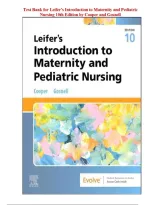
Test Bank for Leifer’s Introduction to Maternity and Pediatric Nursing, 10th Edition by Cooper and Gosnell
Prepare for maternity and pediatric nursing coursework with a structured study resource designed to complement Leifer’s Introduction to Maternity and Pediatric Nursing, 10th Edition. This study-focused test bank provides practice questions that can help nursing students review essential concepts, reinforce learning, develop clinical reasoning, and identify subjects that may require additional study. Maternity and pediatric nursing combines specialized knowledge with careful assessment, communication, safety, family-centered care, and developmental considerations. Students must understand how nursing care changes throughout pregnancy, childbirth, the postpartum period, infancy, childhood, and adolescence. A well-organized practice resource can help learners review these concepts while becoming more comfortable applying nursing knowledge to patient-centered situations. Comprehensive Maternity Nursing Review The resource can support review of important maternity nursing concepts presented throughout the course. Students may use practice questions to reinforce knowledge related to pregnancy, prenatal care, maternal assessment, fetal development, labor and delivery, postpartum care, and newborn nursing. Practice can help learners connect theoretical information with clinical situations. Students can review maternal physiological changes, pregnancy assessment, nutritional considerations, common complications, fetal assessment, labor management, pain management, and postpartum nursing care. Pediatric Nursing Study Support Pediatric nursing requires an understanding of growth and development from infancy through adolescence. This resource can provide opportunities to review developmental milestones, age-specific assessment, common childhood illnesses, pediatric safety, nutrition, communication, and family-centered care. Students can use questions to strengthen their ability to distinguish normal developmental findings from situations that may require further assessment or intervention. Clinical Reasoning and Application Maternity and pediatric nursing questions often require more than simple recall. Students may need to interpret assessment findings, prioritize nursing actions, recognize potential complications, and select appropriate interventions. Using practice questions can help learners develop a systematic approach to clinical scenarios. Students can consider the patient's age, developmental stage, clinical condition, family circumstances, and immediate safety needs when working through questions. Major Areas of Study Practice material associated with this subject may cover areas such as: Maternal and child health principles Family-centered nursing care Women's health assessment Reproductive health Preconception care Prenatal assessment Pregnancy and fetal development Maternal nutrition High-risk pregnancy Pregnancy complications Fetal assessment Labor and delivery Pain management during childbirth Complications of labor Postpartum assessment Postpartum complications Newborn assessment Newborn adaptation to extrauterine life Newborn nutrition and feeding Growth and development Pediatric health assessment Pediatric medication administration Pediatric safety Infant care Toddler development Preschool development School-age children Adolescent health Pediatric respiratory disorders Pediatric cardiovascular conditions Pediatric gastrointestinal disorders Pediatric neurological conditions Pediatric infectious diseases Pediatric endocrine disorders Pediatric renal and urinary conditions Pediatric emergency care Family and psychosocial considerations Effective Study Strategy Students can incorporate the practice questions into a structured study routine. One approach is to review the corresponding textbook chapter first, complete the questions without consulting notes, and then review areas where additional understanding is needed. Incorrect responses can be used as indicators of topics requiring further textbook reading. Students can create brief review notes for difficult concepts and return to the questions later to measure progress. This active-learning approach can make studying more focused than simply rereading large sections of a textbook. Useful for Course and Exam Review This resource may be helpful when preparing for maternity and pediatric nursing examinations, chapter quizzes, classroom assessments, and cumulative course reviews. Students can practice individually or use questions during study-group sessions. Group discussions can encourage learners to explain their reasoning, compare approaches to clinical situations, and identify important nursing priorities. The resource should be used together with assigned readings, instructor materials, clinical experiences, and other approved educational resources. Supports Family-Centered Care A central component of maternity and pediatric nursing is recognizing the importance of families in patient care. Children and newborns require developmentally appropriate care, while maternity nursing involves consideration of the mother, newborn, and family. Practice questions can help students review communication techniques, family involvement, patient education, safety considerations, and culturally responsive nursing care. Developmental Approach to Pediatric Nursing Pediatric patients cannot be treated as small adults. Their physiological characteristics, communication needs, medication considerations, and responses to illness vary according to developmental stage. A practice-question resource can help students review age-specific considerations and strengthen their understanding of appropriate nursing interventions for infants, children, and adolescents. Build Confidence Through Consistent Practice Regular practice gives students an opportunity to revisit challenging concepts and become more familiar with maternity and pediatric nursing terminology. Repeated exposure to clinical scenarios can also help learners organize information more efficiently. Students can use the resource throughout the semester rather than limiting preparation to the days immediately before an examination. Product Highlights Study resource for maternity and pediatric nursing students Designed to complement Leifer’s 10th Edition textbook Practice-question format for active learning Covers major maternity and pediatric nursing concepts Supports clinical reasoning and application Useful for chapter-by-chapter review Suitable for independent study Can be used for study groups Helps identify areas requiring additional review Supports preparation for course assessments Who Can Benefit? This resource may be useful for: Nursing students BSN students ADN students RN students Maternity nursing students Pediatric nursing students Maternal-child nursing students Nursing study groups Nursing educators seeking supplementary practice material Students preparing for course examinations Important Note This product is intended as a study and educational resource associated with Leifer’s Introduction to Maternity and Pediatric Nursing, 10th Edition. It is not an official examination and does not guarantee examination results. It should not be represented as containing confidential, unauthorized, or leaked examination materials. Students should use their assigned textbook, instructor guidance, course materials, and approved references as their primary sources of study.
Document information
- Uploaded on
- September 29, 2026
- Number of pages
- 318
- Written in
- 2026/2027
- Type
- Exam (elaborations)
- Contains
- Questions & answers


