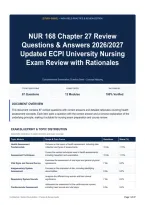
[STUDY GUIDE] • HIGH-YIELD PRACTICE & REVIEW EDITION
NUR 168 Chapter 27 Review
Questions & Answers 2026/2027
Updated ECPI University Nursing
Exam Review with Rationales
Comprehensive Examination Question Bank • Concept Mapping
TOTAL QUESTIONS EXAM TOPICS RATIONALES
87 Questions 12 Modules 100% Verified
DOCUMENT OVERVIEW
This document contains 87 verified questions with correct answers and detailed rationales covering health
assessment concepts. Each item pairs a question with the correct answer and a concise explanation of the
underlying principle, making it suitable for nursing exam preparation and course review.
EXAM BLUEPRINT & TOPIC DISTRIBUTION
Systematic breakdown of subject domains and exam coverage.
Topic Module Scope & Core Focus Questions Share (%)
Health Assessment Focuses on the basics of health assessment, including data
Fundamentals collection and types of assessments. 10 Qs 11.5%
Covers the various techniques used in health assessments,
Assessment Techniques including inspection and auscultation. 10 Qs 11.5%
Examines the assessment of vital signs and general physical
Vital Signs and General Survey appearance. 7 Qs 8.0%
Integumentary System Focuses on the evaluation of skin, including identifying
Assessment abnormalities. 8 Qs 9.2%
Analyzes the different lung sounds and their clinical
Respiratory System Sounds significance. 7 Qs 8.0%
Addresses the assessment of the cardiovascular system,
Cardiovascular Assessment including heart sounds and vital signs. 8 Qs 9.2%
Confidential • Student Study Edition • Practice & Review Guide Page 1 of 27
,STUDENT STUDY & MASTERY EDITION PRACTICE & REVIEW GUIDE
Focuses on the techniques and considerations for assessing
Abdominal Assessment the abdomen. 6 Qs 6.9%
Covers the evaluation of the neurological system, including
Neurologic Assessment cognitive and sensory functions. 7 Qs 8.0%
Discusses how assessment considerations vary across
Developmental Considerations different age groups. 6 Qs 6.9%
Examines the importance of taking health history and
Health History and Interviewing conducting patient interviews. 6 Qs 6.9%
Focuses on the assessment of specific body systems and
Special Assessments functions. 6 Qs 6.9%
Covers priorities and techniques in emergency health
Emergency Assessment assessments. 6 Qs 6.9%
Total Exam Coverage 12 Integrated Topic Modules 87 Qs 100.0%
Confidential • Student Study Edition • Practice & Review Guide Page 2 of 27
, STUDENT STUDY & MASTERY EDITION PRACTICE & REVIEW GUIDE
TOPIC 1: HEALTH ASSESSMENT FUNDAMENTALS
10 Questions • 11.5% of Exam • Focuses on the basics of health assessment, including data collection and types of assessments.
QUESTION 1
What is health assessment data?
Answer: Collection of subjective and objective information.
Rationale: Health assessment data encompasses both subjective information, derived from patient self-reports, and
objective data, obtained through clinical observations and diagnostic tests, providing a comprehensive understanding of a
patient's health status. This duality is critical for accurate diagnosis, treatment planning, and monitoring of patient progress.
QUESTION 2
What is subjective data?
Answer: What the patient says about their experience.
Rationale: Subjective data encompasses information conveyed by the patient regarding their feelings, perceptions, and
experiences, serving as a critical component in holistic assessment. This qualitative data is pivotal for understanding the
patient's perspective and guiding personalized care planning.
QUESTION 3
What is objective data?
Answer: What can be observed about the patient's condition.
Rationale: Objective data comprises measurable and observable information regarding a patient's condition, such as vital
signs, laboratory results, and physical examination findings, which are for accurate assessment and diagnosis. This type of
data contrasts with subjective data, which relies on the patient's personal perceptions and experiences.
Confidential • Student Study Edition • Practice & Review Guide Page 3 of 27
NUR 168 Chapter 27 Review
Questions & Answers 2026/2027
Updated ECPI University Nursing
Exam Review with Rationales
Comprehensive Examination Question Bank • Concept Mapping
TOTAL QUESTIONS EXAM TOPICS RATIONALES
87 Questions 12 Modules 100% Verified
DOCUMENT OVERVIEW
This document contains 87 verified questions with correct answers and detailed rationales covering health
assessment concepts. Each item pairs a question with the correct answer and a concise explanation of the
underlying principle, making it suitable for nursing exam preparation and course review.
EXAM BLUEPRINT & TOPIC DISTRIBUTION
Systematic breakdown of subject domains and exam coverage.
Topic Module Scope & Core Focus Questions Share (%)
Health Assessment Focuses on the basics of health assessment, including data
Fundamentals collection and types of assessments. 10 Qs 11.5%
Covers the various techniques used in health assessments,
Assessment Techniques including inspection and auscultation. 10 Qs 11.5%
Examines the assessment of vital signs and general physical
Vital Signs and General Survey appearance. 7 Qs 8.0%
Integumentary System Focuses on the evaluation of skin, including identifying
Assessment abnormalities. 8 Qs 9.2%
Analyzes the different lung sounds and their clinical
Respiratory System Sounds significance. 7 Qs 8.0%
Addresses the assessment of the cardiovascular system,
Cardiovascular Assessment including heart sounds and vital signs. 8 Qs 9.2%
Confidential • Student Study Edition • Practice & Review Guide Page 1 of 27
,STUDENT STUDY & MASTERY EDITION PRACTICE & REVIEW GUIDE
Focuses on the techniques and considerations for assessing
Abdominal Assessment the abdomen. 6 Qs 6.9%
Covers the evaluation of the neurological system, including
Neurologic Assessment cognitive and sensory functions. 7 Qs 8.0%
Discusses how assessment considerations vary across
Developmental Considerations different age groups. 6 Qs 6.9%
Examines the importance of taking health history and
Health History and Interviewing conducting patient interviews. 6 Qs 6.9%
Focuses on the assessment of specific body systems and
Special Assessments functions. 6 Qs 6.9%
Covers priorities and techniques in emergency health
Emergency Assessment assessments. 6 Qs 6.9%
Total Exam Coverage 12 Integrated Topic Modules 87 Qs 100.0%
Confidential • Student Study Edition • Practice & Review Guide Page 2 of 27
, STUDENT STUDY & MASTERY EDITION PRACTICE & REVIEW GUIDE
TOPIC 1: HEALTH ASSESSMENT FUNDAMENTALS
10 Questions • 11.5% of Exam • Focuses on the basics of health assessment, including data collection and types of assessments.
QUESTION 1
What is health assessment data?
Answer: Collection of subjective and objective information.
Rationale: Health assessment data encompasses both subjective information, derived from patient self-reports, and
objective data, obtained through clinical observations and diagnostic tests, providing a comprehensive understanding of a
patient's health status. This duality is critical for accurate diagnosis, treatment planning, and monitoring of patient progress.
QUESTION 2
What is subjective data?
Answer: What the patient says about their experience.
Rationale: Subjective data encompasses information conveyed by the patient regarding their feelings, perceptions, and
experiences, serving as a critical component in holistic assessment. This qualitative data is pivotal for understanding the
patient's perspective and guiding personalized care planning.
QUESTION 3
What is objective data?
Answer: What can be observed about the patient's condition.
Rationale: Objective data comprises measurable and observable information regarding a patient's condition, such as vital
signs, laboratory results, and physical examination findings, which are for accurate assessment and diagnosis. This type of
data contrasts with subjective data, which relies on the patient's personal perceptions and experiences.
Confidential • Student Study Edition • Practice & Review Guide Page 3 of 27