[STUDY GUIDE] • HIGH-YIELD PRACTICE & REVIEW EDITION
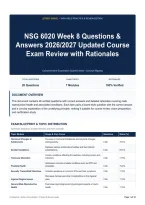
NSG 6020 Week 8 Questions &
Answers 2026/2027 Updated Course
Exam Review with Rationales
Comprehensive Examination Question Bank • Concept Mapping
TOTAL QUESTIONS EXAM TOPICS RATIONALES
26 Questions 7 Modules 100% Verified
DOCUMENT OVERVIEW
This document contains 26 verified questions with correct answers and detailed rationales covering male
reproductive health and associated conditions. Each item pairs a board-style question with the correct answer
and a concise explanation of the underlying principle, making it suitable for course review, exam preparation,
and certification study.
EXAM BLUEPRINT & TOPIC DISTRIBUTION
Systematic breakdown of subject domains and exam coverage.
Topic Module Scope & Core Focus Questions Share (%)
Hormonal Changes in Focuses on hormonal imbalances and physical changes
Adolescents during puberty. 4 Qs 15.4%
Explores various scrotal abnormalities and their clinical
Scrotal Conditions presentations. 6 Qs 23.1%
Covers conditions affecting the testicles, including torsion and
Testicular Disorders infections. 3 Qs 11.5%
Addresses common prostate conditions such as BPH and
Prostate Health prostatitis. 4 Qs 15.4%
Sexually Transmitted Infections Includes questions on common STIs and their symptoms. 3 Qs 11.5%
Discusses hernias and other complications in the inguinal
Inguinal Region Issues area. 3 Qs 11.5%
General Male Reproductive Examines psychological and physiological aspects of men's
Health health. 3 Qs 11.5%
Confidential • Student Study Edition • Practice & Review Guide Page 1 of 18
,STUDENT STUDY & MASTERY EDITION PRACTICE & REVIEW GUIDE
Total Exam Coverage 7 Integrated Topic Modules 26 Qs 100.0%
Confidential • Student Study Edition • Practice & Review Guide Page 2 of 18
, STUDENT STUDY & MASTERY EDITION PRACTICE & REVIEW GUIDE
TOPIC 1: HORMONAL CHANGES IN ADOLESCENTS
4 Questions • 15.4% of Exam • Focuses on hormonal imbalances and physical changes during puberty.
QUESTION 1
A 14-year-old junior high school student is brought in by his mother and father because
he seems to be developing breasts. The mother is upset because she read on the
Internet that smoking marijuana leads to breast enlargement in males. The young man
adamantly denies using any tobacco, alcohol, or drugs. He has recently noticed
changes in his penis, testicles, and pubic hair pattern. Otherwise, his past medical
history is unremarkable. His parents are both in good health. He has two older brothers
who never had this problem. On examination you see a mildly overweight teenager with
enlarged breast tissue that is slightly tender on both sides. Otherwise his examination
is normal. He is agreeable to taking a drug test.
What is the most likely cause of his gynecomastia?
Answer: Imbalance of hormones of puberty.
Rationale: Puberty induces hormonal fluctuations, specifically an increase in estrogen relative to testosterone, which can
lead to transient gynecomastia in adolescents. This condition is typically benign and resolves as hormonal levels stabilize
over time.
QUESTION 2
A 30-year-old man notices a firm, 2-cm mass under his areola. He has no other
symptoms and no diagnosis of breast cancer in his first-degree relatives. What is the
most likely diagnosis?
Answer: Breast tissue - Approximately one third of adult men will have palpable breast tissue under the
areola. While males can have breast cancer, this is much less common. There are no lymph nodes in this
area.
Rationale: Palpable breast tissue in men, particularly beneath the areola, is a common anatomical variation resulting from
the presence of glandular tissue, which can occur without malignancy. Given the absence of symptoms, family history of
breast cancer, and the prevalence of this condition, a benign diagnosis is most likely.
Confidential • Student Study Edition • Practice & Review Guide Page 3 of 18
NSG 6020 Week 8 Questions &
Answers 2026/2027 Updated Course
Exam Review with Rationales
Comprehensive Examination Question Bank • Concept Mapping
TOTAL QUESTIONS EXAM TOPICS RATIONALES
26 Questions 7 Modules 100% Verified
DOCUMENT OVERVIEW
This document contains 26 verified questions with correct answers and detailed rationales covering male
reproductive health and associated conditions. Each item pairs a board-style question with the correct answer
and a concise explanation of the underlying principle, making it suitable for course review, exam preparation,
and certification study.
EXAM BLUEPRINT & TOPIC DISTRIBUTION
Systematic breakdown of subject domains and exam coverage.
Topic Module Scope & Core Focus Questions Share (%)
Hormonal Changes in Focuses on hormonal imbalances and physical changes
Adolescents during puberty. 4 Qs 15.4%
Explores various scrotal abnormalities and their clinical
Scrotal Conditions presentations. 6 Qs 23.1%
Covers conditions affecting the testicles, including torsion and
Testicular Disorders infections. 3 Qs 11.5%
Addresses common prostate conditions such as BPH and
Prostate Health prostatitis. 4 Qs 15.4%
Sexually Transmitted Infections Includes questions on common STIs and their symptoms. 3 Qs 11.5%
Discusses hernias and other complications in the inguinal
Inguinal Region Issues area. 3 Qs 11.5%
General Male Reproductive Examines psychological and physiological aspects of men's
Health health. 3 Qs 11.5%
Confidential • Student Study Edition • Practice & Review Guide Page 1 of 18
,STUDENT STUDY & MASTERY EDITION PRACTICE & REVIEW GUIDE
Total Exam Coverage 7 Integrated Topic Modules 26 Qs 100.0%
Confidential • Student Study Edition • Practice & Review Guide Page 2 of 18
, STUDENT STUDY & MASTERY EDITION PRACTICE & REVIEW GUIDE
TOPIC 1: HORMONAL CHANGES IN ADOLESCENTS
4 Questions • 15.4% of Exam • Focuses on hormonal imbalances and physical changes during puberty.
QUESTION 1
A 14-year-old junior high school student is brought in by his mother and father because
he seems to be developing breasts. The mother is upset because she read on the
Internet that smoking marijuana leads to breast enlargement in males. The young man
adamantly denies using any tobacco, alcohol, or drugs. He has recently noticed
changes in his penis, testicles, and pubic hair pattern. Otherwise, his past medical
history is unremarkable. His parents are both in good health. He has two older brothers
who never had this problem. On examination you see a mildly overweight teenager with
enlarged breast tissue that is slightly tender on both sides. Otherwise his examination
is normal. He is agreeable to taking a drug test.
What is the most likely cause of his gynecomastia?
Answer: Imbalance of hormones of puberty.
Rationale: Puberty induces hormonal fluctuations, specifically an increase in estrogen relative to testosterone, which can
lead to transient gynecomastia in adolescents. This condition is typically benign and resolves as hormonal levels stabilize
over time.
QUESTION 2
A 30-year-old man notices a firm, 2-cm mass under his areola. He has no other
symptoms and no diagnosis of breast cancer in his first-degree relatives. What is the
most likely diagnosis?
Answer: Breast tissue - Approximately one third of adult men will have palpable breast tissue under the
areola. While males can have breast cancer, this is much less common. There are no lymph nodes in this
area.
Rationale: Palpable breast tissue in men, particularly beneath the areola, is a common anatomical variation resulting from
the presence of glandular tissue, which can occur without malignancy. Given the absence of symptoms, family history of
breast cancer, and the prevalence of this condition, a benign diagnosis is most likely.
Confidential • Student Study Edition • Practice & Review Guide Page 3 of 18