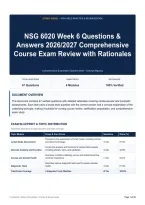
[STUDY GUIDE] • HIGH-YIELD PRACTICE & REVIEW EDITION
NSG 6020 Week 6 Questions &
Answers 2026/2027 Comprehensive
Course Exam Review with Rationales
Comprehensive Examination Question Bank • Concept Mapping
TOTAL QUESTIONS EXAM TOPICS RATIONALES
47 Questions 4 Modules 100% Verified
DOCUMENT OVERVIEW
This document contains 47 verified questions with detailed rationales covering cardiovascular and lymphatic
assessments. Each item pairs a board-style question with the correct answer and a concise explanation of the
underlying principle, making it suitable for nursing course review, certification preparation, and comprehensive
exam study.
EXAM BLUEPRINT & TOPIC DISTRIBUTION
Systematic breakdown of subject domains and exam coverage.
Topic Module Scope & Core Focus Questions Share (%)
Focuses on the assessment of lymph nodes, including normal
Lymph Node Assessment and abnormal findings. 10 Qs 21.3%
Covers the anatomy and functions of various blood vessels
Vascular Anatomy and Function including arteries, veins, and capillaries. 16 Qs 34.0%
Examines conditions affecting venous and arterial blood flow
Venous and Arterial Health and their implications. 11 Qs 23.4%
Describes various diagnostic tests used to assess vascular
Diagnostic Tests health. 10 Qs 21.3%
Total Exam Coverage 4 Integrated Topic Modules 47 Qs 100.0%
Confidential • Student Study Edition • Practice & Review Guide Page 1 of 28
,STUDENT STUDY & MASTERY EDITION PRACTICE & REVIEW GUIDE
TOPIC 1: LYMPH NODE ASSESSMENT
10 Questions • 21.3% of Exam • Focuses on the assessment of lymph nodes, including normal and abnormal findings.
QUESTION 1
Lymph node assessment (normal)
Answer: Lymph nodes are typically not palpable or may be very small. if palpable they're small, mobile
(moveable), non tender. usually <1 cm in size. no noticeable swelling or enlargement. skin over the area is
normal in color no redness or discoloration.
Rationale: Normal lymph nodes are often non-palpable or small, mobile, and non-tender, indicating a healthy immune
response without pathologic enlargement. Their size typically remains under 1 cm, with surrounding skin showing no signs
of inflammation or discoloration, reflecting absence of infection or malignancy.
QUESTION 2
Lymph node assessment (abnormal)
Answer: Enlarge lymph nodes: "swollen glands" described as knots, lumps or kernels. if it is >1cm it is
abnormal. ( inguinal nodes may be slightly bigger) if the nodes are:
-hard: may indicate malignancy
-firm/ rubbery: associated with lymphoma
-fixed (non- moveable) or matted- concerning for malignancy or chronic infections ex-- TB.
- tender or painful: typically suggest infection or inflammation.
- non-tender: ore concerning for malignancy
- fluctuant: may indicate access formation. changes over time: increase ion size or number. if persistence >
4-6 weeks then that is concerning. associated with infection (local or systemic), autoimmune conditions,
malignancy or pain or systemic symptoms.
Rationale: Abnormal lymph node characteristics, such as hardness or fixation, are indicative of malignancy or chronic
infection, while tenderness suggests inflammation. Nodes persisting beyond 4-6 weeks and exhibiting changes in size or
consistency warrant further investigation due to potential underlying pathologies.
Confidential • Student Study Edition • Practice & Review Guide Page 2 of 28
, STUDENT STUDY & MASTERY EDITION PRACTICE & REVIEW GUIDE
QUESTION 3
High risk lymph nodes locations
Answer: Supraclavicular nodes (especially left Virchow's node) this is strongly associated with malignancy (
GI, lung< abdominal cancers) posterior cervical nodes is often seen in viral infections like EBV/
mononucleosis. axillary nodes may indicate breast patho, infection or malignancy. epitrochlear nodes (>0.5
cm is abnormal) associated with systemic infections like hip or lymphoma.
Time Course Considerations
Acute (<2 weeks) → usually infectious
Subacute (2–6 weeks) → infection vs. early malignancy Chronic (>6 weeks) → malignancy until proven
otherwise Associated "B Symptoms" (Concerning for Malignancy) Fever Night sweats Unintentional weight
loss.
Rationale: Supraclavicular lymph nodes, particularly Virchow's node, are critical indicators of malignancy, especially in
gastrointestinal and lung cancers, due to their drainage pathways and association with advanced
disease. Understanding lymph node locations and their implications aids in differentiating between infectious and malignant
processes, guiding diagnostic and therapeutic approaches.
Confidential • Student Study Edition • Practice & Review Guide Page 3 of 28
NSG 6020 Week 6 Questions &
Answers 2026/2027 Comprehensive
Course Exam Review with Rationales
Comprehensive Examination Question Bank • Concept Mapping
TOTAL QUESTIONS EXAM TOPICS RATIONALES
47 Questions 4 Modules 100% Verified
DOCUMENT OVERVIEW
This document contains 47 verified questions with detailed rationales covering cardiovascular and lymphatic
assessments. Each item pairs a board-style question with the correct answer and a concise explanation of the
underlying principle, making it suitable for nursing course review, certification preparation, and comprehensive
exam study.
EXAM BLUEPRINT & TOPIC DISTRIBUTION
Systematic breakdown of subject domains and exam coverage.
Topic Module Scope & Core Focus Questions Share (%)
Focuses on the assessment of lymph nodes, including normal
Lymph Node Assessment and abnormal findings. 10 Qs 21.3%
Covers the anatomy and functions of various blood vessels
Vascular Anatomy and Function including arteries, veins, and capillaries. 16 Qs 34.0%
Examines conditions affecting venous and arterial blood flow
Venous and Arterial Health and their implications. 11 Qs 23.4%
Describes various diagnostic tests used to assess vascular
Diagnostic Tests health. 10 Qs 21.3%
Total Exam Coverage 4 Integrated Topic Modules 47 Qs 100.0%
Confidential • Student Study Edition • Practice & Review Guide Page 1 of 28
,STUDENT STUDY & MASTERY EDITION PRACTICE & REVIEW GUIDE
TOPIC 1: LYMPH NODE ASSESSMENT
10 Questions • 21.3% of Exam • Focuses on the assessment of lymph nodes, including normal and abnormal findings.
QUESTION 1
Lymph node assessment (normal)
Answer: Lymph nodes are typically not palpable or may be very small. if palpable they're small, mobile
(moveable), non tender. usually <1 cm in size. no noticeable swelling or enlargement. skin over the area is
normal in color no redness or discoloration.
Rationale: Normal lymph nodes are often non-palpable or small, mobile, and non-tender, indicating a healthy immune
response without pathologic enlargement. Their size typically remains under 1 cm, with surrounding skin showing no signs
of inflammation or discoloration, reflecting absence of infection or malignancy.
QUESTION 2
Lymph node assessment (abnormal)
Answer: Enlarge lymph nodes: "swollen glands" described as knots, lumps or kernels. if it is >1cm it is
abnormal. ( inguinal nodes may be slightly bigger) if the nodes are:
-hard: may indicate malignancy
-firm/ rubbery: associated with lymphoma
-fixed (non- moveable) or matted- concerning for malignancy or chronic infections ex-- TB.
- tender or painful: typically suggest infection or inflammation.
- non-tender: ore concerning for malignancy
- fluctuant: may indicate access formation. changes over time: increase ion size or number. if persistence >
4-6 weeks then that is concerning. associated with infection (local or systemic), autoimmune conditions,
malignancy or pain or systemic symptoms.
Rationale: Abnormal lymph node characteristics, such as hardness or fixation, are indicative of malignancy or chronic
infection, while tenderness suggests inflammation. Nodes persisting beyond 4-6 weeks and exhibiting changes in size or
consistency warrant further investigation due to potential underlying pathologies.
Confidential • Student Study Edition • Practice & Review Guide Page 2 of 28
, STUDENT STUDY & MASTERY EDITION PRACTICE & REVIEW GUIDE
QUESTION 3
High risk lymph nodes locations
Answer: Supraclavicular nodes (especially left Virchow's node) this is strongly associated with malignancy (
GI, lung< abdominal cancers) posterior cervical nodes is often seen in viral infections like EBV/
mononucleosis. axillary nodes may indicate breast patho, infection or malignancy. epitrochlear nodes (>0.5
cm is abnormal) associated with systemic infections like hip or lymphoma.
Time Course Considerations
Acute (<2 weeks) → usually infectious
Subacute (2–6 weeks) → infection vs. early malignancy Chronic (>6 weeks) → malignancy until proven
otherwise Associated "B Symptoms" (Concerning for Malignancy) Fever Night sweats Unintentional weight
loss.
Rationale: Supraclavicular lymph nodes, particularly Virchow's node, are critical indicators of malignancy, especially in
gastrointestinal and lung cancers, due to their drainage pathways and association with advanced
disease. Understanding lymph node locations and their implications aids in differentiating between infectious and malignant
processes, guiding diagnostic and therapeutic approaches.
Confidential • Student Study Edition • Practice & Review Guide Page 3 of 28