[STUDY GUIDE] • HIGH-YIELD PRACTICE & REVIEW EDITION
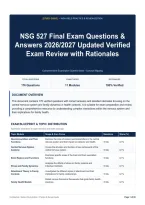
NSG 527 Final Exam Questions &
Answers 2026/2027 Updated Verified
Exam Review with Rationales
Comprehensive Examination Question Bank • Concept Mapping
TOTAL QUESTIONS EXAM TOPICS RATIONALES
176 Questions 11 Modules 100% Verified
DOCUMENT OVERVIEW
This document contains 176 verified questions with correct answers and detailed rationales focusing on the
central nervous system and family dynamics in health contexts. It is suitable for exam preparation and review,
providing a comprehensive resource for understanding complex interactions within the nervous system and
their implications for family health.
EXAM BLUEPRINT & TOPIC DISTRIBUTION
Systematic breakdown of subject domains and exam coverage.
Topic Module Scope & Core Focus Questions Share (%)
Neurotransmitters and Their Explores the roles of various neurotransmitters in the central
Functions nervous system and their impact on behavior and health. 16 Qs 9.1%
Central Nervous System Covers the structure and function of key components of the
Anatomy central nervous system. 16 Qs 9.1%
Examines specific areas of the brain and their associated
Brain Regions and Functions functions. 16 Qs 9.1%
Analyzes the effects of stress on family systems and
Stress and Family Dynamics individual members. 16 Qs 9.1%
Attachment Theory in Family Investigates the different styles of attachment and their
Contexts implications for family relationships. 16 Qs 9.1%
Details various theoretical frameworks that guide family health
Family Health Models practices. 16 Qs 9.1%
Confidential • Student Study Edition • Practice & Review Guide Page 1 of 60
,STUDENT STUDY & MASTERY EDITION PRACTICE & REVIEW GUIDE
Focuses on the composition and interaction patterns within
Family Structure and Dynamics family units. 16 Qs 9.1%
Family Power and Explores the dynamics of power and communication networks
Communication within families. 16 Qs 9.1%
Health Behaviors and Family Examines how family interactions influence health behaviors
Impact and outcomes. 16 Qs 9.1%
Neuroscience and Emotional Analyzes the role of the brain in processing emotions and
Processing stress responses. 16 Qs 9.1%
Etiology of Neurological Discusses the origins and contributing factors of various
Disorders neurological conditions. 16 Qs 9.1%
Total Exam Coverage 11 Integrated Topic Modules 176 Qs 100.0%
Confidential • Student Study Edition • Practice & Review Guide Page 2 of 60
,STUDENT STUDY & MASTERY EDITION PRACTICE & REVIEW GUIDE
TOPIC 1: NEUROTRANSMITTERS AND THEIR FUNCTIONS
16 Questions • 9.1% of Exam • Explores the roles of various neurotransmitters in the central nervous system and their impact on
behavior and health.
QUESTION 1
Involved in voluntary movement, learning, memory, and sleep?
Answer: Acetylcholine
Rationale: Acetylcholine is a neurotransmitter critical for neuromuscular junction function, enabling voluntary muscle
contraction, and plays significant roles in cognitive processes such as learning and memory within the central nervous
system. This highlights acetylcholine's dual role as an excitatory neurotransmitter at the neuromuscular junction and a
modulator of complex brain functions.
QUESTION 2
Too much ___?_____is associated with depression, and too little in the hippocampus
has been associated with dementia.
Answer: Acetylcholine
Rationale: Acetylcholine deficiency in the hippocampus impairs memory formation, contributing to dementia, while
imbalances in central cholinergic pathways are implicated in mood disorders like depression.
The key concept tested is the role of acetylcholine in cognitive function and emotional regulation.
QUESTION 3
Correlated with movement, attention, and learning?
Answer: Dopamine
Rationale: Dopamine is a neurotransmitter primarily associated with the brain's reward and motivation pathways,
influencing motor control, attention, pleasure, and learning. Its dysregulation is implicated in conditions like Parkinson's
disease and addiction.
Confidential • Student Study Edition • Practice & Review Guide Page 3 of 60
, STUDENT STUDY & MASTERY EDITION PRACTICE & REVIEW GUIDE
QUESTION 4
Associated with eating, alertness?
Answer: Norepinephrine
Rationale: Norepinephrine is a catecholamine neurotransmitter and hormone that plays a significant role in the sympathetic
nervous system's "fight-or-flight" response, increasing heart rate, blood pressure, and alertness, and also influences arousal
and appetite. The key concept tested is the physiological functions and associated stimuli of norepinephrine.
QUESTION 5
Involved in energy, and glucose metabolism?
Answer: Epinephrine
Rationale: Epinephrine is a hormone that stimulates glycogenolysis and gluconeogenesis, increasing blood glucose levels
to provide readily available energy during stress. This mechanism highlights its role in both energy mobilization and glucose
metabolism.
QUESTION 6
Too little_______? is associated with depression and some anxiety disorders,
especially obsessive-compulsive disorder. Some antidepressant medications increase
the availability of _________? at the receptor sites.
Answer: Serotonin
Rationale: Low serotonin levels are implicated in mood and anxiety disorders, and selective serotonin reuptake inhibitors
(SSRIs) are a common pharmacotherapy for these conditions. This question tests understanding of neurotransmitter roles in
mental health and the mechanism of action for SSRIs.
QUESTION 7
Involved in pain relief and feelings of pleasure and contentedness?
Answer: Endorphins
Rationale: Endorphins are endogenous opioid neuropeptides that bind to opioid receptors, modulating pain perception and
producing feelings of euphoria and well-being. This mechanism underlies their role in analgesia and mood regulation.
Confidential • Student Study Edition • Practice & Review Guide Page 4 of 60
NSG 527 Final Exam Questions &
Answers 2026/2027 Updated Verified
Exam Review with Rationales
Comprehensive Examination Question Bank • Concept Mapping
TOTAL QUESTIONS EXAM TOPICS RATIONALES
176 Questions 11 Modules 100% Verified
DOCUMENT OVERVIEW
This document contains 176 verified questions with correct answers and detailed rationales focusing on the
central nervous system and family dynamics in health contexts. It is suitable for exam preparation and review,
providing a comprehensive resource for understanding complex interactions within the nervous system and
their implications for family health.
EXAM BLUEPRINT & TOPIC DISTRIBUTION
Systematic breakdown of subject domains and exam coverage.
Topic Module Scope & Core Focus Questions Share (%)
Neurotransmitters and Their Explores the roles of various neurotransmitters in the central
Functions nervous system and their impact on behavior and health. 16 Qs 9.1%
Central Nervous System Covers the structure and function of key components of the
Anatomy central nervous system. 16 Qs 9.1%
Examines specific areas of the brain and their associated
Brain Regions and Functions functions. 16 Qs 9.1%
Analyzes the effects of stress on family systems and
Stress and Family Dynamics individual members. 16 Qs 9.1%
Attachment Theory in Family Investigates the different styles of attachment and their
Contexts implications for family relationships. 16 Qs 9.1%
Details various theoretical frameworks that guide family health
Family Health Models practices. 16 Qs 9.1%
Confidential • Student Study Edition • Practice & Review Guide Page 1 of 60
,STUDENT STUDY & MASTERY EDITION PRACTICE & REVIEW GUIDE
Focuses on the composition and interaction patterns within
Family Structure and Dynamics family units. 16 Qs 9.1%
Family Power and Explores the dynamics of power and communication networks
Communication within families. 16 Qs 9.1%
Health Behaviors and Family Examines how family interactions influence health behaviors
Impact and outcomes. 16 Qs 9.1%
Neuroscience and Emotional Analyzes the role of the brain in processing emotions and
Processing stress responses. 16 Qs 9.1%
Etiology of Neurological Discusses the origins and contributing factors of various
Disorders neurological conditions. 16 Qs 9.1%
Total Exam Coverage 11 Integrated Topic Modules 176 Qs 100.0%
Confidential • Student Study Edition • Practice & Review Guide Page 2 of 60
,STUDENT STUDY & MASTERY EDITION PRACTICE & REVIEW GUIDE
TOPIC 1: NEUROTRANSMITTERS AND THEIR FUNCTIONS
16 Questions • 9.1% of Exam • Explores the roles of various neurotransmitters in the central nervous system and their impact on
behavior and health.
QUESTION 1
Involved in voluntary movement, learning, memory, and sleep?
Answer: Acetylcholine
Rationale: Acetylcholine is a neurotransmitter critical for neuromuscular junction function, enabling voluntary muscle
contraction, and plays significant roles in cognitive processes such as learning and memory within the central nervous
system. This highlights acetylcholine's dual role as an excitatory neurotransmitter at the neuromuscular junction and a
modulator of complex brain functions.
QUESTION 2
Too much ___?_____is associated with depression, and too little in the hippocampus
has been associated with dementia.
Answer: Acetylcholine
Rationale: Acetylcholine deficiency in the hippocampus impairs memory formation, contributing to dementia, while
imbalances in central cholinergic pathways are implicated in mood disorders like depression.
The key concept tested is the role of acetylcholine in cognitive function and emotional regulation.
QUESTION 3
Correlated with movement, attention, and learning?
Answer: Dopamine
Rationale: Dopamine is a neurotransmitter primarily associated with the brain's reward and motivation pathways,
influencing motor control, attention, pleasure, and learning. Its dysregulation is implicated in conditions like Parkinson's
disease and addiction.
Confidential • Student Study Edition • Practice & Review Guide Page 3 of 60
, STUDENT STUDY & MASTERY EDITION PRACTICE & REVIEW GUIDE
QUESTION 4
Associated with eating, alertness?
Answer: Norepinephrine
Rationale: Norepinephrine is a catecholamine neurotransmitter and hormone that plays a significant role in the sympathetic
nervous system's "fight-or-flight" response, increasing heart rate, blood pressure, and alertness, and also influences arousal
and appetite. The key concept tested is the physiological functions and associated stimuli of norepinephrine.
QUESTION 5
Involved in energy, and glucose metabolism?
Answer: Epinephrine
Rationale: Epinephrine is a hormone that stimulates glycogenolysis and gluconeogenesis, increasing blood glucose levels
to provide readily available energy during stress. This mechanism highlights its role in both energy mobilization and glucose
metabolism.
QUESTION 6
Too little_______? is associated with depression and some anxiety disorders,
especially obsessive-compulsive disorder. Some antidepressant medications increase
the availability of _________? at the receptor sites.
Answer: Serotonin
Rationale: Low serotonin levels are implicated in mood and anxiety disorders, and selective serotonin reuptake inhibitors
(SSRIs) are a common pharmacotherapy for these conditions. This question tests understanding of neurotransmitter roles in
mental health and the mechanism of action for SSRIs.
QUESTION 7
Involved in pain relief and feelings of pleasure and contentedness?
Answer: Endorphins
Rationale: Endorphins are endogenous opioid neuropeptides that bind to opioid receptors, modulating pain perception and
producing feelings of euphoria and well-being. This mechanism underlies their role in analgesia and mood regulation.
Confidential • Student Study Edition • Practice & Review Guide Page 4 of 60