
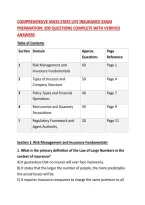
COMPREHENSIVE MASS STATE LIFE INSURANCE EXAM
PREPARATION: 200 QUESTIONS COMPLETE WITH VERIFIED
ANSWERS
Table of Contents
Section Domain Approx. Page
Questions Reference
1 Risk Management and 60 Page 1
Insurance Fundamentals
2 Types of Insurers and 50 Page 4
Company Structure
3 Policy Types and Financial 40 Page 7
Operations
4 Reinsurance and Guaranty 30 Page 9
Associations
5 Regulatory Framework and 20 Page 11
Agent Authority
Section 1: Risk Management and Insurance Fundamentals
1. What is the primary definition of the Law of Large Numbers in the
context of insurance?
A) It guarantees that no insurer will ever face insolvency.
B) It states that the larger the number of people, the more predictable
the actual losses will be.
C) It requires insurance companies to charge the same premium to all
,policyholders.
D) It limits the total amount of risk an insurance company can assume.
Correct Answer: B) It states that the larger the number of people, the
more predictable the actual losses will be.
Rationale: The Law of Large Numbers allows insurance companies to
predict losses accurately by pooling a large group of similar risks, which
helps in calculating appropriate rates.
2. Which of the following best describes speculative risk?
A) A situation that can only result in a loss.
B) A risk that is exclusively covered by insurance companies.
C) A risk that involves the opportunity for either loss or gain.
D) A risk that is avoided through strict underwriting guidelines.
Correct Answer: C) A risk that involves the opportunity for either loss
or gain.
Rationale: Speculative risk involves the chance of financial gain or loss
and is not covered by insurance companies because it is not insurable.
3. Why is pure risk considered the only type of risk that is insurable?
A) Because it involves the potential for significant financial gain.
B) Because it is a situation that can only result in a loss, with no
opportunity for financial gain.
C) Because it is entirely avoidable through risk reduction techniques.
D) Because it is mandated by state guaranty associations.
Correct Answer: B) Because it is a situation that can only result in a
loss, with no opportunity for financial gain.
Rationale: Pure risk is insurable because it involves only the possibility
of loss, making it predictable and manageable for insurers.
,4. Which method of treating risk involves simply avoiding as many
risks as possible?
A) Risk reduction
B) Risk retention
C) Risk avoidance
D) Risk transfer
Correct Answer: C) Risk avoidance
Rationale: Risk avoidance involves steering clear of situations that could
lead to loss, though it is effective but not always practical.
5. A company decides to install a sprinkler system to lessen the
possibility of a severe fire loss. This is an example of which risk
treatment method?
A) Risk avoidance
B) Risk reduction
C) Risk retention
D) Risk transfer
Correct Answer: B) Risk reduction
Rationale: Risk reduction attempts to lessen the possibility of a loss by
taking proactive actions, such as installing safety systems.
6. Which of the following statements is true regarding the Law of
Large Numbers?
A) It makes actual losses completely unpredictable.
B) It is used by insurance companies to calculate rates based on data
from large groups.
C) It applies only to speculative risks.
D) It discourages the sharing of risks among a large group of people.
Correct Answer: B) It is used by insurance companies to calculate rates
based on data from large groups.
, Rationale: Insurance companies use the Law of Large Numbers to
analyze data from a large pool of people, allowing them to predict
losses and calculate accurate premium rates.
7. Which of the following is an example of a speculative risk?
A) A house catching fire.
B) An individual developing a terminal illness.
C) Investing in the stock market.
D) A car accident caused by a distracted driver.
Correct Answer: C) Investing in the stock market.
Rationale: Investing in the stock market involves the possibility of gain
or loss, which classifies it as a speculative risk. Insurance companies do
not cover speculative risks.
8. If an individual chooses not to ride a motorcycle to eliminate the
chance of a motorcycle accident, which risk treatment method are
they using?
A) Risk avoidance
B) Risk reduction
C) Risk retention
D) Risk transfer
Correct Answer: A) Risk avoidance
Rationale: By choosing not to ride a motorcycle, the individual is
avoiding the risk entirely, which is the definition of risk avoidance.
9. What is the primary reason insurance companies do not cover
speculative risks?
A) They are too predictable.
B) They involve the possibility of financial gain and are not insurable.
C) They are covered by state guaranty associations.
PREPARATION: 200 QUESTIONS COMPLETE WITH VERIFIED
ANSWERS
Table of Contents
Section Domain Approx. Page
Questions Reference
1 Risk Management and 60 Page 1
Insurance Fundamentals
2 Types of Insurers and 50 Page 4
Company Structure
3 Policy Types and Financial 40 Page 7
Operations
4 Reinsurance and Guaranty 30 Page 9
Associations
5 Regulatory Framework and 20 Page 11
Agent Authority
Section 1: Risk Management and Insurance Fundamentals
1. What is the primary definition of the Law of Large Numbers in the
context of insurance?
A) It guarantees that no insurer will ever face insolvency.
B) It states that the larger the number of people, the more predictable
the actual losses will be.
C) It requires insurance companies to charge the same premium to all
,policyholders.
D) It limits the total amount of risk an insurance company can assume.
Correct Answer: B) It states that the larger the number of people, the
more predictable the actual losses will be.
Rationale: The Law of Large Numbers allows insurance companies to
predict losses accurately by pooling a large group of similar risks, which
helps in calculating appropriate rates.
2. Which of the following best describes speculative risk?
A) A situation that can only result in a loss.
B) A risk that is exclusively covered by insurance companies.
C) A risk that involves the opportunity for either loss or gain.
D) A risk that is avoided through strict underwriting guidelines.
Correct Answer: C) A risk that involves the opportunity for either loss
or gain.
Rationale: Speculative risk involves the chance of financial gain or loss
and is not covered by insurance companies because it is not insurable.
3. Why is pure risk considered the only type of risk that is insurable?
A) Because it involves the potential for significant financial gain.
B) Because it is a situation that can only result in a loss, with no
opportunity for financial gain.
C) Because it is entirely avoidable through risk reduction techniques.
D) Because it is mandated by state guaranty associations.
Correct Answer: B) Because it is a situation that can only result in a
loss, with no opportunity for financial gain.
Rationale: Pure risk is insurable because it involves only the possibility
of loss, making it predictable and manageable for insurers.
,4. Which method of treating risk involves simply avoiding as many
risks as possible?
A) Risk reduction
B) Risk retention
C) Risk avoidance
D) Risk transfer
Correct Answer: C) Risk avoidance
Rationale: Risk avoidance involves steering clear of situations that could
lead to loss, though it is effective but not always practical.
5. A company decides to install a sprinkler system to lessen the
possibility of a severe fire loss. This is an example of which risk
treatment method?
A) Risk avoidance
B) Risk reduction
C) Risk retention
D) Risk transfer
Correct Answer: B) Risk reduction
Rationale: Risk reduction attempts to lessen the possibility of a loss by
taking proactive actions, such as installing safety systems.
6. Which of the following statements is true regarding the Law of
Large Numbers?
A) It makes actual losses completely unpredictable.
B) It is used by insurance companies to calculate rates based on data
from large groups.
C) It applies only to speculative risks.
D) It discourages the sharing of risks among a large group of people.
Correct Answer: B) It is used by insurance companies to calculate rates
based on data from large groups.
, Rationale: Insurance companies use the Law of Large Numbers to
analyze data from a large pool of people, allowing them to predict
losses and calculate accurate premium rates.
7. Which of the following is an example of a speculative risk?
A) A house catching fire.
B) An individual developing a terminal illness.
C) Investing in the stock market.
D) A car accident caused by a distracted driver.
Correct Answer: C) Investing in the stock market.
Rationale: Investing in the stock market involves the possibility of gain
or loss, which classifies it as a speculative risk. Insurance companies do
not cover speculative risks.
8. If an individual chooses not to ride a motorcycle to eliminate the
chance of a motorcycle accident, which risk treatment method are
they using?
A) Risk avoidance
B) Risk reduction
C) Risk retention
D) Risk transfer
Correct Answer: A) Risk avoidance
Rationale: By choosing not to ride a motorcycle, the individual is
avoiding the risk entirely, which is the definition of risk avoidance.
9. What is the primary reason insurance companies do not cover
speculative risks?
A) They are too predictable.
B) They involve the possibility of financial gain and are not insurable.
C) They are covered by state guaranty associations.


