
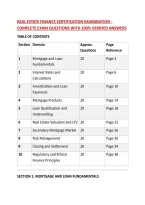
REAL ESTATE FINANCE CERTIFICATION EXAMINATION -
COMPLETE EXAM QUESTIONS WITH 100% VERIFIED ANSWERS
TABLE OF CONTENTS
Section Domain Approx. Page
Questions Reference
1 Mortgage and Loan 20 Page 2
Fundamentals
2 Interest Rates and 20 Page 6
Calculations
3 Amortization and Loan 20 Page 10
Payments
4 Mortgage Products 20 Page 14
5 Loan Qualification and 20 Page 18
Underwriting
6 Real Estate Valuation and LTV 20 Page 22
7 Secondary Mortgage Market 20 Page 26
8 Risk Management 20 Page 30
9 Closing and Settlement 20 Page 34
10 Regulatory and Ethical 20 Page 38
Finance Principles
SECTION 1: MORTGAGE AND LOAN FUNDAMENTALS
,1. Which document represents a legal claim against a property that
serves as security for a debt?
A. Promissory note
B. Mortgage or Deed of Trust
C. Closing disclosure
D. Title insurance policy
Answer: B
Rationale: A mortgage or deed of trust is the security instrument that
pledges the property as collateral for the loan. The promissory note is
the promise to repay.
2. In a mortgage transaction, what is the primary role of the
collateral?
A. To increase the interest rate
B. To serve as a promise to repay the loan
C. To provide security for the lender in case of default
D. To determine the borrower's credit score
Answer: C
Rationale: Collateral is an asset (the property) pledged to a lender to
secure a loan. If the borrower defaults, the lender can seize the
collateral to recover the unpaid balance.
3. Which of the following best defines a lien?
A. The borrower's right to occupy the property
B. A legal claim against a property that must be paid off when the
property is sold
C. The transfer of property ownership to a lender
D. An agreement to pay interest over time
Answer: B
,Rationale: A lien is a legal right or claim against a property by a creditor.
It remains attached to the property until the debt is satisfied.
4. What is the difference between a secured loan and an unsecured
loan?
A. Secured loans have higher interest rates
B. Unsecured loans require collateral
C. Secured loans are backed by collateral, while unsecured loans are not
D. Unsecured loans are only offered by government agencies
Answer: C
Rationale: A secured loan is backed by an asset (like real estate),
whereas an unsecured loan relies solely on the borrower's
creditworthiness without specific asset backing.
5. Which loan term refers to the periodic payment amount required to
repay a loan?
A. Principal
B. Interest
C. Installment
D. Collateral
Answer: C
Rationale: The installment is the periodic payment (usually monthly)
made by the borrower to repay the principal and interest over the life
of the loan.
6. What is a "blanket mortgage"?
A. A mortgage that covers multiple properties
B. A mortgage with no down payment
C. A mortgage that only charges interest
D. A mortgage issued by a private individual
, Answer: A
Rationale: A blanket mortgage is a single loan that is secured by more
than one piece of real estate. It is often used by developers.
7. Which of the following is a characteristic of a closed-end mortgage?
A. The borrower can borrow additional funds at any time
B. The loan amount is fixed and cannot be increased
C. It requires no collateral
D. It is only available for commercial properties
Answer: B
Rationale: A closed-end mortgage is a traditional loan where the full
amount is advanced upfront and no additional funds can be borrowed.
It is fully repaid over the term.
8. What is an "open-end mortgage"?
A. A mortgage that allows the borrower to borrow additional funds up
to a credit limit
B. A mortgage that has no maturity date
C. A mortgage with a variable interest rate
D. A mortgage that can be transferred to another lender
Answer: A
Rationale: An open-end mortgage allows the borrower to borrow
additional money (up to a predetermined limit) as the principal balance
is paid down, similar to a line of credit.
9. Which clause in a mortgage allows the lender to demand full
repayment of the loan if the property is sold?
A. Acceleration clause
B. Due-on-sale clause
C. Prepayment clause
COMPLETE EXAM QUESTIONS WITH 100% VERIFIED ANSWERS
TABLE OF CONTENTS
Section Domain Approx. Page
Questions Reference
1 Mortgage and Loan 20 Page 2
Fundamentals
2 Interest Rates and 20 Page 6
Calculations
3 Amortization and Loan 20 Page 10
Payments
4 Mortgage Products 20 Page 14
5 Loan Qualification and 20 Page 18
Underwriting
6 Real Estate Valuation and LTV 20 Page 22
7 Secondary Mortgage Market 20 Page 26
8 Risk Management 20 Page 30
9 Closing and Settlement 20 Page 34
10 Regulatory and Ethical 20 Page 38
Finance Principles
SECTION 1: MORTGAGE AND LOAN FUNDAMENTALS
,1. Which document represents a legal claim against a property that
serves as security for a debt?
A. Promissory note
B. Mortgage or Deed of Trust
C. Closing disclosure
D. Title insurance policy
Answer: B
Rationale: A mortgage or deed of trust is the security instrument that
pledges the property as collateral for the loan. The promissory note is
the promise to repay.
2. In a mortgage transaction, what is the primary role of the
collateral?
A. To increase the interest rate
B. To serve as a promise to repay the loan
C. To provide security for the lender in case of default
D. To determine the borrower's credit score
Answer: C
Rationale: Collateral is an asset (the property) pledged to a lender to
secure a loan. If the borrower defaults, the lender can seize the
collateral to recover the unpaid balance.
3. Which of the following best defines a lien?
A. The borrower's right to occupy the property
B. A legal claim against a property that must be paid off when the
property is sold
C. The transfer of property ownership to a lender
D. An agreement to pay interest over time
Answer: B
,Rationale: A lien is a legal right or claim against a property by a creditor.
It remains attached to the property until the debt is satisfied.
4. What is the difference between a secured loan and an unsecured
loan?
A. Secured loans have higher interest rates
B. Unsecured loans require collateral
C. Secured loans are backed by collateral, while unsecured loans are not
D. Unsecured loans are only offered by government agencies
Answer: C
Rationale: A secured loan is backed by an asset (like real estate),
whereas an unsecured loan relies solely on the borrower's
creditworthiness without specific asset backing.
5. Which loan term refers to the periodic payment amount required to
repay a loan?
A. Principal
B. Interest
C. Installment
D. Collateral
Answer: C
Rationale: The installment is the periodic payment (usually monthly)
made by the borrower to repay the principal and interest over the life
of the loan.
6. What is a "blanket mortgage"?
A. A mortgage that covers multiple properties
B. A mortgage with no down payment
C. A mortgage that only charges interest
D. A mortgage issued by a private individual
, Answer: A
Rationale: A blanket mortgage is a single loan that is secured by more
than one piece of real estate. It is often used by developers.
7. Which of the following is a characteristic of a closed-end mortgage?
A. The borrower can borrow additional funds at any time
B. The loan amount is fixed and cannot be increased
C. It requires no collateral
D. It is only available for commercial properties
Answer: B
Rationale: A closed-end mortgage is a traditional loan where the full
amount is advanced upfront and no additional funds can be borrowed.
It is fully repaid over the term.
8. What is an "open-end mortgage"?
A. A mortgage that allows the borrower to borrow additional funds up
to a credit limit
B. A mortgage that has no maturity date
C. A mortgage with a variable interest rate
D. A mortgage that can be transferred to another lender
Answer: A
Rationale: An open-end mortgage allows the borrower to borrow
additional money (up to a predetermined limit) as the principal balance
is paid down, similar to a line of credit.
9. Which clause in a mortgage allows the lender to demand full
repayment of the loan if the property is sold?
A. Acceleration clause
B. Due-on-sale clause
C. Prepayment clause


