
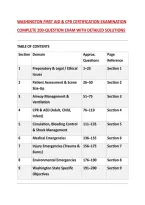
WASHINGTON FIRST AID & CPR CERTIFICATION EXAMINATION
COMPLETE 200-QUESTION EXAM WITH DETAILED SOLUTIONS
TABLE OF CONTENTS
Section Domain Approx. Page
Questions Reference
1 Preparatory & Legal / Ethical 1–25 Section 1
Issues
2 Patient Assessment & Scene 26–50 Section 2
Size-Up
3 Airway Management & 51–75 Section 3
Ventilation
4 CPR & AED (Adult, Child, 76–110 Section 4
Infant)
5 Circulation, Bleeding Control 111–135 Section 5
& Shock Management
6 Medical Emergencies 136–155 Section 6
7 Injury Emergencies (Trauma & 156–175 Section 7
Burns)
8 Environmental Emergencies 176–190 Section 8
9 Washington State Specific 191–200 Section 9
Objectives
,SECTION 1: PREPARATORY & LEGAL / ETHICAL ISSUES
1. A responder arrives at an accident scene and sees broken glass
surrounding an injured person. What should the responder do FIRST?
A. Immediately begin CPR
B. Check the person's pulse
C. Ensure the scene is safe
D. Move the person away from the vehicle
Correct Answer: C. Ensure the scene is safe
Rationale: A responder must first identify and control immediate
hazards before approaching, because becoming another injured victim
can prevent effective emergency assistance. This is the critical first step
in the emergency action principle.
2. What is the primary purpose of performing an initial scene
assessment?
A. Determine the victim's medical history
B. Identify hazards and determine the number of victims
C. Decide whether transportation is necessary
D. Determine the victim's insurance information
Correct Answer: B. Identify hazards and determine the number of
victims
Rationale: The scene size-up involves identifying hazards, determining
the mechanism of injury or nature of illness, and determining the
number of patients. This information guides all subsequent actions.
,3. A first aid provider is protected from liability when providing
emergency care in good faith under which legal principle?
A. Duty to act
B. Good Samaritan Law
C. Standard of care
D. Abandonment
Correct Answer: B. Good Samaritan Law
Rationale: Good Samaritan laws protect individuals who voluntarily
provide emergency care in good faith without expectation of
compensation, provided their actions are not grossly negligent.
4. Before providing first aid to a conscious adult, what must the
responder obtain?
A. A written waiver
B. Consent from the person
C. Approval from a physician
D. Permission from a family member
Correct Answer: B. Consent from the person
Rationale: To avoid legal problems, always ask a person for permission
before providing first aid. This may be done by stating: "My name is... I
am a first-aid provider. May I help you?"
5. A person refuses care after an injury at work. What should the
responder do?
, A. Phone 9-1-1 and stay with the person until advanced help arrives
B. Check the laws in your area about providing first aid
C. Leave the person alone and go back to work
D. Take care of the person anyway
Correct Answer: A. Phone 9-1-1 and stay with the person until
advanced help arrives
Rationale: If someone with a serious injury or illness refuses care,
phone 9-1-1 and stay with the person until advanced help arrives. Your
role includes providing care until someone with more advanced training
takes over.
6. What does the Washington State EMS-No CPR Program allow?
A. EMS to withhold resuscitation when a valid DNR bracelet or
wristband is present
B. Family members to decide whether to resuscitate
C. EMS to withhold resuscitation when a valid DNR bracelet or
wristband is present
D. Physicians to cancel a 9-1-1 response
Correct Answer: C. EMS to withhold resuscitation when a valid DNR
bracelet or wristband is present
Rationale: Washington requires a DNR bracelet or wristband indicating
"No-CPR" to be present on a patient's wrist for EMS to withhold
resuscitation. This is a Washington State-specific legal objective.
7. What does the term "standard of care" refer to in first aid?
COMPLETE 200-QUESTION EXAM WITH DETAILED SOLUTIONS
TABLE OF CONTENTS
Section Domain Approx. Page
Questions Reference
1 Preparatory & Legal / Ethical 1–25 Section 1
Issues
2 Patient Assessment & Scene 26–50 Section 2
Size-Up
3 Airway Management & 51–75 Section 3
Ventilation
4 CPR & AED (Adult, Child, 76–110 Section 4
Infant)
5 Circulation, Bleeding Control 111–135 Section 5
& Shock Management
6 Medical Emergencies 136–155 Section 6
7 Injury Emergencies (Trauma & 156–175 Section 7
Burns)
8 Environmental Emergencies 176–190 Section 8
9 Washington State Specific 191–200 Section 9
Objectives
,SECTION 1: PREPARATORY & LEGAL / ETHICAL ISSUES
1. A responder arrives at an accident scene and sees broken glass
surrounding an injured person. What should the responder do FIRST?
A. Immediately begin CPR
B. Check the person's pulse
C. Ensure the scene is safe
D. Move the person away from the vehicle
Correct Answer: C. Ensure the scene is safe
Rationale: A responder must first identify and control immediate
hazards before approaching, because becoming another injured victim
can prevent effective emergency assistance. This is the critical first step
in the emergency action principle.
2. What is the primary purpose of performing an initial scene
assessment?
A. Determine the victim's medical history
B. Identify hazards and determine the number of victims
C. Decide whether transportation is necessary
D. Determine the victim's insurance information
Correct Answer: B. Identify hazards and determine the number of
victims
Rationale: The scene size-up involves identifying hazards, determining
the mechanism of injury or nature of illness, and determining the
number of patients. This information guides all subsequent actions.
,3. A first aid provider is protected from liability when providing
emergency care in good faith under which legal principle?
A. Duty to act
B. Good Samaritan Law
C. Standard of care
D. Abandonment
Correct Answer: B. Good Samaritan Law
Rationale: Good Samaritan laws protect individuals who voluntarily
provide emergency care in good faith without expectation of
compensation, provided their actions are not grossly negligent.
4. Before providing first aid to a conscious adult, what must the
responder obtain?
A. A written waiver
B. Consent from the person
C. Approval from a physician
D. Permission from a family member
Correct Answer: B. Consent from the person
Rationale: To avoid legal problems, always ask a person for permission
before providing first aid. This may be done by stating: "My name is... I
am a first-aid provider. May I help you?"
5. A person refuses care after an injury at work. What should the
responder do?
, A. Phone 9-1-1 and stay with the person until advanced help arrives
B. Check the laws in your area about providing first aid
C. Leave the person alone and go back to work
D. Take care of the person anyway
Correct Answer: A. Phone 9-1-1 and stay with the person until
advanced help arrives
Rationale: If someone with a serious injury or illness refuses care,
phone 9-1-1 and stay with the person until advanced help arrives. Your
role includes providing care until someone with more advanced training
takes over.
6. What does the Washington State EMS-No CPR Program allow?
A. EMS to withhold resuscitation when a valid DNR bracelet or
wristband is present
B. Family members to decide whether to resuscitate
C. EMS to withhold resuscitation when a valid DNR bracelet or
wristband is present
D. Physicians to cancel a 9-1-1 response
Correct Answer: C. EMS to withhold resuscitation when a valid DNR
bracelet or wristband is present
Rationale: Washington requires a DNR bracelet or wristband indicating
"No-CPR" to be present on a patient's wrist for EMS to withhold
resuscitation. This is a Washington State-specific legal objective.
7. What does the term "standard of care" refer to in first aid?


