
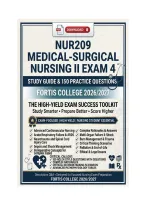
,NUR209Medical-Surgical Nursing II Exam 4
Study Guide & 150 Practice Questions Fortis
College 2026/2027
1. A 72-year-old patient is admitted with sudden onset of left-sided weakness and slurred
speech that began 45 minutes ago. The nurse notes facial drooping on the left side and a
National Institutes of Health Stroke Scale (NIHSS) score of 12. A non-contrast CT scan of the
head is negative for hemorrhage. Which action should the nurse anticipate as the priority
intervention?
A. Administer aspirin 325 mg orally to prevent further clot formation.
B. Prepare the patient for intravenous alteplase (tPA) therapy.
C. Place the patient in a supine position with the head flat.
D. Initiate supplemental oxygen at 4 L/min via nasal cannula.
Correct Answer: B. Prepare the patient for intravenous alteplase (tPA) therapy.
Rationale: For an acute ischemic stroke with symptom onset within 3 to 4.5 hours, IV alteplase
is the priority intervention to restore cerebral blood flow and minimize permanent neurological
damage. The CT scan must first rule out hemorrhage before thrombolytic therapy can be
administered. Aspirin is not given within 24 hours of tPA.
,2. A nurse is caring for a patient who experienced a hemorrhagic stroke. Which assessment
finding requires immediate notification of the healthcare provider?
A. Blood pressure of 150/90 mm Hg.
B. Heart rate of 88 beats/min.
C. New onset of severe headache with vomiting.
D. Glasgow Coma Scale score of 14.
Correct Answer: C. New onset of severe headache with vomiting.
Rationale: In a patient with a hemorrhagic stroke, a sudden severe headache with vomiting may
indicate rebleeding or increased intracranial pressure, which requires immediate intervention. A
GCS of 14 indicates mild impairment and is not the priority concern.
3. Admission vital signs for a brain-injured patient are blood pressure 128/68, pulse 110, and
respirations 26. Which set of vital signs, if taken 1 hour after admission, will be of most concern
to the nurse?
A. Blood pressure 154/68, pulse 56, respirations 12.
B. Blood pressure 138/72, pulse 78, respirations 20.
C. Blood pressure 130/70, pulse 90, respirations 22.
, D. Blood pressure 120/65, pulse 100, respirations 18.
Correct Answer: A. Blood pressure 154/68, pulse 56, respirations 12.
Rationale: This finding is consistent with Cushing's triad (hypertension, bradycardia, and
irregular respirations), which indicates increased intracranial pressure and impending
herniation. Immediate intervention is required.
4. A patient who has suspected epidural hematoma is admitted to the emergency department.
Which action will the nurse expect to take?
A. Prepare the patient for craniotomy.
B. Administer IV corticosteroids.
C. Initiate hypothermia therapy.
D. Place the patient in Trendelenburg position.
Correct Answer: A. Prepare the patient for craniotomy.
Rationale: An epidural hematoma is a neurosurgical emergency requiring immediate evacuation
via craniotomy to prevent brain herniation and death.
Study Guide & 150 Practice Questions Fortis
College 2026/2027
1. A 72-year-old patient is admitted with sudden onset of left-sided weakness and slurred
speech that began 45 minutes ago. The nurse notes facial drooping on the left side and a
National Institutes of Health Stroke Scale (NIHSS) score of 12. A non-contrast CT scan of the
head is negative for hemorrhage. Which action should the nurse anticipate as the priority
intervention?
A. Administer aspirin 325 mg orally to prevent further clot formation.
B. Prepare the patient for intravenous alteplase (tPA) therapy.
C. Place the patient in a supine position with the head flat.
D. Initiate supplemental oxygen at 4 L/min via nasal cannula.
Correct Answer: B. Prepare the patient for intravenous alteplase (tPA) therapy.
Rationale: For an acute ischemic stroke with symptom onset within 3 to 4.5 hours, IV alteplase
is the priority intervention to restore cerebral blood flow and minimize permanent neurological
damage. The CT scan must first rule out hemorrhage before thrombolytic therapy can be
administered. Aspirin is not given within 24 hours of tPA.
,2. A nurse is caring for a patient who experienced a hemorrhagic stroke. Which assessment
finding requires immediate notification of the healthcare provider?
A. Blood pressure of 150/90 mm Hg.
B. Heart rate of 88 beats/min.
C. New onset of severe headache with vomiting.
D. Glasgow Coma Scale score of 14.
Correct Answer: C. New onset of severe headache with vomiting.
Rationale: In a patient with a hemorrhagic stroke, a sudden severe headache with vomiting may
indicate rebleeding or increased intracranial pressure, which requires immediate intervention. A
GCS of 14 indicates mild impairment and is not the priority concern.
3. Admission vital signs for a brain-injured patient are blood pressure 128/68, pulse 110, and
respirations 26. Which set of vital signs, if taken 1 hour after admission, will be of most concern
to the nurse?
A. Blood pressure 154/68, pulse 56, respirations 12.
B. Blood pressure 138/72, pulse 78, respirations 20.
C. Blood pressure 130/70, pulse 90, respirations 22.
, D. Blood pressure 120/65, pulse 100, respirations 18.
Correct Answer: A. Blood pressure 154/68, pulse 56, respirations 12.
Rationale: This finding is consistent with Cushing's triad (hypertension, bradycardia, and
irregular respirations), which indicates increased intracranial pressure and impending
herniation. Immediate intervention is required.
4. A patient who has suspected epidural hematoma is admitted to the emergency department.
Which action will the nurse expect to take?
A. Prepare the patient for craniotomy.
B. Administer IV corticosteroids.
C. Initiate hypothermia therapy.
D. Place the patient in Trendelenburg position.
Correct Answer: A. Prepare the patient for craniotomy.
Rationale: An epidural hematoma is a neurosurgical emergency requiring immediate evacuation
via craniotomy to prevent brain herniation and death.


