
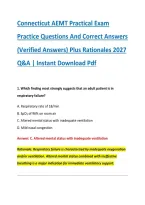
Connecticut AEMT Practical Exam
Practice Questions And Correct Answers
(Verified Answers) Plus Rationales 2027
Q&A | Instant Download Pdf
1. Which finding most strongly suggests that an adult patient is in
respiratory failure?
A. Respiratory rate of 18/min
B. SpO₂ of 96% on room air
C. Altered mental status with inadequate ventilation
D. Mild nasal congestion
Answer: C. Altered mental status with inadequate ventilation
Rationale: Respiratory failure is characterized by inadequate oxygenation
and/or ventilation. Altered mental status combined with ineffective
breathing is a major indication for immediate ventilatory support.
,2. An AEMT encounters an unresponsive adult who is not breathing
normally. After confirming pulselessness, what should be done
immediately?
A. Obtain a 12-lead ECG
B. Begin high-quality CPR
C. Establish an IV before compressions
D. Administer oxygen by nasal cannula
Answer: B. Begin high-quality CPR
Rationale: Cardiac arrest requires immediate high-quality CPR. Other
interventions should be performed without unnecessarily delaying chest
compressions.
3. Which airway adjunct is most appropriate for an unconscious patient
without a gag reflex?
A. Nasopharyngeal airway
B. Oropharyngeal airway
C. Supraglottic airway in every case
D. Nasal cannula
Answer: B. Oropharyngeal airway
,Rationale: An OPA is appropriate for an unresponsive patient who lacks a
gag reflex. It helps prevent the tongue from obstructing the airway.
4. When inserting an OPA in an adult, the AEMT should generally:
A. Insert it with the tip pointed toward the hard palate
B. Insert it upside down and rotate it after entering the mouth
C. Advance it only until the lips are reached
D. Use it in any patient with an intact gag reflex
Answer: B. Insert it upside down and rotate it after entering the mouth
Rationale: In adults, the OPA may be inserted with the tip toward the roof
of the mouth and rotated 180 degrees as it advances, unless an alternative
insertion technique is preferred. It should not be used in a patient with an
intact gag reflex.
5. Which patient is the best candidate for a nasopharyngeal airway?
A. An alert patient with a strong gag reflex who requires airway support
B. An apneic patient with severe facial trauma
C. A patient with a suspected basilar skull fracture
D. A patient with complete upper-airway obstruction
, Answer: A. An alert patient with a strong gag reflex who requires airway
support
Rationale: An NPA can be tolerated by patients with an intact gag reflex.
Significant facial trauma or suspected basilar skull fracture may
contraindicate or require extreme caution with nasal airway insertion.
6. A patient with severe asthma is becoming exhausted and has decreasing
respiratory effort. What is the priority?
A. Encourage the patient to walk
B. Provide ventilatory support as needed
C. Withhold oxygen
D. Give oral fluids
Answer: B. Provide ventilatory support as needed
Rationale: A tiring asthmatic patient with decreasing respiratory effort
may be progressing toward respiratory failure. Supporting ventilation and
oxygenation becomes the priority.
7. Which assessment finding is most concerning in a patient with
anaphylaxis?
Practice Questions And Correct Answers
(Verified Answers) Plus Rationales 2027
Q&A | Instant Download Pdf
1. Which finding most strongly suggests that an adult patient is in
respiratory failure?
A. Respiratory rate of 18/min
B. SpO₂ of 96% on room air
C. Altered mental status with inadequate ventilation
D. Mild nasal congestion
Answer: C. Altered mental status with inadequate ventilation
Rationale: Respiratory failure is characterized by inadequate oxygenation
and/or ventilation. Altered mental status combined with ineffective
breathing is a major indication for immediate ventilatory support.
,2. An AEMT encounters an unresponsive adult who is not breathing
normally. After confirming pulselessness, what should be done
immediately?
A. Obtain a 12-lead ECG
B. Begin high-quality CPR
C. Establish an IV before compressions
D. Administer oxygen by nasal cannula
Answer: B. Begin high-quality CPR
Rationale: Cardiac arrest requires immediate high-quality CPR. Other
interventions should be performed without unnecessarily delaying chest
compressions.
3. Which airway adjunct is most appropriate for an unconscious patient
without a gag reflex?
A. Nasopharyngeal airway
B. Oropharyngeal airway
C. Supraglottic airway in every case
D. Nasal cannula
Answer: B. Oropharyngeal airway
,Rationale: An OPA is appropriate for an unresponsive patient who lacks a
gag reflex. It helps prevent the tongue from obstructing the airway.
4. When inserting an OPA in an adult, the AEMT should generally:
A. Insert it with the tip pointed toward the hard palate
B. Insert it upside down and rotate it after entering the mouth
C. Advance it only until the lips are reached
D. Use it in any patient with an intact gag reflex
Answer: B. Insert it upside down and rotate it after entering the mouth
Rationale: In adults, the OPA may be inserted with the tip toward the roof
of the mouth and rotated 180 degrees as it advances, unless an alternative
insertion technique is preferred. It should not be used in a patient with an
intact gag reflex.
5. Which patient is the best candidate for a nasopharyngeal airway?
A. An alert patient with a strong gag reflex who requires airway support
B. An apneic patient with severe facial trauma
C. A patient with a suspected basilar skull fracture
D. A patient with complete upper-airway obstruction
, Answer: A. An alert patient with a strong gag reflex who requires airway
support
Rationale: An NPA can be tolerated by patients with an intact gag reflex.
Significant facial trauma or suspected basilar skull fracture may
contraindicate or require extreme caution with nasal airway insertion.
6. A patient with severe asthma is becoming exhausted and has decreasing
respiratory effort. What is the priority?
A. Encourage the patient to walk
B. Provide ventilatory support as needed
C. Withhold oxygen
D. Give oral fluids
Answer: B. Provide ventilatory support as needed
Rationale: A tiring asthmatic patient with decreasing respiratory effort
may be progressing toward respiratory failure. Supporting ventilation and
oxygenation becomes the priority.
7. Which assessment finding is most concerning in a patient with
anaphylaxis?


