
A-LEVEL MATHEMATICS / VECTOR GEOMETRY / INDEPENDENT SUPPLEMENT
METHOD SUMMARY + ORIGINAL PRACTICE
Vectors:
from calculation to reason
A-Level Maths
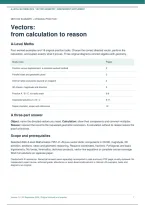
Four worked examples and 18 original practice tasks. Choose the correct directed vector, perform the
calculation, and explain exactly what it proves. Three original diagrams connect algebra with geometry.
Study route Pages
Position versus displacement: a complete worked method 2
Parallel sides and geometric proof 3
Internal ratios and points beyond an endpoint 4
3D checks, magnitude and direction 5
Practice A / B / C: six tasks each 6-8
Separated solutions A / B / C 9-11
Repair checklist, scope and references 12
A three-part answer
Object: name the directed vectors you need. Calculation: show their components and common multiplier.
Reason: connect the result to the requested geometric conclusion. A calculation without its reason leaves the
proof unfinished.
Scope and prerequisites
Selected AQA A-level Mathematics 7357 J1-J5 pure-vector skills: components in 2D/3D, magnitude, 2D
direction, positions, ratios and geometric reasoning. Requires coordinates, fractions, Pythagoras and basic
trigonometry. No forces, kinematics, dot/cross products, vector-line equations or complete-course coverage.
Work full solutions on separate paper.
Created with AI assistance. Numerical answers were separately recomputed in code and every PDF page visually reviewed. No
independent expert review, achieved grade, attendance or exam-board endorsement is claimed. All examples, tasks and
diagrams are original.
Version 1.0 | 29 September 2026 | Original methods and practice 1
, A-LEVEL MATHEMATICS / VECTOR GEOMETRY / INDEPENDENT SUPPLEMENT
01 / NAME THE JOURNEY
Destination minus start
We write AB for the directed vector from A to B, with an arrow over AB when writing by hand. Lower-case a
and b mean the position vectors OA and OB. A pair such as (x, y) represents components, not a scalar
length.
Worked example A
Let A = (1, 2) and B = (7, 5). Moving from A to B means increasing x by 6 and y by 3. Therefore AB = b - a =
(7 - 1, 5 - 2) = (6, 3).
B(7, 5)
A(1, 2)
O(0, 0)
The route O to A to B has the same endpoint as O to B. Equal axis scales; coordinates in arbitrary units.
Why subtraction works
The route equation is a + AB = b. Subtract a to isolate the unknown journey: AB = b - a. The vector a + b
generally points somewhere else; it does not connect A to B.
Check Result
Endpoint (1, 2) + (6, 3) = (7, 5), so A + AB = B.
Reverse BA = (-6, -3) = -AB. Same length, opposite direction.
Length |AB| = sqrt(6 squared + 3 squared) = sqrt(45) = 3sqrt(5).
A useful habit: say the start and end out loud before subtracting. If the requested quantity is a distance, finish with a
nonnegative scalar length; components alone are not a distance.
Version 1.0 | 29 September 2026 | Original methods and practice 2
METHOD SUMMARY + ORIGINAL PRACTICE
Vectors:
from calculation to reason
A-Level Maths
Four worked examples and 18 original practice tasks. Choose the correct directed vector, perform the
calculation, and explain exactly what it proves. Three original diagrams connect algebra with geometry.
Study route Pages
Position versus displacement: a complete worked method 2
Parallel sides and geometric proof 3
Internal ratios and points beyond an endpoint 4
3D checks, magnitude and direction 5
Practice A / B / C: six tasks each 6-8
Separated solutions A / B / C 9-11
Repair checklist, scope and references 12
A three-part answer
Object: name the directed vectors you need. Calculation: show their components and common multiplier.
Reason: connect the result to the requested geometric conclusion. A calculation without its reason leaves the
proof unfinished.
Scope and prerequisites
Selected AQA A-level Mathematics 7357 J1-J5 pure-vector skills: components in 2D/3D, magnitude, 2D
direction, positions, ratios and geometric reasoning. Requires coordinates, fractions, Pythagoras and basic
trigonometry. No forces, kinematics, dot/cross products, vector-line equations or complete-course coverage.
Work full solutions on separate paper.
Created with AI assistance. Numerical answers were separately recomputed in code and every PDF page visually reviewed. No
independent expert review, achieved grade, attendance or exam-board endorsement is claimed. All examples, tasks and
diagrams are original.
Version 1.0 | 29 September 2026 | Original methods and practice 1
, A-LEVEL MATHEMATICS / VECTOR GEOMETRY / INDEPENDENT SUPPLEMENT
01 / NAME THE JOURNEY
Destination minus start
We write AB for the directed vector from A to B, with an arrow over AB when writing by hand. Lower-case a
and b mean the position vectors OA and OB. A pair such as (x, y) represents components, not a scalar
length.
Worked example A
Let A = (1, 2) and B = (7, 5). Moving from A to B means increasing x by 6 and y by 3. Therefore AB = b - a =
(7 - 1, 5 - 2) = (6, 3).
B(7, 5)
A(1, 2)
O(0, 0)
The route O to A to B has the same endpoint as O to B. Equal axis scales; coordinates in arbitrary units.
Why subtraction works
The route equation is a + AB = b. Subtract a to isolate the unknown journey: AB = b - a. The vector a + b
generally points somewhere else; it does not connect A to B.
Check Result
Endpoint (1, 2) + (6, 3) = (7, 5), so A + AB = B.
Reverse BA = (-6, -3) = -AB. Same length, opposite direction.
Length |AB| = sqrt(6 squared + 3 squared) = sqrt(45) = 3sqrt(5).
A useful habit: say the start and end out loud before subtracting. If the requested quantity is a distance, finish with a
nonnegative scalar length; components alone are not a distance.
Version 1.0 | 29 September 2026 | Original methods and practice 2


