
JB Learning Final Exam | 300 Verified Questions EMS / EMT / Paramedic
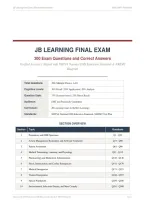
JB LEARNING FINAL EXAM
300 Exam Questions and Correct Answers
Verified Answers | Aligned with NHTSA National EMS Education Standards & NREMT
Blueprint
Total Questions: 300 (Multiple Choice, A-D)
Cognitive Levels: 30% Recall | 50% Application | 20% Analysis
Question Style: 75% Scenario-based | 25% Direct Recall
Audience: EMT and Paramedic Candidates
Curriculum: JB Learning (Jones & Bartlett Learning)
Standards: NHTSA National EMS Education Standards, NREMT Test Plan
SECTION OVERVIEW
Section Topic Questions
1 Preparatory and EMS Operations Q1 - Q30
2 Airway Management, Respiration, and Artificial Ventilation Q31 - Q60
3 Patient Assessment Q61 - Q90
4 Medical Terminology, Anatomy, and Physiology Q91 - Q115
5 Pharmacology and Medication Administration Q116 - Q140
6 Shock, Resuscitation, and Cardiac Emergencies Q141 - Q170
7 Medical Emergencies Q171 - Q215
8 Trauma Emergencies Q216 - Q255
9 Special Populations Q256 - Q280
10 Environmental, Infectious Disease, and Mass Casualty Q281 - Q300
Aligned with NHTSA National EMS Education Standards & NREMT Blueprint Page 1
,JB Learning Final Exam | 300 Verified Questions EMS / EMT / Paramedic
EXAMINEE INSTRUCTIONS
• Each question has four answer options (A, B, C, D). Select the ONE best answer.
• The correct answer is marked [CORRECT] and followed by a detailed rationale.
• Rationales cite JB Learning curriculum content, NHTSA standards, and NREMT test plan references.
• Scenario-based questions require field decision-making and prioritization consistent with EMS protocol.
Aligned with NHTSA National EMS Education Standards & NREMT Blueprint Page 2
,JB Learning Final Exam | 300 Verified Questions EMS / EMT / Paramedic
SECTION 1: Preparatory and EMS Operations
EMS Systems, Legal/Ethical, Well-Being, Documentation, and Lifting/Moving Patients
Q1: You arrive on scene to find an unresponsive adult male. The patient's wife states he has a terminal illness
and shows you a valid, signed Do Not Resuscitate (DNR) order. The patient is apneic and pulseless. What is
your MOST appropriate action?
A. Initiate full resuscitative efforts; the DNR must be verified by medical direction before honoring it.
B. Confirm the DNR is valid and conforms to state protocols, then withhold resuscitative efforts and
provide supportive care to the family. [CORRECT]
C. Begin CPR but withhold advanced airway interventions only.
D. Contact medical direction for permission to honor the DNR before taking any action.
Correct Answer: B
Rationale: A valid DNR that meets state requirements must be honored by EMS providers without delay. Honoring a valid DNR
respects patient autonomy and is an ethical and legal obligation under advance directives. Initiating CPR (A) violates the
patient's expressed wishes; partial resuscitation (C) has no medical or legal basis. While online medical direction may be
contacted for support (D), it is not required to honor a valid, properly executed DNR.
Q2: Which of the following BEST describes the role of off-line (indirect) medical direction in an EMS
system?
A. A physician gives direct radio orders to a paramedic in the field for an unfamiliar procedure.
B. Standing orders and approved protocols are developed by the medical director for field use without
real-time consultation. [CORRECT]
C. The medical director responds to all cardiac arrest calls to oversee resuscitation.
D. Online medical control is contacted after each call to review documentation accuracy.
Correct Answer: B
Rationale: Off-line (indirect) medical direction involves the development of standing orders, protocols, and clinical guidelines
approved by the medical director that EMS providers follow without real-time physician consultation. This allows rapid,
evidence-based field care. Choice A describes on-line (direct) medical direction. Choice C is impractical and not within the
typical role of a medical director. Choice D describes a quality improvement function, not off-line medical direction.
Aligned with NHTSA National EMS Education Standards & NREMT Blueprint Page 3
, JB Learning Final Exam | 300 Verified Questions EMS / EMT / Paramedic
Q3: A 17-year-old female is involved in a motor vehicle crash. She is alert and oriented but has an open
fracture of the tibia. She refuses treatment and transport, stating she is fine. What is the MOST appropriate
action?
A. Have her sign a refusal form and leave the scene.
B. Explain the risks, encourage transport, contact her parents, and have her sign a refusal only if she
remains competent to refuse. [CORRECT]
C. Transport her under implied consent because she is a minor with a serious injury.
D. Transport her under the doctrine of emergency doctrine regardless of her wishes.
Correct Answer: B
Rationale: Minors generally cannot legally refuse care; consent must be obtained from a parent or legal guardian. EMS should
explain risks, encourage transport, and contact the parents. If the minor is mature and the situation allows, refusal may be
documented with parental involvement. Choice A ignores the minor's legal status. Choices C and D misapply implied and
emergency doctrine: implied consent applies when the parent cannot be reached for a life-threatening emergency, not for a
competent minor with a non-life-threatening injury.
Q4: Which component of the EMS system is MOST directly responsible for ongoing provider competency and
protocol adherence through case review?
A. Medical direction
B. Continuous quality improvement (CQI) [CORRECT]
C. Emergency Medical Dispatch (EMD)
D. Hospital liaison program
Correct Answer: B
Rationale: Continuous Quality Improvement (CQI) is the structured process of reviewing calls, audits, patient care reports, and
outcomes to evaluate and improve provider performance and protocol adherence. Medical direction (A) establishes protocols but
CQI is the review mechanism. EMD (C) handles call triage and pre-arrival instructions. Hospital liaison (D) improves handoff
communication but is not the primary mechanism for ongoing competency review.
Q5: You are called to a scene where a patient has fallen from a roof. The scene appears unsafe due to downed
electrical wires near the patient. What is your FIRST priority?
A. Rapidly extricate the patient before the wires cause further harm.
B. Request the power company to secure the electrical hazard before approaching the patient.
[CORRECT]
C. Approach the patient while maintaining a safe distance from the wires.
D. Apply dry leather gloves and drag the patient away from the wires.
Correct Answer: B
Rationale: Scene safety is the first priority in any EMS response. Downed power lines must be secured by the utility company
before patient contact. The risk of electrocution is lethal to responders and the patient. Choices A, C, and D all place the provider
at risk. Even dry leather gloves (D) do not protect against high-voltage lines. The JB Learning curriculum emphasizes that no
patient care action should precede scene safety verification.
Aligned with NHTSA National EMS Education Standards & NREMT Blueprint Page 4
JB LEARNING FINAL EXAM
300 Exam Questions and Correct Answers
Verified Answers | Aligned with NHTSA National EMS Education Standards & NREMT
Blueprint
Total Questions: 300 (Multiple Choice, A-D)
Cognitive Levels: 30% Recall | 50% Application | 20% Analysis
Question Style: 75% Scenario-based | 25% Direct Recall
Audience: EMT and Paramedic Candidates
Curriculum: JB Learning (Jones & Bartlett Learning)
Standards: NHTSA National EMS Education Standards, NREMT Test Plan
SECTION OVERVIEW
Section Topic Questions
1 Preparatory and EMS Operations Q1 - Q30
2 Airway Management, Respiration, and Artificial Ventilation Q31 - Q60
3 Patient Assessment Q61 - Q90
4 Medical Terminology, Anatomy, and Physiology Q91 - Q115
5 Pharmacology and Medication Administration Q116 - Q140
6 Shock, Resuscitation, and Cardiac Emergencies Q141 - Q170
7 Medical Emergencies Q171 - Q215
8 Trauma Emergencies Q216 - Q255
9 Special Populations Q256 - Q280
10 Environmental, Infectious Disease, and Mass Casualty Q281 - Q300
Aligned with NHTSA National EMS Education Standards & NREMT Blueprint Page 1
,JB Learning Final Exam | 300 Verified Questions EMS / EMT / Paramedic
EXAMINEE INSTRUCTIONS
• Each question has four answer options (A, B, C, D). Select the ONE best answer.
• The correct answer is marked [CORRECT] and followed by a detailed rationale.
• Rationales cite JB Learning curriculum content, NHTSA standards, and NREMT test plan references.
• Scenario-based questions require field decision-making and prioritization consistent with EMS protocol.
Aligned with NHTSA National EMS Education Standards & NREMT Blueprint Page 2
,JB Learning Final Exam | 300 Verified Questions EMS / EMT / Paramedic
SECTION 1: Preparatory and EMS Operations
EMS Systems, Legal/Ethical, Well-Being, Documentation, and Lifting/Moving Patients
Q1: You arrive on scene to find an unresponsive adult male. The patient's wife states he has a terminal illness
and shows you a valid, signed Do Not Resuscitate (DNR) order. The patient is apneic and pulseless. What is
your MOST appropriate action?
A. Initiate full resuscitative efforts; the DNR must be verified by medical direction before honoring it.
B. Confirm the DNR is valid and conforms to state protocols, then withhold resuscitative efforts and
provide supportive care to the family. [CORRECT]
C. Begin CPR but withhold advanced airway interventions only.
D. Contact medical direction for permission to honor the DNR before taking any action.
Correct Answer: B
Rationale: A valid DNR that meets state requirements must be honored by EMS providers without delay. Honoring a valid DNR
respects patient autonomy and is an ethical and legal obligation under advance directives. Initiating CPR (A) violates the
patient's expressed wishes; partial resuscitation (C) has no medical or legal basis. While online medical direction may be
contacted for support (D), it is not required to honor a valid, properly executed DNR.
Q2: Which of the following BEST describes the role of off-line (indirect) medical direction in an EMS
system?
A. A physician gives direct radio orders to a paramedic in the field for an unfamiliar procedure.
B. Standing orders and approved protocols are developed by the medical director for field use without
real-time consultation. [CORRECT]
C. The medical director responds to all cardiac arrest calls to oversee resuscitation.
D. Online medical control is contacted after each call to review documentation accuracy.
Correct Answer: B
Rationale: Off-line (indirect) medical direction involves the development of standing orders, protocols, and clinical guidelines
approved by the medical director that EMS providers follow without real-time physician consultation. This allows rapid,
evidence-based field care. Choice A describes on-line (direct) medical direction. Choice C is impractical and not within the
typical role of a medical director. Choice D describes a quality improvement function, not off-line medical direction.
Aligned with NHTSA National EMS Education Standards & NREMT Blueprint Page 3
, JB Learning Final Exam | 300 Verified Questions EMS / EMT / Paramedic
Q3: A 17-year-old female is involved in a motor vehicle crash. She is alert and oriented but has an open
fracture of the tibia. She refuses treatment and transport, stating she is fine. What is the MOST appropriate
action?
A. Have her sign a refusal form and leave the scene.
B. Explain the risks, encourage transport, contact her parents, and have her sign a refusal only if she
remains competent to refuse. [CORRECT]
C. Transport her under implied consent because she is a minor with a serious injury.
D. Transport her under the doctrine of emergency doctrine regardless of her wishes.
Correct Answer: B
Rationale: Minors generally cannot legally refuse care; consent must be obtained from a parent or legal guardian. EMS should
explain risks, encourage transport, and contact the parents. If the minor is mature and the situation allows, refusal may be
documented with parental involvement. Choice A ignores the minor's legal status. Choices C and D misapply implied and
emergency doctrine: implied consent applies when the parent cannot be reached for a life-threatening emergency, not for a
competent minor with a non-life-threatening injury.
Q4: Which component of the EMS system is MOST directly responsible for ongoing provider competency and
protocol adherence through case review?
A. Medical direction
B. Continuous quality improvement (CQI) [CORRECT]
C. Emergency Medical Dispatch (EMD)
D. Hospital liaison program
Correct Answer: B
Rationale: Continuous Quality Improvement (CQI) is the structured process of reviewing calls, audits, patient care reports, and
outcomes to evaluate and improve provider performance and protocol adherence. Medical direction (A) establishes protocols but
CQI is the review mechanism. EMD (C) handles call triage and pre-arrival instructions. Hospital liaison (D) improves handoff
communication but is not the primary mechanism for ongoing competency review.
Q5: You are called to a scene where a patient has fallen from a roof. The scene appears unsafe due to downed
electrical wires near the patient. What is your FIRST priority?
A. Rapidly extricate the patient before the wires cause further harm.
B. Request the power company to secure the electrical hazard before approaching the patient.
[CORRECT]
C. Approach the patient while maintaining a safe distance from the wires.
D. Apply dry leather gloves and drag the patient away from the wires.
Correct Answer: B
Rationale: Scene safety is the first priority in any EMS response. Downed power lines must be secured by the utility company
before patient contact. The risk of electrocution is lethal to responders and the patient. Choices A, C, and D all place the provider
at risk. Even dry leather gloves (D) do not protect against high-voltage lines. The JB Learning curriculum emphasizes that no
patient care action should precede scene safety verification.
Aligned with NHTSA National EMS Education Standards & NREMT Blueprint Page 4


