
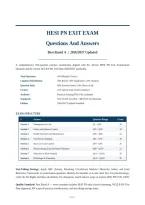
HESI PN EXIT EXAM
Questions And Answers
Best Rated A | 2026/2027 Updated
A comprehensive 160-question practice examination aligned with the official HESI PN Exit Examination
blueprint and the current NCLEX-PN Test Plan (2026/2027 standards).
Total Questions: 160 (Multiple Choice)
Cognitive Distribution: 30% Recall / 50% Application / 20% Analysis
Question Style: 80% Scenario-based / 20% Direct recall
Format: A-D options with verified rationales
Audience: Practical Nursing (PN/LVN) candidates
Standards: NCLEX-PN Test Plan + HESI PN Exit blueprint
Edition: 2026/2027 Updated Standards
EXAM STRUCTURE
# Section Question Range Count
Section 1 Management of Care Q1 – Q20 20
Section 2 Safety and Infection Control Q21 – Q38 18
Section 3 Health Promotion and Maintenance Q39 – Q60 22
Section 4 Psychosocial Integrity Q61 – Q78 18
Section 5 Basic Care and Comfort Q79 – Q98 20
Section 6 Pharmacological and Parenteral Therapies Q99 – Q120 22
Section 7 Reduction of Risk Potential Q121 – Q140 20
Section 8 Physiological Adaptation Q141 – Q160 20
Test-Taking Strategy: Apply ABC (Airway, Breathing, Circulation), Maslow's Hierarchy, Safety, and Least
Restrictive frameworks to prioritization questions. Identify the unstable or at-risk client first. For pharmacology,
verify the Six Rights and dose calculations. For delegation, match tasks to scope of practice (RN, PN/LVN, UAP).
Quality Standard: Best Rated A — every rationale includes HESI PN-style clinical reasoning, NCLEX-PN Test
Plan alignment, PN scope-of-practice considerations, and test-taking strategy notes.
Page 1
, HESI PN Exit Exam Questions And Answers Best Rated A | 2026/2027 Updated
Section 1: Management of Care
Questions 1 – 20 | 20 Questions
Focus areas: Advocacy, Delegation, Prioritization, Continuity of Care, Legal/Ethical Practice, & Case Management
Q1. The PN is caring for four clients on a medical-surgical unit. Which client should the PN assess
FIRST?
A. A client who is 2 days postoperative from an appendectomy requesting pain medication for incisional
discomfort rated 6/10.
B. A client who is 3 days postoperative from a hip replacement and reports new onset of calf pain with
localized swelling. [CORRECT]
C. A client with pneumonia who has a productive cough with yellow sputum and is scheduled for discharge
tomorrow.
D. A client with type 2 diabetes whose morning blood glucose is 180 mg/dL and is awaiting breakfast.
Correct Answer: B
Rationale: New onset calf pain with swelling in a postoperative orthopedic client suggests deep vein thrombosis
(DVT), a potentially life-threatening complication that can progress to pulmonary embolism. Using the ABC
framework and acute-versus-chronic prioritization, this client requires immediate assessment because DVT can
rapidly deteriorate into respiratory compromise. The other clients are stable: postoperative incisional pain is
expected, pneumonia with discharge planning indicates improvement, and a blood glucose of 180 mg/dL is mildly
elevated but not urgent. Test-taking strategy: identify the client with the highest risk of rapid deterioration.
Q2. The charge nurse is delegating care for the shift. Which task is MOST appropriate to delegate to
the Unlicensed Assistive Personnel (UAP)?
A. Teaching a client newly diagnosed with diabetes how to perform foot care.
B. Assessing the skin integrity of a client with stage 3 pressure injury.
C. Ambulating a stable client who is 2 days postoperative from a cholecystectomy. [CORRECT]
D. Evaluating the effectiveness of a PRN analgesic administered 30 minutes ago.
Correct Answer: C
Rationale: Ambulating a stable postoperative client is within the UAP scope of practice because it is a routine,
non-complex task with predictable outcomes and does not require nursing judgment. Client teaching requires the
knowledge and judgment of a licensed nurse (RN or PN), assessment of skin integrity and wound staging require
the expertise of a licensed nurse, and evaluating medication effectiveness requires nursing judgment and is outside
UAP scope. The Five Rights of Delegation confirm this delegation: right task (routine ambulation), right
circumstance (stable postoperative client), right person (UAP), right direction (clear instructions), and right
supervision (PN remains accountable).
Page 2
, HESI PN Exit Exam Questions And Answers Best Rated A | 2026/2027 Updated
Q3. A client scheduled for an emergency appendectomy refuses to sign the surgical consent form,
stating, "I want to wait for my daughter to arrive." What is the MOST appropriate action by the PN?
A. Explain to the client that the surgery is an emergency and the consent can be waived.
B. Notify the surgeon and document the client's refusal and stated reason in the medical record.
[CORRECT]
C. Sign the consent form as a witness and proceed with preoperative preparations.
D. Inform the client that refusing surgery could result in a life-threatening rupture.
Correct Answer: B
Rationale: Informed consent requires that the client fully understand the procedure, risks, benefits, and alternatives,
and consent must be voluntary without coercion. The client has the legal right to refuse treatment, and the PN's
responsibility is to notify the surgeon (who can address concerns or determine if emergency criteria apply) and
document the refusal and reason. Option A is incorrect because true emergencies require specific criteria and
physician documentation, not nurse assumption. Option C is inappropriate because the PN cannot coerce or witness
consent that the client refuses. Option D uses fear-based communication, which is coercive and violates the
principle of informed consent.
Q4. A client with a terminal illness tells the PN, "I don't want any more treatments. I just want to be
comfortable." The healthcare provider has not yet addressed advance directives. What should the PN
do FIRST?
A. Document the client's statement and continue with the prescribed treatment plan.
B. Notify the healthcare provider of the client's request and provide contact information for palliative
care services. [CORRECT]
C. Tell the client that they cannot stop treatments once they have started.
D. Contact the family to discuss the client's decision before notifying the provider.
Correct Answer: B
Rationale: The Patient Self-Determination Act requires that healthcare providers respect a client's right to make
decisions about their care, including refusal of treatment. The PN acts as a client advocate by immediately notifying
the healthcare provider of the client's wishes so that the treatment plan can be revised and palliative care can be
initiated. Documenting the statement without action (Option A) does not advocate for the client. Option C provides
false information; clients have the right to refuse treatment at any time. Option D violates the client's confidentiality
and autonomy; the family should only be involved if the client consents to their involvement.
Page 3
, HESI PN Exit Exam Questions And Answers Best Rated A | 2026/2027 Updated
Q5. The PN overhears a colleague discussing a client's diagnosis in the hospital elevator. Which action
by the PN is MOST appropriate?
A. Report the colleague to the nursing supervisor immediately after the incident occurs.
B. Confront the colleague privately and remind them about HIPAA regulations regarding client
confidentiality. [CORRECT]
C. Ignore the situation since no clients were observed in the elevator at the time.
D. File an anonymous incident report without addressing the colleague directly.
Correct Answer: B
Rationale: HIPAA (Health Insurance Portability and Accountability Act) protects client health information, and
discussing diagnoses in public areas such as elevators violates confidentiality. The PN's first action should be to
address the colleague privately to stop the behavior and educate about HIPAA regulations; this preserves
professional relationships while protecting client privacy. Option A bypasses professional courtesy and the chain of
communication. Option C is incorrect because HIPAA violations must be addressed even when no clients are
observed; the behavior itself is the violation. Option D is appropriate if the colleague does not respond to the private
reminder, but the direct professional approach is the first step.
Q6. Which assignment is MOST appropriate for the PN to accept from the charge nurse on a medical
unit?
A. A client who is 4 hours post-cardiac catheterization requiring frequent hemodynamic monitoring.
B. A client receiving a continuous heparin infusion requiring hourly activated partial thromboplastin time
(aPTT) monitoring.
C. A client who is 2 days postoperative from a hernia repair with a Jackson-Pratt drain and stable vital
signs. [CORRECT]
D. A client who is newly admitted with acute gastrointestinal bleeding and requires IV fluid resuscitation.
Correct Answer: C
Rationale: The PN scope of practice includes caring for stable clients with predictable outcomes; a postoperative
client with a JP drain and stable vital signs is appropriate for PN assignment. Clients requiring complex
assessments, frequent hemodynamic monitoring (Option A), titration of high-alert medications such as heparin
(Option B), or management of unstable acute conditions such as GI bleeding (Option D) require RN-level care. The
PN should advocate for appropriate assignments by requesting reassignment of clients requiring complex nursing
judgment beyond PN scope. Test-taking strategy: identify the client with stable, predictable needs.
Page 4
Questions And Answers
Best Rated A | 2026/2027 Updated
A comprehensive 160-question practice examination aligned with the official HESI PN Exit Examination
blueprint and the current NCLEX-PN Test Plan (2026/2027 standards).
Total Questions: 160 (Multiple Choice)
Cognitive Distribution: 30% Recall / 50% Application / 20% Analysis
Question Style: 80% Scenario-based / 20% Direct recall
Format: A-D options with verified rationales
Audience: Practical Nursing (PN/LVN) candidates
Standards: NCLEX-PN Test Plan + HESI PN Exit blueprint
Edition: 2026/2027 Updated Standards
EXAM STRUCTURE
# Section Question Range Count
Section 1 Management of Care Q1 – Q20 20
Section 2 Safety and Infection Control Q21 – Q38 18
Section 3 Health Promotion and Maintenance Q39 – Q60 22
Section 4 Psychosocial Integrity Q61 – Q78 18
Section 5 Basic Care and Comfort Q79 – Q98 20
Section 6 Pharmacological and Parenteral Therapies Q99 – Q120 22
Section 7 Reduction of Risk Potential Q121 – Q140 20
Section 8 Physiological Adaptation Q141 – Q160 20
Test-Taking Strategy: Apply ABC (Airway, Breathing, Circulation), Maslow's Hierarchy, Safety, and Least
Restrictive frameworks to prioritization questions. Identify the unstable or at-risk client first. For pharmacology,
verify the Six Rights and dose calculations. For delegation, match tasks to scope of practice (RN, PN/LVN, UAP).
Quality Standard: Best Rated A — every rationale includes HESI PN-style clinical reasoning, NCLEX-PN Test
Plan alignment, PN scope-of-practice considerations, and test-taking strategy notes.
Page 1
, HESI PN Exit Exam Questions And Answers Best Rated A | 2026/2027 Updated
Section 1: Management of Care
Questions 1 – 20 | 20 Questions
Focus areas: Advocacy, Delegation, Prioritization, Continuity of Care, Legal/Ethical Practice, & Case Management
Q1. The PN is caring for four clients on a medical-surgical unit. Which client should the PN assess
FIRST?
A. A client who is 2 days postoperative from an appendectomy requesting pain medication for incisional
discomfort rated 6/10.
B. A client who is 3 days postoperative from a hip replacement and reports new onset of calf pain with
localized swelling. [CORRECT]
C. A client with pneumonia who has a productive cough with yellow sputum and is scheduled for discharge
tomorrow.
D. A client with type 2 diabetes whose morning blood glucose is 180 mg/dL and is awaiting breakfast.
Correct Answer: B
Rationale: New onset calf pain with swelling in a postoperative orthopedic client suggests deep vein thrombosis
(DVT), a potentially life-threatening complication that can progress to pulmonary embolism. Using the ABC
framework and acute-versus-chronic prioritization, this client requires immediate assessment because DVT can
rapidly deteriorate into respiratory compromise. The other clients are stable: postoperative incisional pain is
expected, pneumonia with discharge planning indicates improvement, and a blood glucose of 180 mg/dL is mildly
elevated but not urgent. Test-taking strategy: identify the client with the highest risk of rapid deterioration.
Q2. The charge nurse is delegating care for the shift. Which task is MOST appropriate to delegate to
the Unlicensed Assistive Personnel (UAP)?
A. Teaching a client newly diagnosed with diabetes how to perform foot care.
B. Assessing the skin integrity of a client with stage 3 pressure injury.
C. Ambulating a stable client who is 2 days postoperative from a cholecystectomy. [CORRECT]
D. Evaluating the effectiveness of a PRN analgesic administered 30 minutes ago.
Correct Answer: C
Rationale: Ambulating a stable postoperative client is within the UAP scope of practice because it is a routine,
non-complex task with predictable outcomes and does not require nursing judgment. Client teaching requires the
knowledge and judgment of a licensed nurse (RN or PN), assessment of skin integrity and wound staging require
the expertise of a licensed nurse, and evaluating medication effectiveness requires nursing judgment and is outside
UAP scope. The Five Rights of Delegation confirm this delegation: right task (routine ambulation), right
circumstance (stable postoperative client), right person (UAP), right direction (clear instructions), and right
supervision (PN remains accountable).
Page 2
, HESI PN Exit Exam Questions And Answers Best Rated A | 2026/2027 Updated
Q3. A client scheduled for an emergency appendectomy refuses to sign the surgical consent form,
stating, "I want to wait for my daughter to arrive." What is the MOST appropriate action by the PN?
A. Explain to the client that the surgery is an emergency and the consent can be waived.
B. Notify the surgeon and document the client's refusal and stated reason in the medical record.
[CORRECT]
C. Sign the consent form as a witness and proceed with preoperative preparations.
D. Inform the client that refusing surgery could result in a life-threatening rupture.
Correct Answer: B
Rationale: Informed consent requires that the client fully understand the procedure, risks, benefits, and alternatives,
and consent must be voluntary without coercion. The client has the legal right to refuse treatment, and the PN's
responsibility is to notify the surgeon (who can address concerns or determine if emergency criteria apply) and
document the refusal and reason. Option A is incorrect because true emergencies require specific criteria and
physician documentation, not nurse assumption. Option C is inappropriate because the PN cannot coerce or witness
consent that the client refuses. Option D uses fear-based communication, which is coercive and violates the
principle of informed consent.
Q4. A client with a terminal illness tells the PN, "I don't want any more treatments. I just want to be
comfortable." The healthcare provider has not yet addressed advance directives. What should the PN
do FIRST?
A. Document the client's statement and continue with the prescribed treatment plan.
B. Notify the healthcare provider of the client's request and provide contact information for palliative
care services. [CORRECT]
C. Tell the client that they cannot stop treatments once they have started.
D. Contact the family to discuss the client's decision before notifying the provider.
Correct Answer: B
Rationale: The Patient Self-Determination Act requires that healthcare providers respect a client's right to make
decisions about their care, including refusal of treatment. The PN acts as a client advocate by immediately notifying
the healthcare provider of the client's wishes so that the treatment plan can be revised and palliative care can be
initiated. Documenting the statement without action (Option A) does not advocate for the client. Option C provides
false information; clients have the right to refuse treatment at any time. Option D violates the client's confidentiality
and autonomy; the family should only be involved if the client consents to their involvement.
Page 3
, HESI PN Exit Exam Questions And Answers Best Rated A | 2026/2027 Updated
Q5. The PN overhears a colleague discussing a client's diagnosis in the hospital elevator. Which action
by the PN is MOST appropriate?
A. Report the colleague to the nursing supervisor immediately after the incident occurs.
B. Confront the colleague privately and remind them about HIPAA regulations regarding client
confidentiality. [CORRECT]
C. Ignore the situation since no clients were observed in the elevator at the time.
D. File an anonymous incident report without addressing the colleague directly.
Correct Answer: B
Rationale: HIPAA (Health Insurance Portability and Accountability Act) protects client health information, and
discussing diagnoses in public areas such as elevators violates confidentiality. The PN's first action should be to
address the colleague privately to stop the behavior and educate about HIPAA regulations; this preserves
professional relationships while protecting client privacy. Option A bypasses professional courtesy and the chain of
communication. Option C is incorrect because HIPAA violations must be addressed even when no clients are
observed; the behavior itself is the violation. Option D is appropriate if the colleague does not respond to the private
reminder, but the direct professional approach is the first step.
Q6. Which assignment is MOST appropriate for the PN to accept from the charge nurse on a medical
unit?
A. A client who is 4 hours post-cardiac catheterization requiring frequent hemodynamic monitoring.
B. A client receiving a continuous heparin infusion requiring hourly activated partial thromboplastin time
(aPTT) monitoring.
C. A client who is 2 days postoperative from a hernia repair with a Jackson-Pratt drain and stable vital
signs. [CORRECT]
D. A client who is newly admitted with acute gastrointestinal bleeding and requires IV fluid resuscitation.
Correct Answer: C
Rationale: The PN scope of practice includes caring for stable clients with predictable outcomes; a postoperative
client with a JP drain and stable vital signs is appropriate for PN assignment. Clients requiring complex
assessments, frequent hemodynamic monitoring (Option A), titration of high-alert medications such as heparin
(Option B), or management of unstable acute conditions such as GI bleeding (Option D) require RN-level care. The
PN should advocate for appropriate assignments by requesting reassignment of clients requiring complex nursing
judgment beyond PN scope. Test-taking strategy: identify the client with stable, predictable needs.
Page 4


