
VO L UME
180
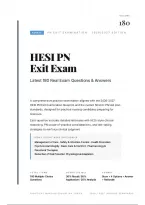
A GRA D E P N E X I T E X A M I N ATI O N · 2 0 2 0 2 7 E D I TI O N
HESI PN
Exit Exam
Latest 180 Real Exam Questions & Answers
A comprehensive practice examination aligned with the 2026-2027
HESI PN Exit Examination blueprint and the current NCLEX-PN test plan
standards, designed for practical nursing candidates preparing for
licensure.
Each question includes detailed rationales with HESI-style clinical
reasoning, PN scope-of-practice considerations, and test-taking
strategies to reinforce clinical judgment.
E I G H T C L I E N T N E E D C AT E G O R I E S
Management of Care · Safety & Infection Control · Health Promotion
Psychosocial Integrity · Basic Care & Comfort · Pharmacology &
Parenteral Therapies
Reduction of Risk Potential · Physiological Adaptation
T O TAL I T EMS CO GN I T I VE MI X F O R M AT
180 Multiple-Choice 30% Recall / 50% Stem + 4 Options + Answer
Questions Application / 20% Analysis + Rationale
P R A C T I C A L N U R S I N G E D U C AT I O N S E R I E S 2 0 2 0 2 7 U P D AT E D S T A N D A R D S
,HESI PN Exit Exam — 180 Questions & Answers | AGrade 2026/2027 Page 2
HESI PN Exit Exam
Latest 180 Real Exam Questions & Answers | AGrade | 2026/2027 Updated
This examination is structured into eight sections aligned with the NCLEX-PN test plan and the HESI PN Exit
Examination blueprint. Each question presents a clinical scenario followed by four options (A–D), the correct
answer, and a comprehensive rationale with HESI-style clinical reasoning and test-taking strategy notes. Cognitive
mix: 30% recall, 50% application, 20% analysis. Question count: 180.
SECTION 1: MANAGEMENT OF CARE
Advocacy, Delegation, Prioritization, Continuity of Care, Legal/Ethical Practice, & Case Management (Q1-Q22)
Q1. The PN is caring for four clients on a medical-surgical unit. Which client should the PN assess
FIRST?
A. A client receiving IV antibiotics who is 2 hours post-infusion complaining of mild itching at the IV site.
B. A client who is 2 days postoperative reporting incisional pain rated 6/10 after ambulation.
C. A client with chronic heart failure who has a respiratory rate of 32 and pink frothy sputum.
[CORRECT]
D. A client with type 2 diabetes whose blood glucose is 220 mg/dL 1 hour after eating.
Correct Answer: C. A client with chronic heart failure who has a respiratory rate of 32 and pink...
Rationale: Using the ABC priority-setting framework, the client with chronic heart failure exhibiting a
respiratory rate of 32 and pink frothy sputum is demonstrating signs of acute pulmonary edema, a
life-threatening condition requiring immediate intervention. Airway and breathing take priority over circulation
and comfort. Option A suggests a mild allergic response that should be monitored but is not immediately
life-threatening. Option B requires pain management but is stable. Option D reflects expected postprandial
hyperglycemia. Test-taking strategy: when a question asks which client to assess FIRST, identify the client with
the most acute threat to ABCs.
Q2. Which task is MOST appropriate for the PN to delegate to a Unlicensed Assistive Personnel
(UAP)?
A. Teaching a newly diagnosed diabetic client how to self-administer insulin.
B. Ambulating a stable client who is 3 days postoperative from an appendectomy. [CORRECT]
C. Assessing the wound of a client who had a surgical dehiscence repair.
D. Documenting the intake and output of a client receiving IV diuretics.
Correct Answer: B. Ambulating a stable client who is 3 days postoperative from an appendectomy.
Rationale: Ambulating a stable postoperative client is within the UAP scope of practice, as it involves routine
care for a client with a predictable condition. Option A requires initial teaching, which is the responsibility of
the RN (and beyond UAP scope). Option C requires wound assessment, a nursing assessment task that cannot be
delegated. Option D involves measurement but documentation of a client receiving IV diuretics requires
Practical Nursing Education Series · 2026/2027 Updated Standards AGRADE Practice Examination
,HESI PN Exit Exam — 180 Questions & Answers | AGrade 2026/2027 Page 3
interpretation of values by the nurse. Test-taking strategy: when delegating to UAP, choose tasks that involve
routine care of stable clients with predictable outcomes, and that do not require assessment, teaching, or clinical
judgment.
Q3. A PN is preparing to obtain informed consent from a client scheduled for an elective
cholecystectomy. The client states, "I'm not sure why I need this surgery." What is the MOST
appropriate action for the PN?
A. Witness the client's signature after the surgeon has explained the procedure.
B. Explain the surgical procedure, risks, and benefits to the client.
C. Notify the surgeon that the client needs further explanation before signing. [CORRECT]
D. Have the client sign the consent and document the client's statement.
Correct Answer: C. Notify the surgeon that the client needs further explanation before signing.
Rationale: Informed consent requires that the client fully understands the procedure, risks, benefits, and
alternatives before signing. The surgeon is responsible for providing this explanation, not the PN. When the
client expresses uncertainty, the PN must notify the surgeon so they can return and clarify. Option A is
premature since the client does not understand. Option B is outside the PN scope — only the provider
performing the procedure can legally obtain informed consent. Option D violates the principle of informed
consent. Test-taking strategy: the PN's role in consent is to witness the signature, ensure the client appears
competent, and notify the provider if the client has questions.
Q4. A PN overhears a colleague discussing a client's diagnosis in the hospital elevator. Which
action should the PN take FIRST?
A. Report the colleague to the charge nurse immediately.
B. Remind the colleague about client confidentiality and HIPAA regulations. [CORRECT]
C. Document the incident in the client's medical record.
D. File an incident report with the facility's privacy officer.
Correct Answer: B. Remind the colleague about client confidentiality and HIPAA regulations.
Rationale: The first action should be to directly address the colleague and remind them of HIPAA regulations
and client confidentiality. This is a professional responsibility to advocate for client privacy and provides an
opportunity for immediate correction of the behavior. If the behavior continues or involves a serious breach,
then reporting to the charge nurse or privacy officer would be appropriate. Option A and D may be necessary
later if the colleague does not respond. Option C is incorrect — incident documentation belongs in a separate
report, not the client's medical record. Test-taking strategy: when a colleague violates policy, address directly
first, then escalate if needed.
Q5. An older adult client with advanced dementia is admitted with pneumonia. The client's family
states the client would not want aggressive treatment. There is no advance directive on file. What
is the BEST action for the PN?
A. Respect the family's wishes and limit antibiotics to comfort measures only.
B. Initiate full treatment until an advance directive can be obtained.
C. Notify the healthcare provider and request a Do-Not-Resuscitate (DNR) order.
D. Continue prescribed treatment and notify social services for advance care planning. [CORRECT]
Practical Nursing Education Series · 2026/2027 Updated Standards AGRADE Practice Examination
, HESI PN Exit Exam — 180 Questions & Answers | AGrade 2026/2027 Page 4
Correct Answer: D. Continue prescribed treatment and notify social services for advance care pla...
Rationale: Without a written advance directive, the PN must continue prescribed treatment while advocating
for advance care planning. Option A is incorrect — without legal documentation, the family's verbal report
cannot override the treatment plan. Option B is partially correct but does not address the family's concerns.
Option C requires a physician's order and family/legal guardian consent. Option D is the most comprehensive —
continuing treatment while involving social services to facilitate advance care planning addresses both the legal
and ethical aspects. Test-taking strategy: when advance directives are absent, continue treatment while initiating
the process to establish the client's wishes through proper channels.
Q6. Which client should be assigned to the LPN/PN rather than the RN?
A. A client who is 6 hours post-coronary artery bypass graft with unstable vital signs.
B. A client admitted with acute gastrointestinal bleeding requiring fluid resuscitation.
C. A stable client receiving oral antibiotics for a urinary tract infection. [CORRECT]
D. A client newly diagnosed with heart failure requiring extensive teaching.
Correct Answer: C. A stable client receiving oral antibiotics for a urinary tract infection.
Rationale: The LPN/PN scope of practice includes caring for stable clients with predictable outcomes. A client
receiving oral antibiotics for a UTI is stable with an expected treatment trajectory. Option A involves a critically
ill postoperative client requiring frequent assessment and complex interventions — RN appropriate. Option B
involves an unstable client with active bleeding requiring RN-level care. Option D involves extensive teaching
for a new diagnosis, which is within the RN scope. Test-taking strategy: assign stable, predictable clients with
routine care needs to the LPN; reserve unstable, complex, or teaching-intensive clients for the RN.
Q7. A PN is caring for a client who is being discharged after a total hip replacement. Which
statement by the client indicates a need for further teaching PRIOR to discharge?
A. "I will use a raised toilet seat to prevent hip flexion beyond 90 degrees."
B. "I should sleep on my operative side with a pillow between my legs." [CORRECT]
C. "I will not cross my legs at the knees or ankles when sitting."
D. "I should avoid bending forward to put on my shoes and socks."
Correct Answer: B. "I should sleep on my operative side with a pillow between my legs."
Rationale: Sleeping on the operative side after a total hip replacement places the prosthesis at risk for
dislocation due to adduction and potential excessive flexion. Clients should sleep on the non-operative side with
a pillow between the legs to maintain abduction. Options A, C, and D all reflect correct hip precautions that
should be followed after hip replacement surgery. Test-taking strategy: in discharge teaching questions, identify
the statement that contradicts the established precautions — for hip replacement, avoid adduction (crossing
legs), flexion beyond 90 degrees, and sleeping on the operative side.
Q8. A PN suspects that a 4-year-old child brought to the clinic has signs of physical abuse. What is
the PRIORITY action for the PN?
A. Confront the parents about the suspected abuse.
B. Document the findings and report to Child Protective Services. [CORRECT]
C. Wait for additional evidence before taking action.
D. Discuss the suspicions with the healthcare provider only.
Practical Nursing Education Series · 2026/2027 Updated Standards AGRADE Practice Examination
180
A GRA D E P N E X I T E X A M I N ATI O N · 2 0 2 0 2 7 E D I TI O N
HESI PN
Exit Exam
Latest 180 Real Exam Questions & Answers
A comprehensive practice examination aligned with the 2026-2027
HESI PN Exit Examination blueprint and the current NCLEX-PN test plan
standards, designed for practical nursing candidates preparing for
licensure.
Each question includes detailed rationales with HESI-style clinical
reasoning, PN scope-of-practice considerations, and test-taking
strategies to reinforce clinical judgment.
E I G H T C L I E N T N E E D C AT E G O R I E S
Management of Care · Safety & Infection Control · Health Promotion
Psychosocial Integrity · Basic Care & Comfort · Pharmacology &
Parenteral Therapies
Reduction of Risk Potential · Physiological Adaptation
T O TAL I T EMS CO GN I T I VE MI X F O R M AT
180 Multiple-Choice 30% Recall / 50% Stem + 4 Options + Answer
Questions Application / 20% Analysis + Rationale
P R A C T I C A L N U R S I N G E D U C AT I O N S E R I E S 2 0 2 0 2 7 U P D AT E D S T A N D A R D S
,HESI PN Exit Exam — 180 Questions & Answers | AGrade 2026/2027 Page 2
HESI PN Exit Exam
Latest 180 Real Exam Questions & Answers | AGrade | 2026/2027 Updated
This examination is structured into eight sections aligned with the NCLEX-PN test plan and the HESI PN Exit
Examination blueprint. Each question presents a clinical scenario followed by four options (A–D), the correct
answer, and a comprehensive rationale with HESI-style clinical reasoning and test-taking strategy notes. Cognitive
mix: 30% recall, 50% application, 20% analysis. Question count: 180.
SECTION 1: MANAGEMENT OF CARE
Advocacy, Delegation, Prioritization, Continuity of Care, Legal/Ethical Practice, & Case Management (Q1-Q22)
Q1. The PN is caring for four clients on a medical-surgical unit. Which client should the PN assess
FIRST?
A. A client receiving IV antibiotics who is 2 hours post-infusion complaining of mild itching at the IV site.
B. A client who is 2 days postoperative reporting incisional pain rated 6/10 after ambulation.
C. A client with chronic heart failure who has a respiratory rate of 32 and pink frothy sputum.
[CORRECT]
D. A client with type 2 diabetes whose blood glucose is 220 mg/dL 1 hour after eating.
Correct Answer: C. A client with chronic heart failure who has a respiratory rate of 32 and pink...
Rationale: Using the ABC priority-setting framework, the client with chronic heart failure exhibiting a
respiratory rate of 32 and pink frothy sputum is demonstrating signs of acute pulmonary edema, a
life-threatening condition requiring immediate intervention. Airway and breathing take priority over circulation
and comfort. Option A suggests a mild allergic response that should be monitored but is not immediately
life-threatening. Option B requires pain management but is stable. Option D reflects expected postprandial
hyperglycemia. Test-taking strategy: when a question asks which client to assess FIRST, identify the client with
the most acute threat to ABCs.
Q2. Which task is MOST appropriate for the PN to delegate to a Unlicensed Assistive Personnel
(UAP)?
A. Teaching a newly diagnosed diabetic client how to self-administer insulin.
B. Ambulating a stable client who is 3 days postoperative from an appendectomy. [CORRECT]
C. Assessing the wound of a client who had a surgical dehiscence repair.
D. Documenting the intake and output of a client receiving IV diuretics.
Correct Answer: B. Ambulating a stable client who is 3 days postoperative from an appendectomy.
Rationale: Ambulating a stable postoperative client is within the UAP scope of practice, as it involves routine
care for a client with a predictable condition. Option A requires initial teaching, which is the responsibility of
the RN (and beyond UAP scope). Option C requires wound assessment, a nursing assessment task that cannot be
delegated. Option D involves measurement but documentation of a client receiving IV diuretics requires
Practical Nursing Education Series · 2026/2027 Updated Standards AGRADE Practice Examination
,HESI PN Exit Exam — 180 Questions & Answers | AGrade 2026/2027 Page 3
interpretation of values by the nurse. Test-taking strategy: when delegating to UAP, choose tasks that involve
routine care of stable clients with predictable outcomes, and that do not require assessment, teaching, or clinical
judgment.
Q3. A PN is preparing to obtain informed consent from a client scheduled for an elective
cholecystectomy. The client states, "I'm not sure why I need this surgery." What is the MOST
appropriate action for the PN?
A. Witness the client's signature after the surgeon has explained the procedure.
B. Explain the surgical procedure, risks, and benefits to the client.
C. Notify the surgeon that the client needs further explanation before signing. [CORRECT]
D. Have the client sign the consent and document the client's statement.
Correct Answer: C. Notify the surgeon that the client needs further explanation before signing.
Rationale: Informed consent requires that the client fully understands the procedure, risks, benefits, and
alternatives before signing. The surgeon is responsible for providing this explanation, not the PN. When the
client expresses uncertainty, the PN must notify the surgeon so they can return and clarify. Option A is
premature since the client does not understand. Option B is outside the PN scope — only the provider
performing the procedure can legally obtain informed consent. Option D violates the principle of informed
consent. Test-taking strategy: the PN's role in consent is to witness the signature, ensure the client appears
competent, and notify the provider if the client has questions.
Q4. A PN overhears a colleague discussing a client's diagnosis in the hospital elevator. Which
action should the PN take FIRST?
A. Report the colleague to the charge nurse immediately.
B. Remind the colleague about client confidentiality and HIPAA regulations. [CORRECT]
C. Document the incident in the client's medical record.
D. File an incident report with the facility's privacy officer.
Correct Answer: B. Remind the colleague about client confidentiality and HIPAA regulations.
Rationale: The first action should be to directly address the colleague and remind them of HIPAA regulations
and client confidentiality. This is a professional responsibility to advocate for client privacy and provides an
opportunity for immediate correction of the behavior. If the behavior continues or involves a serious breach,
then reporting to the charge nurse or privacy officer would be appropriate. Option A and D may be necessary
later if the colleague does not respond. Option C is incorrect — incident documentation belongs in a separate
report, not the client's medical record. Test-taking strategy: when a colleague violates policy, address directly
first, then escalate if needed.
Q5. An older adult client with advanced dementia is admitted with pneumonia. The client's family
states the client would not want aggressive treatment. There is no advance directive on file. What
is the BEST action for the PN?
A. Respect the family's wishes and limit antibiotics to comfort measures only.
B. Initiate full treatment until an advance directive can be obtained.
C. Notify the healthcare provider and request a Do-Not-Resuscitate (DNR) order.
D. Continue prescribed treatment and notify social services for advance care planning. [CORRECT]
Practical Nursing Education Series · 2026/2027 Updated Standards AGRADE Practice Examination
, HESI PN Exit Exam — 180 Questions & Answers | AGrade 2026/2027 Page 4
Correct Answer: D. Continue prescribed treatment and notify social services for advance care pla...
Rationale: Without a written advance directive, the PN must continue prescribed treatment while advocating
for advance care planning. Option A is incorrect — without legal documentation, the family's verbal report
cannot override the treatment plan. Option B is partially correct but does not address the family's concerns.
Option C requires a physician's order and family/legal guardian consent. Option D is the most comprehensive —
continuing treatment while involving social services to facilitate advance care planning addresses both the legal
and ethical aspects. Test-taking strategy: when advance directives are absent, continue treatment while initiating
the process to establish the client's wishes through proper channels.
Q6. Which client should be assigned to the LPN/PN rather than the RN?
A. A client who is 6 hours post-coronary artery bypass graft with unstable vital signs.
B. A client admitted with acute gastrointestinal bleeding requiring fluid resuscitation.
C. A stable client receiving oral antibiotics for a urinary tract infection. [CORRECT]
D. A client newly diagnosed with heart failure requiring extensive teaching.
Correct Answer: C. A stable client receiving oral antibiotics for a urinary tract infection.
Rationale: The LPN/PN scope of practice includes caring for stable clients with predictable outcomes. A client
receiving oral antibiotics for a UTI is stable with an expected treatment trajectory. Option A involves a critically
ill postoperative client requiring frequent assessment and complex interventions — RN appropriate. Option B
involves an unstable client with active bleeding requiring RN-level care. Option D involves extensive teaching
for a new diagnosis, which is within the RN scope. Test-taking strategy: assign stable, predictable clients with
routine care needs to the LPN; reserve unstable, complex, or teaching-intensive clients for the RN.
Q7. A PN is caring for a client who is being discharged after a total hip replacement. Which
statement by the client indicates a need for further teaching PRIOR to discharge?
A. "I will use a raised toilet seat to prevent hip flexion beyond 90 degrees."
B. "I should sleep on my operative side with a pillow between my legs." [CORRECT]
C. "I will not cross my legs at the knees or ankles when sitting."
D. "I should avoid bending forward to put on my shoes and socks."
Correct Answer: B. "I should sleep on my operative side with a pillow between my legs."
Rationale: Sleeping on the operative side after a total hip replacement places the prosthesis at risk for
dislocation due to adduction and potential excessive flexion. Clients should sleep on the non-operative side with
a pillow between the legs to maintain abduction. Options A, C, and D all reflect correct hip precautions that
should be followed after hip replacement surgery. Test-taking strategy: in discharge teaching questions, identify
the statement that contradicts the established precautions — for hip replacement, avoid adduction (crossing
legs), flexion beyond 90 degrees, and sleeping on the operative side.
Q8. A PN suspects that a 4-year-old child brought to the clinic has signs of physical abuse. What is
the PRIORITY action for the PN?
A. Confront the parents about the suspected abuse.
B. Document the findings and report to Child Protective Services. [CORRECT]
C. Wait for additional evidence before taking action.
D. Discuss the suspicions with the healthcare provider only.
Practical Nursing Education Series · 2026/2027 Updated Standards AGRADE Practice Examination


