
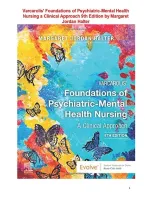
Varcarolis' Foundations of Psychiatric-Mental Health Nursing: A Clinical Approach 9th Edition by Margaret Jordan Halter
Prepare for psychiatric-mental health nursing coursework with a comprehensive study resource based on Varcarolis' Foundations of Psychiatric-Mental Health Nursing: A Clinical Approach, 9th Edition by Margaret Jordan Halter. This resource is designed to help nursing students review essential psychiatric nursing concepts, strengthen clinical reasoning, reinforce therapeutic communication skills, and prepare for nursing school examinations. Psychiatric-mental health nursing requires a combination of theoretical knowledge, clinical judgment, communication skills, assessment abilities, and compassionate patient care. Students must understand mental health conditions while also learning how to establish therapeutic relationships, recognize changes in behavior, identify safety concerns, administer medications appropriately, and provide evidence-informed nursing interventions. This study resource provides opportunities to review these important areas through question-based learning and focused examination preparation. Comprehensive Psychiatric-Mental Health Nursing Review The material is suitable for reviewing fundamental concepts associated with psychiatric and mental health nursing. Students can use it to reinforce knowledge of mental health assessment, therapeutic communication, psychiatric disorders, treatment approaches, psychopharmacology, patient safety, and nursing interventions. Important areas of study may include anxiety-related conditions, mood disorders, psychotic disorders, personality disorders, substance-related disorders, trauma-related conditions, neurocognitive disorders, eating disorders, and other behavioral health concerns. By working through practice questions and reviewing explanations, students can strengthen their ability to connect theoretical concepts with practical nursing care. Therapeutic Communication Practice Communication is one of the most important skills in psychiatric nursing. Nurses must communicate in ways that promote trust, respect, safety, and patient participation. This resource can help students practice identifying therapeutic versus nontherapeutic communication techniques. Questions may encourage learners to consider appropriate responses to patients experiencing anxiety, depression, hallucinations, delusions, grief, anger, fear, or other emotional challenges. Students can review concepts such as active listening, open-ended questions, reflection, clarification, restatement, silence, validation, empathy, boundaries, and professional communication. Psychiatric Assessment and Clinical Judgment Effective psychiatric nursing begins with accurate assessment. Nurses must observe behavior, assess mood and affect, identify thought processes, evaluate cognition, assess risk, and recognize changes that may require immediate intervention. Practice questions can help students develop clinical judgment by asking them to distinguish significant assessment findings from expected findings and determine appropriate nursing responses. Learners can practice asking: What is the most important assessment finding? Does the patient present an immediate safety concern? What should the nurse assess first? Which response promotes therapeutic communication? What intervention is most appropriate? What patient behavior requires additional evaluation? Which finding should be reported? What patient education is appropriate? These approaches can help students become more confident when working through psychiatric nursing scenarios. Psychopharmacology Review Psychiatric medications are an important component of mental health nursing. Nurses need to understand medication indications, common adverse effects, safety considerations, patient education, and appropriate monitoring. This study resource can support review of major medication categories commonly encountered in psychiatric nursing, including antidepressants, antipsychotics, mood stabilizers, anxiolytics, sedative-hypnotic medications, and other relevant therapies. Students can use practice questions to reinforce medication-related concepts and connect pharmacological treatment with patient assessment and nursing responsibilities. Patient Safety and Crisis Management Safety is a central priority in psychiatric nursing. Nurses may care for patients experiencing suicidal thoughts, self-harm behaviors, aggression, severe anxiety, psychosis, substance withdrawal, or other situations requiring careful assessment and intervention. Practice-based learning can help students review principles related to risk assessment, environmental safety, observation, therapeutic interventions, crisis management, and appropriate escalation of care. Understanding when a patient requires immediate intervention is an essential part of psychiatric nursing clinical judgment. Mental Health Conditions and Nursing Care The resource can be used to review nursing considerations for a wide variety of psychiatric and behavioral health conditions. Potential study areas include: Anxiety disorders Depressive disorders Bipolar and related disorders Schizophrenia and other psychotic disorders Personality disorders Trauma- and stressor-related disorders Obsessive-compulsive and related disorders Substance use and substance-related disorders Eating disorders Neurocognitive disorders Sleep-related concerns Grief and loss Crisis and emergency psychiatric care Child and adolescent mental health Older-adult psychiatric care Community mental health nursing Clinical Application Psychiatric nursing concepts are most useful when students understand how they apply to real patient situations. Question-based study provides opportunities to connect assessment findings, diagnoses, communication techniques, medications, and nursing interventions. Instead of memorizing isolated facts, students can focus on understanding why a particular intervention is appropriate and how patient responses influence the next nursing action. This approach can also support preparation for clinical rotations by reinforcing professional boundaries, therapeutic relationships, patient education, documentation, safety principles, and ethical nursing practice. Useful for Nursing Students This resource can be incorporated into a variety of study schedules. Students may use it for daily review, chapter-by-chapter preparation, examination practice, group study, or final review before a psychiatric-mental health nursing assessment. A useful strategy is to complete a set of practice questions, identify incorrect responses, review the underlying concepts, and then return to similar questions later. Students can maintain a list of challenging topics and use their textbook, class notes, instructor materials, and other authorized resources to strengthen those areas. Develop Stronger Test-Taking Skills Psychiatric nursing questions frequently require careful interpretation of patient statements and clinical situations. Students may need to determine the most therapeutic response, identify the priority nursing intervention, recognize a safety concern, or select the finding that requires further assessment. Practice can help learners become more comfortable identifying keywords and distinguishing between answers that appear reasonable but have different levels of priority. Students can practice: Reading the entire scenario carefully. Identifying the patient's primary concern. Determining whether there is an immediate safety issue. Distinguishing assessment from intervention. Applying therapeutic communication principles. Considering the nursing process. Eliminating clearly inappropriate responses. Selecting the response that best supports safe, patient-centered care. Academic Study Resource This product is intended as a study and examination-preparation resource. It should be used alongside the official textbook, course materials, instructor guidance, and other authorized educational resources. The goal is to help students reinforce psychiatric-mental health nursing knowledge, practice clinical reasoning, identify knowledge gaps, and become more comfortable applying concepts to patient-care situations. Whether you are beginning your psychiatric nursing course or preparing for a major examination, structured practice can make review more focused and productive. Product Highlights Based on Varcarolis' psychiatric-mental health nursing subject area 9th Edition study support Author: Margaret Jordan Halter Psychiatric nursing practice questions Mental health assessment review Therapeutic communication practice Psychiatric medication review Patient safety concepts Clinical judgment and prioritization Mental health disorders review Nursing interventions Crisis management concepts Patient education Suitable for nursing students Useful for independent or group study Designed to complement authorized course materials Suggested Study Approach For effective preparation, students should avoid relying solely on memorizing answers. Instead, read each question carefully, identify the concept being tested, determine the most appropriate nursing response, and explain why the selected option is appropriate. Review missed questions and return to the underlying psychiatric nursing concept. Combining practice questions with textbook reading, active recall, medication review, therapeutic communication practice, and clinical scenarios can provide a more comprehensive study experience.
Document information
- Uploaded on
- September 28, 2026
- Number of pages
- 472
- Written in
- 2026/2027
- Type
- Exam (elaborations)
- Contains
- Questions & answers


