
Rasmussen Mental Health Exam 2 – 70-Question Test Bank Updated 2026/2027 – Complete Solution
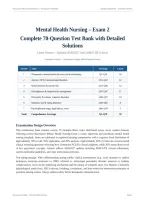
Mental Health Nursing – Exam 2
Complete 70-Question Test Bank with Detailed
Solutions
Latest Version – Updated 2026/2027 with DSM-5-TR Criteria
Complete Solution | Rasmussen College Mental Health Nursing
Section Topic Q Range Count
1 Therapeutic communication & nurse-client relationship Q1–Q10 10
2 Anxiety, OCD, trauma-related disorders Q11–Q22 12
3 Mood disorders & suicide risk Q23–Q36 14
4 Schizophrenia & antipsychotic management Q37–Q47 11
5 Personality & somatic symptom disorders Q48–Q57 10
6 Substance use & eating disorders Q58–Q65 8
7 Psychopharmacology, legal/ethical, crisis Q66–Q70 5
Total Comprehensive Coverage Q1–Q70 70
Examination Design Overview
This examination bank contains exactly 70 multiple-choice items distributed across seven content domains
reflecting current Rasmussen Mental Health Nursing Exam 2 course objectives and psychiatric-mental health
nursing standards. Items are calibrated to registered nursing competencies with a cognitive level distribution of
approximately 30% recall, 50% application, and 20% analysis. Approximately 80% of items are scenario-based
clinical reasoning questions reflecting Next Generation NCLEX clinical judgment, while 20% assess direct recall
of key psychiatric concepts. Content reflects 2026/2027 updates including DSM-5-TR criteria refinements,
current medication guidelines, and crisis intervention protocols.
Test-taking strategy: When differentiating among similar clinical presentations (e.g., acute dystonia vs. tardive
dyskinesia, serotonin syndrome vs. NMS, schizoid vs. schizotypal personality disorder, anorexia vs. bulimia
complications), focus on the underlying mechanism and the timing of symptom onset. Use Maslow’s hierarchy
(physiological needs first), ABCs (airway, breathing, circulation), and least-restrictive intervention principles to
prioritize nursing actions. Always address safety before therapeutic communication.
Rasmussen College – Mental Health Nursing Page 1
,Rasmussen Mental Health Exam 2 – 70-Question Test Bank Updated 2026/2027 – Complete Solution
Section 1: Therapeutic Communication and the Nurse-Client Relationship
Techniques, Barriers, Boundaries, Transference, & Countertransference — Questions Q1–Q10
A client newly admitted for depression says to the nurse, "There’s no point in talking to you. Nobody really
understands me anyway." Which response by the nurse best demonstrates the therapeutic communication
technique of active listening combined with offering self?
A. I understand how you feel. I have days like that too.
B. You sound discouraged. I’ll sit here with you for a while; you can talk whenever you’re ready.
[CORRECT]
C. Why do you think nobody understands you? Tell me more about that.
D. You should not give up. Therapy really does work, you know.
Correct Answer: B
Rationale: The nurse uses reflection ("You sound discouraged") to acknowledge the client’s feeling without judgment,
and offering self ("I’ll sit here with you") communicates availability and unconditional positive regard. This combination
of active listening and offering self builds trust and encourages the client to share at their own pace. Option A is false
reassurance and shifts focus to the nurse. Option C is "why," which can feel interrogational. Option D gives advice and
minimizes the client’s experience — both are non-therapeutic.
A client states, "I’m so angry at my husband for leaving me." Which response by the nurse demonstrates
the technique of restating?
A. You’re angry at your husband for leaving you. [CORRECT]
B. Why are you angry at your husband?
C. It sounds like you’re feeling abandoned.
D. You shouldn’t be angry. He’s not worth your energy.
Correct Answer: A
Rationale: Restating (also called paraphrasing) repeats the client’s main idea in similar words to confirm understanding
and encourage elaboration. Option A exactly mirrors the client’s statement, validating the feeling and inviting the client to
continue. Option B uses "why," which is non-therapeutic. Option C is reflection of feeling (a related but distinct
technique). Option D gives advice and judges the client’s emotion — both are non-therapeutic and shut down
communication.
A client says, "Sometimes I think everyone would be better off without me." Which response by the nurse
best uses the technique of clarification?
A. Are you saying you want to hurt yourself?
B. Tell me more about what you mean by "better off without you." [CORRECT]
C. Don’t talk like that. Your family loves you.
D. I know exactly how you feel. I’ve had thoughts like that too.
Correct Answer: B
Rationale: Clarification seeks to better understand an ambiguous or potentially significant statement before responding.
Because the client’s statement may indicate suicidal ideation, the nurse clarifies meaning before assuming intent. Option A
makes an assumption ("Are you saying you want to hurt yourself?") that closes exploration; better phrasing is open-ended
clarification. Option C is false reassurance. Option D shifts the focus to the nurse (self-disclosure), which is
non-therapeutic in this high-risk situation. Always directly assess suicidal ideation — the open clarification in Option B
best supports that follow-up.
Rasmussen College – Mental Health Nursing Page 2
, Rasmussen Mental Health Exam 2 – 70-Question Test Bank Updated 2026/2027 – Complete Solution
A client diagnosed with terminal cancer says, "I just don’t know how my family will manage without me."
Which response demonstrates offering self?
A. I will personally make sure your family is taken care of.
B. I’m here for you. Would you like to talk about your concerns for your family? [CORRECT]
C. Your family will be fine; they’re stronger than you think.
D. You should focus on yourself right now.
Correct Answer: B
Rationale: Offering self communicates "I am available to you" without making unrealistic promises. Option B
communicates presence and invites the client to share. Option A is an inappropriate promise the nurse cannot realistically
fulfill. Option C is false reassurance that minimizes the client’s concern. Option D changes the subject and dismisses the
client’s expressed need to process their family’s future.
A client expresses anxiety about an upcoming procedure, stating, "I’m scared it will hurt." Which
response by the nurse is an example of false reassurance (a non-therapeutic barrier)?
A. Tell me more about what you’re worried might happen.
B. Don’t worry. Everything will be just fine; you’ll see. [CORRECT]
C. What have you found helpful in the past when you’ve felt scared?
D. It sounds like you’re worried about pain during the procedure.
Correct Answer: B
Rationale: False reassurance offers cheery, unsupported guarantees ("Everything will be just fine") that minimize the
client’s feelings and shut down further expression. It is a non-therapeutic communication barrier because it dismisses real
concerns and undermines trust if outcomes are unfavorable. Options A, C, and D use therapeutic techniques (exploring,
focusing on coping, and reflection). The nurse should acknowledge the fear and provide accurate information or invite the
client to elaborate.
A client with newly diagnosed diabetes asks the nurse, "Should I stop eating all carbohydrates?" Which is
the most therapeutic response?
A. Yes, you should eliminate all carbs from your diet.
B. That’s a medical question for your provider; I’ll have them talk to you.
C. Let’s review what you’ve learned about carbohydrates and diabetes, and then we can decide together
what questions to ask the dietitian. [CORRECT]
D. Why would you want to do that?
Correct Answer: C
Rationale: Giving advice (Option A) is non-therapeutic and may be unsafe because carbohydrate restriction requires
individualized medical guidance. Option B dismisses the client and fails to provide education. Option D uses "why," which
can feel judgmental. Option C demonstrates collaborative problem-solving, encourages client involvement, and reinforces
education — therapeutic techniques consistent with the nurse’s role in teaching and advocacy.
Rasmussen College – Mental Health Nursing Page 3
Mental Health Nursing – Exam 2
Complete 70-Question Test Bank with Detailed
Solutions
Latest Version – Updated 2026/2027 with DSM-5-TR Criteria
Complete Solution | Rasmussen College Mental Health Nursing
Section Topic Q Range Count
1 Therapeutic communication & nurse-client relationship Q1–Q10 10
2 Anxiety, OCD, trauma-related disorders Q11–Q22 12
3 Mood disorders & suicide risk Q23–Q36 14
4 Schizophrenia & antipsychotic management Q37–Q47 11
5 Personality & somatic symptom disorders Q48–Q57 10
6 Substance use & eating disorders Q58–Q65 8
7 Psychopharmacology, legal/ethical, crisis Q66–Q70 5
Total Comprehensive Coverage Q1–Q70 70
Examination Design Overview
This examination bank contains exactly 70 multiple-choice items distributed across seven content domains
reflecting current Rasmussen Mental Health Nursing Exam 2 course objectives and psychiatric-mental health
nursing standards. Items are calibrated to registered nursing competencies with a cognitive level distribution of
approximately 30% recall, 50% application, and 20% analysis. Approximately 80% of items are scenario-based
clinical reasoning questions reflecting Next Generation NCLEX clinical judgment, while 20% assess direct recall
of key psychiatric concepts. Content reflects 2026/2027 updates including DSM-5-TR criteria refinements,
current medication guidelines, and crisis intervention protocols.
Test-taking strategy: When differentiating among similar clinical presentations (e.g., acute dystonia vs. tardive
dyskinesia, serotonin syndrome vs. NMS, schizoid vs. schizotypal personality disorder, anorexia vs. bulimia
complications), focus on the underlying mechanism and the timing of symptom onset. Use Maslow’s hierarchy
(physiological needs first), ABCs (airway, breathing, circulation), and least-restrictive intervention principles to
prioritize nursing actions. Always address safety before therapeutic communication.
Rasmussen College – Mental Health Nursing Page 1
,Rasmussen Mental Health Exam 2 – 70-Question Test Bank Updated 2026/2027 – Complete Solution
Section 1: Therapeutic Communication and the Nurse-Client Relationship
Techniques, Barriers, Boundaries, Transference, & Countertransference — Questions Q1–Q10
A client newly admitted for depression says to the nurse, "There’s no point in talking to you. Nobody really
understands me anyway." Which response by the nurse best demonstrates the therapeutic communication
technique of active listening combined with offering self?
A. I understand how you feel. I have days like that too.
B. You sound discouraged. I’ll sit here with you for a while; you can talk whenever you’re ready.
[CORRECT]
C. Why do you think nobody understands you? Tell me more about that.
D. You should not give up. Therapy really does work, you know.
Correct Answer: B
Rationale: The nurse uses reflection ("You sound discouraged") to acknowledge the client’s feeling without judgment,
and offering self ("I’ll sit here with you") communicates availability and unconditional positive regard. This combination
of active listening and offering self builds trust and encourages the client to share at their own pace. Option A is false
reassurance and shifts focus to the nurse. Option C is "why," which can feel interrogational. Option D gives advice and
minimizes the client’s experience — both are non-therapeutic.
A client states, "I’m so angry at my husband for leaving me." Which response by the nurse demonstrates
the technique of restating?
A. You’re angry at your husband for leaving you. [CORRECT]
B. Why are you angry at your husband?
C. It sounds like you’re feeling abandoned.
D. You shouldn’t be angry. He’s not worth your energy.
Correct Answer: A
Rationale: Restating (also called paraphrasing) repeats the client’s main idea in similar words to confirm understanding
and encourage elaboration. Option A exactly mirrors the client’s statement, validating the feeling and inviting the client to
continue. Option B uses "why," which is non-therapeutic. Option C is reflection of feeling (a related but distinct
technique). Option D gives advice and judges the client’s emotion — both are non-therapeutic and shut down
communication.
A client says, "Sometimes I think everyone would be better off without me." Which response by the nurse
best uses the technique of clarification?
A. Are you saying you want to hurt yourself?
B. Tell me more about what you mean by "better off without you." [CORRECT]
C. Don’t talk like that. Your family loves you.
D. I know exactly how you feel. I’ve had thoughts like that too.
Correct Answer: B
Rationale: Clarification seeks to better understand an ambiguous or potentially significant statement before responding.
Because the client’s statement may indicate suicidal ideation, the nurse clarifies meaning before assuming intent. Option A
makes an assumption ("Are you saying you want to hurt yourself?") that closes exploration; better phrasing is open-ended
clarification. Option C is false reassurance. Option D shifts the focus to the nurse (self-disclosure), which is
non-therapeutic in this high-risk situation. Always directly assess suicidal ideation — the open clarification in Option B
best supports that follow-up.
Rasmussen College – Mental Health Nursing Page 2
, Rasmussen Mental Health Exam 2 – 70-Question Test Bank Updated 2026/2027 – Complete Solution
A client diagnosed with terminal cancer says, "I just don’t know how my family will manage without me."
Which response demonstrates offering self?
A. I will personally make sure your family is taken care of.
B. I’m here for you. Would you like to talk about your concerns for your family? [CORRECT]
C. Your family will be fine; they’re stronger than you think.
D. You should focus on yourself right now.
Correct Answer: B
Rationale: Offering self communicates "I am available to you" without making unrealistic promises. Option B
communicates presence and invites the client to share. Option A is an inappropriate promise the nurse cannot realistically
fulfill. Option C is false reassurance that minimizes the client’s concern. Option D changes the subject and dismisses the
client’s expressed need to process their family’s future.
A client expresses anxiety about an upcoming procedure, stating, "I’m scared it will hurt." Which
response by the nurse is an example of false reassurance (a non-therapeutic barrier)?
A. Tell me more about what you’re worried might happen.
B. Don’t worry. Everything will be just fine; you’ll see. [CORRECT]
C. What have you found helpful in the past when you’ve felt scared?
D. It sounds like you’re worried about pain during the procedure.
Correct Answer: B
Rationale: False reassurance offers cheery, unsupported guarantees ("Everything will be just fine") that minimize the
client’s feelings and shut down further expression. It is a non-therapeutic communication barrier because it dismisses real
concerns and undermines trust if outcomes are unfavorable. Options A, C, and D use therapeutic techniques (exploring,
focusing on coping, and reflection). The nurse should acknowledge the fear and provide accurate information or invite the
client to elaborate.
A client with newly diagnosed diabetes asks the nurse, "Should I stop eating all carbohydrates?" Which is
the most therapeutic response?
A. Yes, you should eliminate all carbs from your diet.
B. That’s a medical question for your provider; I’ll have them talk to you.
C. Let’s review what you’ve learned about carbohydrates and diabetes, and then we can decide together
what questions to ask the dietitian. [CORRECT]
D. Why would you want to do that?
Correct Answer: C
Rationale: Giving advice (Option A) is non-therapeutic and may be unsafe because carbohydrate restriction requires
individualized medical guidance. Option B dismisses the client and fails to provide education. Option D uses "why," which
can feel judgmental. Option C demonstrates collaborative problem-solving, encourages client involvement, and reinforces
education — therapeutic techniques consistent with the nurse’s role in teaching and advocacy.
Rasmussen College – Mental Health Nursing Page 3


