This Oncology 2026/2027 study guide is a focused 9-page exam review covering fundamental concepts in cancer biology, neoplasia, tumor classification, cellular abnormalities, staging and grading, carcinogenesis, metastasis, cancer prevention and treatment. The opening material defines oncology, cancer/neoplasia and tumors before reviewing hyperplasia, dysplasia, metaplasia and anaplasia. It also examines stem and progenitor cells and characterizes cancer growth as autonomous, excessive and disorganized. Oncology 2021
A major section compares benign and malignant tumors and introduces terminology used to classify cancers by cell type and tissue of origin. Students review carcinomas, sarcomas, lymphomas and leukemias, followed by the document's presentation of the TNM staging system, where T relates to the primary tumor, N to regional lymph-node involvement and M to distant metastasis. Tumor grading is also addressed through levels of cellular differentiation. The source additionally discusses common cancers in men and women and identifies lung cancer as having the highest mortality rate within its review material. Oncology 2021
The guide then examines cancer etiology and pathogenesis, including exogenous carcinogenic influences, endogenous genomic factors, oncogenes and tumor-suppressor genes. Risk factors presented in the material include heredity, hormones, immune mechanisms, age, precancerous lesions, geographic and demographic factors, obesity, stress, smoking and viruses. Students also review the C.A.U.T.I.O.N. warning-sign mnemonic, along with local and systemic manifestations of malignancy, cancer-related pain and fatigue, angiogenesis and the nutritional effects associated with cancer. Oncology 2021
Another important section covers metastasis, diagnosis and cancer prevention. The source describes metastatic spread through blood, lymph and direct extension and lists the lungs, liver, brain and bones among common metastatic locations. It distinguishes primary from secondary tumors and reviews diagnostic approaches involving blood, urine, stool and other body fluids, biopsy, visualization and radiography. Prevention is organized into primary prevention through reducing carcinogen exposure, secondary prevention through screening and early detection, and tertiary prevention once cancer is already present. Oncology 2021
The final pages focus on oncology treatment and disease course. Students review curative versus palliative treatment and major therapeutic approaches including surgery, chemotherapy, radiation, biotherapy/immunotherapy and hormonal therapy. The guide discusses treatment effects on bone marrow, the immune and gastrointestinal systems, skin and hair, and concludes with terminology concerning acute and subacute cancer, remission and cure. It also contains course-specific statements concerning physical-therapy modalities such as electrical stimulation, ultrasound and heat in patients with cancer; these should be studied as the document presents them rather than treated as independently verified clinical guidance. Oncology 2021
Relevant students: This resource is relevant to oncology students, nursing students, medical-surgical nursing students, physical therapy and rehabilitation students, pathophysiology students, allied-health learners and healthcare students preparing for examinations on cancer biology and treatment. It is particularly useful for learners reviewing neoplasia, benign versus malignant tumors, TNM staging, tumor grading, carcinogenesis, metastasis, cancer prevention, chemotherapy and radiation therapy. The uploaded document does not identify a course code or university/institution, so adding those details to the title would require unsupported information. Oncology 2021
Keywords: oncology 2026, oncology 2027, oncology questions and answers, oncology exam review, cancer biology, cancer pathophysiology, neoplasia questions, benign and malignant tumors, hyperplasia dysplasia metaplasia anaplasia, tumor classification, carcinoma sarcoma lymphoma leukemia, TNM staging, cancer staging questions, tumor grading, cancer etiology, carcinogenesis, oncogenes, tumor suppressor genes, cancer risk factors, CAUTION cancer warning signs, cancer manifestations, cancer related fatigue, cancer pain, metastasis, primary and secondary tumors, cancer diagnosis, cancer prevention, primary secondary tertiary prevention, cancer treatment, chemotherapy questions, radiation therapy questions, biotherapy cancer, immunotherapy cancer, hormonal therapy cancer, curative and palliative treatment, cancer remission, oncology study guide, medical surgical nursing oncology, pathophysiology cancer exam
Content preview
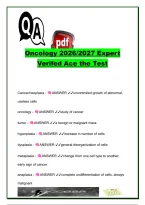
Oncology 2026/2027 Expert
Verifed Ace the Test
Cancer/neoplasia - ANSWER ✔✔uncontrolled growth of abnormal,
useless cells
oncology - ANSWER ✔✔study of cancer
tumor - ANSWER ✔✔a benign or maignant mass
hyperplasia - ANSWER ✔✔increase in number of cells
dysplasia - ANSWER ✔✔general disorganization of cells
metaplasia - ANSWER ✔✔change from one cell type to another;
early sign of cancer
anaplasia - ANSWER ✔✔complete undifferentiation of cells, always
malignant
, stem cells and progenitor cells - ANSWER ✔✔undifferentiated cells
that mitotically divide
cancer growth is: - ANSWER ✔✔autonomous, excessive,
disorganized
autonomous cancer growth - ANSWER ✔✔cancer doesn't need
signal to grow
excessive cancer growth - ANSWER ✔✔nothing limits the growth of
cancer
disorganized cancer growth - ANSWER ✔✔growth does not look like
original cell
ways to classify tumors - ANSWER ✔✔cell type, tissue of origin,
degree of differentiation, clinical presentation, histologic presentation
benign tumors - ANSWER ✔✔remain localized, grow slower, do no
infiltrate other tissues or metastasize to distal sites, generally easy to
remove (remain encapsulated), cells remain well differentiated (retaining
some original structure and function), cells are more homogenous,
normal number of chromosomes
malignant tumors - ANSWER ✔✔more rapid growth, can infiltrate
and/or metastasize, nonencapsulated (legs, no borders), cells are more