
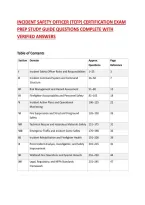
INCIDENT SAFETY OFFICER (TCFP) CERTIFICATION EXAM
PREP STUDY GUIDE QUESTIONS COMPLETE WITH
VERIFIED ANSWERS
Table of Contents
Section Domain Approx. Page
Questions Reference
I Incident Safety Officer Roles and Responsibilities 1–25 3
II Incident Command System and Command 26–50 7
Structure
III Risk Management and Hazard Assessment 51–80 12
IV Firefighter Accountability and Personnel Safety 81–105 18
V Incident Action Plans and Operational 106–125 22
Monitoring
VI Fire Suppression and Structural Fireground 126–150 26
Safety
VII Technical Rescue and Hazardous Materials Safety 151–175 31
VIII Emergency Traffic and Incident Scene Safety 176–190 36
IX Incident Rehabilitation and Firefighter Health 191–200 39
X Post-Incident Analysis, Investigation, and Safety 201–215 41
Improvement
XI Wildland Fire Operations and Special Hazards 216–230 44
XII Legal, Regulatory, and NFPA Standards 231–245 47
Framework
,Section I: Incident Safety Officer Roles and Responsibilities (Questions
1–25)
1. Which NFPA standard establishes the requirements for the Incident
Safety Officer within the incident management system?
A. NFPA 1500
B. NFPA 1026
C. NFPA 1521
D. NFPA 1561
Correct Answer: D) NFPA 1561
Rationale: NFPA 1561, Standard on Emergency Services Incident
Management System and Command Safety, defines the ISO role within
the incident management system, including duties related to
monitoring safety hazards and developing measures to ensure
personnel safety.
2. Whose primary responsibility is it to focus on scene-specific
operations and safety?
A. The Incident Commander
B. The Incident Safety Officer (ISO)
C. The Health and Safety Officer (HSO)
D. The Safety Committee Chair
Correct Answer: B) The Incident Safety Officer (ISO)
Rationale: The ISO is specifically tasked with scene-specific safety
operations, while the HSO manages the broader department health and
safety program.
3. Which NFPA standard currently sets the ISO qualifications for NIMS
safety officers?
A. NFPA 1561
,B. NFPA 1026
C. NFPA 1500
D. NFPA 1521
Correct Answer: B) NFPA 1026
Rationale: NFPA 1026, Standard for Incident Management Personnel
Professional Qualifications, outlines the qualifications for NIMS safety
officers.
4. The division of the safety officer role into HSO and ISO was written
into which NFPA standard?
A. NFPA 1500
B. NFPA 1561
C. NFPA 1026
D. NFPA 1521
Correct Answer: D) NFPA 1521
Rationale: In the mid-1990s, NFPA 1521 formally divided the safety
officer role into the Health and Safety Officer and the Incident Safety
Officer.
5. Most line-of-duty deaths (LODDs) are:
A. Burn related
B. Stress (cardiac) related
C. Apparatus related
D. Fall related
Correct Answer: B) Stress (cardiac) related
Rationale: Statistical data consistently shows that the majority of
firefighter LODDs are attributed to stress or cardiac-related events.
6. What organization conducts LODD examinations of specific
incidents to assist fire departments in developing prevention
, processes?
A. Fire Department Safety Officer's Association (FDSOA)
B. National Fire Protection Association (NFPA)
C. National Institute for Occupational Safety and Health (NIOSH)
D. National Fire Academy (NFA)
Correct Answer: C) National Institute for Occupational Safety and
Health (NIOSH)
Rationale: NIOSH conducts independent investigations of firefighter
line-of-duty deaths and publishes recommendations to prevent future
occurrences.
7. In the MEDIC acronym, the D stands for:
A. Develop
B. Define
C. Discover
D. Delegate
Correct Answer: A) Develop
Rationale: The MEDIC acronym is a risk management framework where
D represents Develop, referring to developing strategies to manage
identified risks.
8. In what year was Homeland Security Presidential Directive 5
(Management of Domestic Incidents) signed?
A. 1997
B. 2004
C. 2001
D. 2011
Correct Answer: B) 2004
Rationale: HSPD-5 was signed in 2004 and established the National
Incident Management System (NIMS).
PREP STUDY GUIDE QUESTIONS COMPLETE WITH
VERIFIED ANSWERS
Table of Contents
Section Domain Approx. Page
Questions Reference
I Incident Safety Officer Roles and Responsibilities 1–25 3
II Incident Command System and Command 26–50 7
Structure
III Risk Management and Hazard Assessment 51–80 12
IV Firefighter Accountability and Personnel Safety 81–105 18
V Incident Action Plans and Operational 106–125 22
Monitoring
VI Fire Suppression and Structural Fireground 126–150 26
Safety
VII Technical Rescue and Hazardous Materials Safety 151–175 31
VIII Emergency Traffic and Incident Scene Safety 176–190 36
IX Incident Rehabilitation and Firefighter Health 191–200 39
X Post-Incident Analysis, Investigation, and Safety 201–215 41
Improvement
XI Wildland Fire Operations and Special Hazards 216–230 44
XII Legal, Regulatory, and NFPA Standards 231–245 47
Framework
,Section I: Incident Safety Officer Roles and Responsibilities (Questions
1–25)
1. Which NFPA standard establishes the requirements for the Incident
Safety Officer within the incident management system?
A. NFPA 1500
B. NFPA 1026
C. NFPA 1521
D. NFPA 1561
Correct Answer: D) NFPA 1561
Rationale: NFPA 1561, Standard on Emergency Services Incident
Management System and Command Safety, defines the ISO role within
the incident management system, including duties related to
monitoring safety hazards and developing measures to ensure
personnel safety.
2. Whose primary responsibility is it to focus on scene-specific
operations and safety?
A. The Incident Commander
B. The Incident Safety Officer (ISO)
C. The Health and Safety Officer (HSO)
D. The Safety Committee Chair
Correct Answer: B) The Incident Safety Officer (ISO)
Rationale: The ISO is specifically tasked with scene-specific safety
operations, while the HSO manages the broader department health and
safety program.
3. Which NFPA standard currently sets the ISO qualifications for NIMS
safety officers?
A. NFPA 1561
,B. NFPA 1026
C. NFPA 1500
D. NFPA 1521
Correct Answer: B) NFPA 1026
Rationale: NFPA 1026, Standard for Incident Management Personnel
Professional Qualifications, outlines the qualifications for NIMS safety
officers.
4. The division of the safety officer role into HSO and ISO was written
into which NFPA standard?
A. NFPA 1500
B. NFPA 1561
C. NFPA 1026
D. NFPA 1521
Correct Answer: D) NFPA 1521
Rationale: In the mid-1990s, NFPA 1521 formally divided the safety
officer role into the Health and Safety Officer and the Incident Safety
Officer.
5. Most line-of-duty deaths (LODDs) are:
A. Burn related
B. Stress (cardiac) related
C. Apparatus related
D. Fall related
Correct Answer: B) Stress (cardiac) related
Rationale: Statistical data consistently shows that the majority of
firefighter LODDs are attributed to stress or cardiac-related events.
6. What organization conducts LODD examinations of specific
incidents to assist fire departments in developing prevention
, processes?
A. Fire Department Safety Officer's Association (FDSOA)
B. National Fire Protection Association (NFPA)
C. National Institute for Occupational Safety and Health (NIOSH)
D. National Fire Academy (NFA)
Correct Answer: C) National Institute for Occupational Safety and
Health (NIOSH)
Rationale: NIOSH conducts independent investigations of firefighter
line-of-duty deaths and publishes recommendations to prevent future
occurrences.
7. In the MEDIC acronym, the D stands for:
A. Develop
B. Define
C. Discover
D. Delegate
Correct Answer: A) Develop
Rationale: The MEDIC acronym is a risk management framework where
D represents Develop, referring to developing strategies to manage
identified risks.
8. In what year was Homeland Security Presidential Directive 5
(Management of Domestic Incidents) signed?
A. 1997
B. 2004
C. 2001
D. 2011
Correct Answer: B) 2004
Rationale: HSPD-5 was signed in 2004 and established the National
Incident Management System (NIMS).


