This NURS 5315 Cardiovascular 2026/2027 study guide contains a focused collection of expert-verified questions and answers covering cardiovascular physiology, cardiac hemodynamics, myocardial contraction, cardiac electrophysiology, electrolyte effects, adrenergic receptors, catecholamines, and cardiovascular pharmacology. The 13-page document integrates material identified as coming from book, lecture, and video lecture content, making it particularly useful for students preparing for examinations on cardiac function and the physiological mechanisms underlying cardiovascular drug therapy. The document is explicitly labeled “Nurs/2027 Expert Verified Ace the Test,” but it does not identify a university or institution. Nurs
A central focus is cardiac hemodynamics and ventricular performance. The document reviews cardiac output, stroke volume, ejection fraction, preload, and afterload and explains the relationships among these measurements. Cardiac output is presented as the volume of blood pumped from the left ventricle per minute and calculated from heart rate and stroke volume. Stroke volume represents the amount ejected during each cardiac cycle, while ejection fraction represents the percentage of ventricular blood ejected with each contraction. Preload is discussed in terms of end-diastolic volume and pressure, whereas afterload is described as the resistance the ventricle must overcome, including aortic pressure and systemic vascular resistance. Nurs
The resource provides detailed coverage of myocardial contractility and excitation-contraction coupling. Students review actin and myosin interaction, the cross-bridge cycle, calcium binding to troponin C, movement of tropomyosin, and the relationship between intracellular calcium concentration and contraction strength. It also explains that myocardial relaxation occurs as intracellular calcium decreases and discusses magnesium's role in ATP binding at the myosin site. This makes the document particularly valuable for connecting cellular cardiac physiology with clinically important changes in cardiac performance. Nurs
Another important section addresses cardiac action potentials and electrolyte disturbances. The material discusses sodium, potassium, chloride, and calcium permeability during myocardial action potentials, threshold potential, depolarization, hyperpolarization, and the effects of hypokalemia. Students also review hypercalcemia, hypocalcemia, hypomagnesemia, and hypermagnesemia, including clinical manifestations such as increased neuromuscular excitability, Chvostek and Trousseau signs, tetany, changes in reflexes, hypotension, bradycardia, tachycardia, heart block, and cardiac arrest as presented in the source material. Nurs
The document also provides a concise review of cardiac anatomy, circulation, and coronary blood supply. Topics include the functions of the right and left heart, arteries, capillaries, venules, veins and lymphatic vessels; blood flow through the right atrium, tricuspid valve, right ventricle, pulmonary circulation, left atrium, mitral valve, left ventricle, aortic valve and aorta; and the role of the right and left coronary arteries in supplying the myocardium and other cardiac structures. Nurs
A particularly high-yield portion covers catecholamines and adrenergic receptors. Students review chronotropy and inotropy as well as beta-1, beta-2 and alpha-1 receptor activity. The document associates beta-1 receptors with increased heart rate, myocardial contractility and renin secretion; beta-2 stimulation with vascular and bronchial smooth-muscle relaxation; and alpha-1 stimulation with vasoconstriction. Epinephrine, norepinephrine and dopamine are then discussed in relation to these receptors and their effects on cardiac output, vascular tone and blood pressure. Dopamine receives additional attention because the material differentiates its effects at low, moderate and high doses. Nurs
Cardiovascular pharmacology is integrated directly with the physiology. The document reviews beta blockers, calcium channel blockers, digitalis and dobutamine, emphasizing their effects on myocardial contraction. Beta blockers are described as reducing myocardial demand through beta-receptor blockade and are linked in the source to atrial fibrillation and chronic left-sided heart failure or reduced ejection fraction. Diltiazem, verapamil and nifedipine are discussed as calcium channel blockers that decrease contraction strength, while dobutamine is presented as a beta-1 agonist that improves contractility and increases heart rate. Digitalis is addressed through its effects on the sodium-potassium ATPase pump, intracellular sodium and calcium, and the source's discussion of toxicity. Nurs
The final portion brings these concepts together by identifying physiological, pathological, and pharmacological factors that increase or decrease myocardial contraction. Increased intracellular calcium, catecholamine activity, altered sodium-calcium exchange and digitalis are included among factors that increase contraction, whereas beta blockade, systolic heart failure, acidosis, hypoxia/hypercapnia, and nondihydropyridine calcium-channel blockade are discussed as factors that reduce contraction. This organization makes the document useful for exam questions requiring students to predict how a medication, electrolyte abnormality, receptor stimulus, or pathological state will affect cardiovascular performance. Nurs
Relevant Students: This document is especially relevant for NURS 5315 students, advanced pathophysiology students, MSN students, nurse practitioner students, FNP students, AGNP students, acute care NP students, APRN students, graduate nursing students, cardiovascular nursing students, and other health-sciences students reviewing cardiac physiology and cardiovascular pharmacology. It is particularly useful for learners preparing for questions on cardiac output, stroke volume, ejection fraction, preload, afterload, myocardial contractility, action potentials, electrolyte abnormalities, adrenergic receptors, vasoactive medications, and cardiovascular drug mechanisms. The document does not specify a university, so no institution should be attributed to it without additional evidence. Nurs
Academic Source Note: The document repeatedly identifies individual material as coming from a “Book,” “Lecture,” or “Video Lecture,” but it does not provide enough bibliographic information to accurately identify the specific textbook, edition, authors, or journal used. Therefore, assigning an external APA textbook or journal citation would require unsupported assumptions. The description above remains grounded in the uploaded NURS 5315 document rather than falsely attributing its material to an unidentified publication. Nurs
Keywords: NURS 5315 cardiovascular, NURS 2027, NURS5315 questions and answers, NURS 5315 exam preparation, cardiovascular exam questions, cardiovascular pathophysiology, cardiac physiology, advanced pathophysiology exam, cardiac hemodynamics, cardiac output, stroke volume, ejection fraction, preload, afterload, myocardial contractility, myocardial contraction, cardiac action potential, excitation contraction coupling, actin and myosin, troponin C, intracellular calcium, hypokalemia, hypercalcemia, hypocalcemia, hypomagnesemia, hypermagnesemia, Chvostek sign, Trousseau sign, coronary circulation, right coronary artery, left coronary artery, blood flow through the heart, beta blockers, beta 1 receptors, beta 2 receptors, alpha 1 receptors, catecholamines, epinephrine, norepinephrine, dopamine, chronotropy, inotropy, vasoconstriction, vasodilation, calcium channel blockers, diltiazem, verapamil, nifedipine, digitalis, digoxin toxicity, dobutamine, heart failure, reduced ejection fraction, atrial fibrillation, cardiovascular pharmacology, nursing pathophysiology, APRN exam questions, nurse practitioner study guide
Content preview
Nurs5315 2026/2027 Expert
Verifed Ace the Test
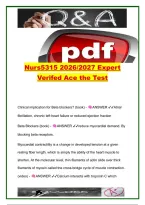
Clinical implication for Beta blockers? (book) - ANSWER ✔✔Atrial
fibrillation, chronic left heart failure or reduced ejection fraction
Beta Blockers (book) - ANSWER ✔✔reduce myocardial demand. By
blocking beta receptors.
Myocardial contractility is a change in developed tension at a given
resting fiber length, which is simply the ability of the heart muscle to
shorten. At the molecular level, thin filaments of actin slide over thick
filaments of myosin called the cross-bridge cycle of muscle contraction.
(video) - ANSWER ✔✔Calcium interacts with troponin C which
, causes tropomyosin to move thus allowing actin and myosin to work
together to cause contraction.
Explain the difference between cardiac hemodynamic measures Video
Lecture:
Cardiac Output - ANSWER ✔✔Cardiac output is the amount of blood
pushed from the left ventricle in 1 minute. It is calculated by multiplying
the heart rate in beats per minute by the stroke volume.
Right Heart (book) - ANSWER ✔✔pumps blood through the lungs
Left Heart (book) - ANSWER ✔✔sends blood throughout the
systemic circulation, which supplies all of the body except the lungs.
Arteries (hint A for away) (Book) - ANSWER ✔✔carry blood (away)
from the heart to all parts of the body, where they branch into arterioles
and even smaller vessels until they become a fine meshwork of
capillaries.
Capillaries (Book) - ANSWER ✔✔allow the closest contact and
exchange between the blood and the interstitial space, or interstitium—
the environment in which the cells live
Venules and the veins (Book) - ANSWER ✔✔carry blood from
capillaries back to the heart.