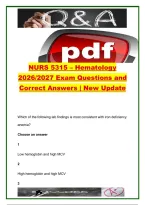
This NURS 5315 Hematology 2026/2027 exam study document contains 51 questions with correct answers covering high-yield hematology concepts, laboratory interpretation, blood-cell physiology, coagulation disorders, anemia, leukemia, lymphoma, and red blood cell disorders. The material combines multiple-choice questions with direct question-and-answer review, making it suitable for rapid revision, active recall, and preparation for hematology examinations. The uploaded document identifies the course as NURS 5315 – Hematology and the academic period as 2026/2027, but it does not name a university or institution. NURS 5315
A major portion of the document focuses on anemia and red blood cell physiology. Students review iron deficiency anemia, pernicious anemia, hemolytic anemia, megaloblastic anemia, anemia associated with chronic disease and chronic kidney disease, and sickle cell anemia. Questions test recognition of important laboratory patterns such as low hemoglobin with low MCV in iron deficiency anemia, increased bilirubin in hemolytic anemia, hypersegmented neutrophils in megaloblastic anemia, and decreased reticulocyte counts in chronic kidney disease-related anemia. The material also covers hemoglobin electrophoresis for sickle cell disease and the beta-globin abnormality associated with sickle cell anemia. NURS 5315
The document provides substantial coverage of coagulation pathways and bleeding disorders. Topics include the intrinsic, extrinsic, and common coagulation pathways; prothrombin time (PT); activated partial thromboplastin time (aPTT); Factor VII; Factor VIII deficiency in hemophilia A; Factor IX deficiency in hemophilia B; antithrombin III; vitamin K-dependent clotting factors; von Willebrand factor testing; and disseminated intravascular coagulation (DIC). Students also review increased fibrin degradation products and D-dimer in DIC and the relationship between prolonged PT with a normal aPTT and Factor VII deficiency. NURS 5315
Another key section covers hematopoiesis, erythropoietin, polycythemia, and blood-cell function. Questions address bone marrow as the primary site of adult RBC production, iron as the oxygen-binding component of hemoglobin, platelets in clotting and wound healing, hematocrit measurement, and complete blood count testing. The document explains the relationship between hypoxia and increased erythropoietin production, including increased RBC production at high altitude and secondary polycythemia associated with chronic hypoxia. It also introduces polycythemia vera as uncontrolled RBC production associated with increased blood viscosity. NURS 5315
The hematologic malignancy section reviews acute lymphoblastic leukemia (ALL), chronic myeloid leukemia (CML), Hodgkin lymphoma, non-Hodgkin lymphoma, and multiple myeloma. Students encounter associations such as ALL with childhood leukemia, the Philadelphia chromosome t(9;22) with CML, Reed-Sternberg cells with Hodgkin lymphoma, and hypercalcemia with bone pain in multiple myeloma. White blood cell concepts are also tested, including neutrophils as the most abundant circulating leukocytes and basophils in allergic responses. NURS 5315
Anticoagulation and laboratory monitoring are incorporated throughout the questions. The material covers warfarin and INR monitoring, dabigatran as a direct thrombin inhibitor, platelet-function assessment, CBC interpretation, reticulocyte counts, hemoglobin electrophoresis, hematocrit, PT, aPTT, D-dimer, and von Willebrand factor antigen testing. This laboratory emphasis makes the resource particularly useful for students who need to connect hematologic pathophysiology with diagnostic findings and clinical testing. NURS 5315
Relevant students: This document is particularly relevant for NURS 5315 students, nursing students, advanced practice nursing students, nurse practitioner students, pathophysiology students, hematology students, and other health-sciences students studying blood disorders and laboratory interpretation. It can support exam preparation in courses covering anemia, coagulation, hematologic malignancies, erythropoiesis, anticoagulants, and clinical hematology. The uploaded document does not specify a university, so no university name should be attributed to the material without supporting information. NURS 5315
Academic References: Kaushansky, K., Lichtman, M. A., Prchal, J. T., Levi, M. M., Press, O. W., Burns, L. J., & Caligiuri, M. A. (Eds.). Williams Hematology. McGraw Hill. This established hematology reference provides academic background for erythropoiesis, anemia, coagulation disorders, leukemias, lymphomas, myeloma, and myeloproliferative disorders. Jameson, J. L., Fauci, A. S., Kasper, D. L., Hauser, S. L., Loscalzo, J., & Longo, D. L. (Eds.). Harrison’s Principles of Internal Medicine. McGraw Hill. Relevant chapters provide additional clinical context for anemia, sickle cell disease, coagulation abnormalities, leukemia, lymphoma, multiple myeloma, and polycythemia. These references provide supporting academic context; the specific description of the study material above is grounded in the uploaded document. NURS 5315
Keywords: NURS 5315 hematology, hematology exam questions, hematology questions and answers, hematology exam , hematology study guide, nursing hematology exam, anemia exam questions, iron deficiency anemia, low MCV, pernicious anemia, vitamin B12 deficiency, hemolytic anemia, megaloblastic anemia, sickle cell anemia, sickle cell disease, hemoglobin electrophoresis, red blood cells, RBC disorders, erythropoietin, hematopoiesis, polycythemia, polycythemia vera, coagulation pathway, intrinsic pathway, extrinsic pathway, PT aPTT, Factor VII, Factor VIII, Factor IX, hemophilia A, hemophilia B, DIC, disseminated intravascular coagulation, D dimer, von Willebrand disease, vitamin K clotting factors, anticoagulants, warfarin INR, dabigatran, leukemia, acute lymphoblastic leukemia, ALL, chronic myeloid leukemia, CML, Philadelphia chromosome, Hodgkin lymphoma, non Hodgkin lymphoma, Reed Sternberg cells, multiple myeloma, CBC interpretation, hematocrit, reticulocyte count, hematology exam preparation
Content preview
NURS 5315 – Hematology
2026/2027 Exam Questions and
Correct Answers | New Update
Which of the following lab findings is most consistent with iron deficiency
anemia?
Choose an answer
1
Low hemoglobin and high MCV
2
High hemoglobin and high MCV
3
, Low hemoglobin and low MCV
4
Normal hemoglobin and low MCV
ANS 3
A patient with a prolonged prothrombin time (PT) but normal activated
partial thromboplastin time (aPTT) likely has a deficiency in which
clotting factor?
Choose an answer
1
Factor Xiii
2
Factor Xii
3
Factor VII
4
Factor Xi
ANS 3