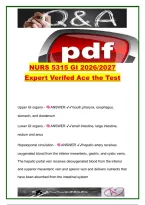
This NURS 5315 GI 2026/2027 study resource contains 50+ questions and answers, pathophysiology explanations, clinical manifestations, risk factors, diagnostic findings, complications, and screening concepts across 14 pages. It provides concentrated advanced-pathophysiology review of the upper and lower gastrointestinal tract, diarrhea, GI bleeding, peptic ulcer disease, inflammatory bowel disease, intestinal obstruction, portal hypertension, liver disease, viral hepatitis, gallbladder disease, pancreatitis, gastrointestinal cancers, and selected neonatal and congenital GI disorders. The opening page establishes the upper GI organs as the mouth, pharynx, esophagus, stomach, and duodenum and the lower GI tract as the small intestine, large intestine, rectum, and anus before introducing hepatoportal circulation. NURS 5315 GI 2026
A major early section distinguishes osmotic, secretory, and motility-related diarrhea. Osmotic diarrhea is described as resulting from nonabsorbable substances drawing water into the intestinal lumen and is associated in the source with nonabsorbable sugars, tube feedings, dumping syndrome, malabsorption, pancreatic enzyme deficiency, bile salt deficiency, bacterial overgrowth, and celiac disease. Secretory diarrhea is associated with infectious causes such as rotavirus, bacterial enterotoxins, and C. difficile. The document connects altered intestinal motility and short-bowel states with intestinal resection, bypass procedures, IBS, diabetic neuropathy, hyperthyroidism, and laxative abuse. Complications reviewed include dehydration, electrolyte disturbances, metabolic acidosis, weight loss, and malabsorption. NURS 5315 GI 2026
The resource provides high-yield comparison of upper and lower GI bleeding. Upper GI bleeding is associated with the esophagus, stomach, and duodenum and potential causes such as esophageal varices, peptic ulcers, and Mallory-Weiss tears, with bright-red or coffee-ground emesis highlighted as characteristic findings. Lower GI bleeding is connected with the jejunum, ileum, colon, and rectum and conditions such as inflammatory bowel disease, malignancy, diverticular disease, and hemorrhoids. Hematochezia is presented as particularly suggestive of bleeding involving the distal colon or rectum. NURS 5315 GI 2026
Peptic ulcer disease (PUD) is reviewed through mucosal injury and exposure to gastric acid. The document lists smoking, advanced age, NSAID use, alcohol, chronic illness, pancreatitis, COPD, obesity, gastrinoma, and Helicobacter pylori among associated factors. It differentiates gastric-type symptom patterns from duodenal ulcers, describing duodenal ulcer pain as epigastric discomfort relieved by food and noting possible melena and hematemesis. NURS 5315 GI 2026
A substantial section compares ulcerative colitis and Crohn’s disease. The source characterizes ulcerative colitis by recurrent diarrhea and bloody stools, with extraintestinal findings including polyarthritis, uveitis, sclerosing cholangitis, erythema nodosum, and pyoderma gangrenosum. Complications listed include toxic megacolon, perforation, colorectal adenocarcinoma, venous thromboembolism, and microthrombi. Crohn’s disease is described as potentially involving any part of the GI tract but particularly the ileum and proximal colon, with transmural inflammation and skip lesions as important pathophysiologic characteristics. The document also associates Crohn’s disease with CARD15/NOD2 gene mutation, smoking, family history, altered gut microbiome, fistulas, abscesses, intestinal obstruction, malabsorption, and weight loss. NURS 5315 GI 2026
Other intestinal disorders include diverticulosis, diverticulitis, appendicitis, small-bowel obstruction, and large-bowel obstruction. Diverticulitis is associated with inflammation of diverticula and left-lower-quadrant pain, with abscess, rupture, and peritonitis listed as potential complications. Appendicitis is characterized by pain that may begin in the epigastric or periumbilical region before localizing to the right lower quadrant. Small-bowel obstruction is linked to postoperative adhesions, tumors, Crohn’s disease, hernias, and intussusception, whereas large-bowel obstruction is described as less common and often associated with tumors, diverticulitis, inflammatory bowel disease, or volvulus. NURS 5315 GI 2026
The hepatobiliary section extensively reviews portal hypertension, ascites, hepatic encephalopathy, jaundice, and cirrhosis. Portal hypertension is described as elevated pressure within the portal venous system due to resistance to portal blood flow, commonly associated with cirrhosis, fibrosis, thrombosis, or narrowing of the portal vein. Ascites is presented as fluid accumulation within the peritoneal cavity, producing abdominal distention, increased abdominal girth, weight gain, edema, and potentially respiratory compromise. Hepatic encephalopathy is associated in the document with ammonia accumulation, cerebral edema, increased intracranial pressure, and asterixis, with triggers including GI bleeding, infection, alcohol, constipation, sedatives, electrolyte disturbances, and volume depletion. NURS 5315 GI 2026
The source distinguishes non-obstructive and obstructive jaundice using bilirubin metabolism and biliary flow. It then explains alcoholic cirrhosis as replacement of functioning hepatic tissue by fibrosis following cellular necrosis, inflammation, and regeneration. Consequences listed include reduced clotting-factor and albumin synthesis, ascites, impaired detoxification, jaundice, gastric and esophageal varices, anemia, GI bleeding, splenomegaly, hepatopulmonary syndrome, and hepatorenal syndrome. Hepatopulmonary syndrome is associated with hypoxemia and intrapulmonary vascular dilation, whereas hepatorenal syndrome is described as renal failure related to severe renal vasoconstriction or reduced perfusion. NURS 5315 GI 2026
Another important exam section compares hepatitis A, B, C, D, and E according to incubation, transmission, chronic-carrier status, vaccination, prevention, and immune-globulin availability as presented in the source. Hepatitis A and E are associated with fecal-oral transmission, while hepatitis B, C, and D are associated with blood and body-fluid exposure. The document also reviews HAV IgM and IgG, hepatitis B surface antigen, surface antibody, total core antibody and IgM core antibody, along with hepatitis C antibody testing. These entries reproduce the uploaded study guide’s terminology and interpretations and should be studied as source material rather than treated as independently updated diagnostic guidance. NURS 5315 GI 2026
Gallbladder and pancreatic disease receive detailed coverage through cholelithiasis, cholecystitis, and acute pancreatitis. Gallstone risk factors listed include obesity, rapid weight loss, middle age, female sex, oral contraceptive use, ileal disease, malabsorption, and hypertriglyceridemia. Biliary obstruction is associated with right-upper-quadrant biliary colic that may radiate toward the back or right scapula. Cholecystitis is connected with biliary obstruction, fatty meals, a positive Murphy sign, leukocytosis, elevated alkaline phosphatase, and elevated direct bilirubin. NURS 5315 GI 2026
Acute pancreatitis is explained as pancreatic enzymes escaping into surrounding tissues and initiating tissue digestion, potentially resulting in hemorrhage. Causes listed include alcohol, gallstones, peptic ulcer disease, abdominal trauma, hyperlipidemia, smoking, medications, viral infections, autoimmune disease, ischemia, post-ERCP complications, and genetic factors. Clinical manifestations include abrupt postprandial or epigastric pain radiating to the back, nausea, vomiting, fever, hypocalcemia, jaundice, fluid loss, and potentially hypovolemic shock. Complications identified include ARDS, heart failure, renal failure, coagulopathies, sepsis, paralytic ileus, and GI bleeding. NURS 5315 GI 2026
The cancer section covers esophageal, colorectal, and pancreatic cancer. Esophageal cancer is associated with chronic inflammation and metaplastic changes and may remain clinically silent until advanced disease, with chest pain and dysphagia highlighted in the source. Colorectal cancer is connected with polyps, increasing age, diet, smoking, obesity, family history, inactivity, and inflammatory bowel disease, with manifestations including anemia, occult bleeding, abdominal mass, pain, obstruction, and distention. Pancreatic cancer risk factors listed include smoking, family history, type 2 diabetes, chronic pancreatitis, alcohol exposure, and non-O blood type, while K-ras mutation is identified as an important genetic alteration. NURS 5315 GI 2026
The final section reviews cleft lip and palate, pyloric stenosis, and neonatal jaundice. The source discusses embryologic timing and potential maternal or nutritional factors for cleft abnormalities. Pyloric stenosis is characterized by narrowing of the pylorus with impaired movement of food from the stomach to the duodenum and vomiting after feeding. Neonatal jaundice is divided into physiologic and pathologic patterns, with the document discussing unconjugated hyperbilirubinemia, timing after birth, ABO/Rh incompatibility, prematurity, breastfeeding, delayed meconium passage, and hemolytic disease of the newborn. NURS 5315 GI 2026
Relevant students: This resource is relevant to NURS 5315 students, Advanced Pathophysiology students, MSN students, graduate nursing students, nurse practitioner students, FNP students, AGNP and acute-care NP students, DNP learners, gastroenterology nursing students, and healthcare learners preparing for examinations covering gastrointestinal, hepatic, biliary, and pancreatic pathophysiology. The uploaded document does not identify a specific university, so no unsupported university name has been inserted into the title. NURS 5315 GI 2026
Keywords: NURS 5315 GI, NURS 5315 GI 2026, NURS 5315 GI 2027, NURS 5315 questions and answers, gastrointestinal pathophysiology, GI exam questions, advanced pathophysiology GI, upper GI bleed, lower GI bleed, peptic ulcer disease, duodenal ulcer, ulcerative colitis, Crohn disease, inflammatory bowel disease, diverticulitis, diverticulosis, appendicitis, small bowel obstruction, large bowel obstruction, portal hypertension, ascites, hepatic encephalopathy, asterixis, jaundice, cirrhosis, alcoholic cirrhosis, hepatopulmonary syndrome, hepatorenal syndrome, autoimmune hepatitis, hepatitis A, hepatitis B, hepatitis C, hepatitis D, hepatitis E, hepatitis serology, cholelithiasis, cholecystitis, Murphy sign, acute pancreatitis, pancreatic cancer, colorectal cancer, esophageal cancer, pyloric stenosis, neonatal jaundice, MSN pathophysiology, nurse practitioner exam preparation