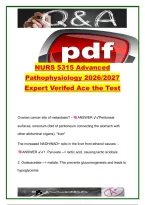
This NURS 5315 Advanced Pathophysiology 2026/2027 study resource contains 100+ questions, answers, definitions, clinical manifestations, pathophysiologic mechanisms, laboratory concepts, and disease associations across 27 pages. The document provides broad graduate-level review of cellular adaptation and injury, reactive oxygen species, hypoxia and reperfusion injury, cancer biology and metastasis, fluid balance and edema, sodium and potassium disorders, calcium and phosphate regulation, acid-base disturbances, DNA/RNA, chromosome abnormalities, and inheritance patterns. It is structured as concise question-and-answer material intended for rapid exam preparation and concept review. NURS 5315 Advanced Pathophysiol…
The first major area examines cellular injury, oxidative stress, and metabolic dysfunction. The source explains how ethanol-associated increases in the hepatic NADH/NAD+ ratio influence pyruvate, oxaloacetate, glycerol-3-phosphate, triglyceride formation, ketogenesis, and lipogenesis. It reviews reactive oxygen species (ROS) and free radicals, including their production through normal cellular respiration, radiation or ultraviolet exposure, exogenous chemicals and drugs, transition metals, and nitric oxide. Antioxidant defenses listed include vitamin E, vitamin C, cysteine, glutathione, albumin, ceruloplasmin, and transferrin. NURS 5315 Advanced Pathophysiol…
Students receive detailed review of action potentials and electrolyte-related cellular excitability. The material connects hypokalemia with hyperpolarization and reduced neuromuscular excitability, while hyperkalemia is associated with membrane depolarization, increased excitability, peaked T waves, paresthesia, paralysis, and potentially cardiac standstill. Hypocalcemia is linked with increased sodium permeability and greater excitability, including tetany, hyperreflexia, circumoral paresthesia, seizures, and dysrhythmias. Hypercalcemia is presented as reducing sodium permeability and cellular excitability, with manifestations such as weakness, fatigue, hyporeflexia, confusion, and encephalopathy. NURS 5315 Advanced Pathophysiol…
A substantial section covers cellular adaptation and cell death. Students distinguish atrophy, hypertrophy, hyperplasia, dysplasia, and metaplasia, with examples including disuse atrophy, left ventricular hypertrophy, compensatory liver hyperplasia, cervical dysplasia, smoking-related epithelial metaplasia, and Barrett esophagus. The resource also covers carcinoma in situ, hypoxic cellular injury, reperfusion injury, apoptosis, autophagy, infarction, and necrosis. Coagulative necrosis is associated primarily with organs such as the kidney and heart, whereas liquefactive necrosis is connected with ischemic injury involving neurons and glial cells in the brain. NURS 5315 Advanced Pathophysiol…
Cancer pathophysiology is another major focus. The document contrasts normal and malignant cellular growth and reviews tumor markers including alpha-fetoprotein (AFP), carcinoembryonic antigen (CEA), beta-human chorionic gonadotropin (β-hCG), and prostate-specific antigen (PSA). Students review carcinoma, sarcoma, adenocarcinoma and blastoma terminology, along with metastatic patterns for ovarian, lung, colorectal, testicular, prostate, breast, head and neck cancers, sarcoma, and melanoma. Ovarian cancer, for example, is associated in the source with spread to peritoneal surfaces, omentum, and liver, while prostate cancer is associated with bone—particularly the lumbar spine—and liver metastasis. NURS 5315 Advanced Pathophysiol…
The oncology section also covers the TNM staging system, with T describing the primary tumor, N describing lymph-node involvement, and M describing distant metastasis. The document interprets T3N2M0 as a large tumor with local nodal involvement but no evidence of distant metastasis. Additional high-yield concepts include the BRCA gene, paraneoplastic syndromes, cachexia, cancer-cell differentiation, and characteristic metastatic sites. The source emphasizes that paraneoplastic syndromes may result from tumor-secreted hormones or tumor-triggered immune responses and may represent early manifestations of an otherwise unidentified cancer. NURS 5315 Advanced Pathophysiol…
Another extensive section examines fluid dynamics and edema. Students differentiate osmolality, osmosis, osmotic pressure, hydrostatic pressure, and oncotic pressure. Albumin is identified as the principal plasma protein and an important contributor to oncotic pressure. The document explains edema through four major mechanisms: increased hydrostatic pressure, decreased oncotic pressure, increased capillary permeability, and lymphatic obstruction. Clinical manifestations include swelling, puffiness, pitting, and restricted movement, while liver disease, protein malnutrition, glomerular disease, hemorrhage, burns, and other conditions are discussed in relation to altered plasma protein and fluid dynamics. NURS 5315 Advanced Pathophysiol…
Fluid-volume regulation is connected with antidiuretic hormone (ADH/vasopressin), the renin-angiotensin-aldosterone system (RAAS), and natriuretic peptides ANP and BNP. The resource describes RAAS activation following low blood volume, progressing from renin and angiotensinogen through angiotensin I and ACE-mediated production of angiotensin II, vasoconstriction, aldosterone release, sodium and water retention, and potassium excretion. In contrast, ANP and BNP are described as promoting sodium and water excretion and reducing blood volume. Normal plasma osmolality is given as 280–295 mOsm/kg. NURS 5315 Advanced Pathophysiol…
The electrolyte section provides concentrated review of hypernatremia, hyponatremia, hypokalemia, hyperkalemia, hypocalcemia, and hypercalcemia. Students examine how insulin, acid-base status, osmolality, exercise, renal dysfunction, medications, tissue injury, aldosterone, and gastrointestinal losses influence potassium distribution and concentration. The source identifies progressively serious manifestations of hyponatremia ranging from nausea, lethargy and muscle cramps to agitation, disorientation, seizures, coma and death. Calcium and phosphate are presented as inversely related and regulated by parathyroid hormone, vitamin D, and calcitonin. NURS 5315 Advanced Pathophysiol…
The resource also gives a structured review of metabolic and respiratory acid-base disorders. Metabolic acidosis is connected with excess hydrogen ions, bicarbonate deficiency, ketoacidosis and lactic acidosis, with hyperventilation or Kussmaul respirations described as compensatory mechanisms. Metabolic alkalosis is associated with excess bicarbonate or hydrogen-ion loss through mechanisms such as vomiting, gastric suction and diuretic use. Respiratory acidosis is associated with hypoventilation and conditions including COPD, pneumonia, OSA and impaired respiratory musculature, whereas respiratory alkalosis is associated with hyperventilation, hypoxemia, pulmonary embolism, high altitude, fever, sepsis, anxiety and other conditions listed in the source. NURS 5315 Advanced Pathophysiol…
The final pages concentrate on molecular genetics and chromosomal abnormalities. Students review the DNA bases adenine, thymine, guanine and cytosine, complementary base pairing, DNA replication, RNA, transcription and translation. The resource distinguishes haploid gametes containing 23 chromosomes from diploid somatic cells containing 46 chromosomes and explains mitosis versus meiosis. Chromosomal abnormalities include polyploidy, aneuploidy, autosomal and sex-chromosome aneuploidy, deletions, duplications, inversions and translocations. Examples include trisomies 13, 18 and 21, Turner syndrome, Klinefelter syndrome and cri-du-chat syndrome. NURS 5315 Advanced Pathophysiol…
Inheritance concepts conclude the review, with Huntington disease associated with a dominant disease allele and cystic fibrosis identified as autosomal recessive in the document. The final question returns to hypoxic injury, tracing the sequence from insufficient oxygen to decreased mitochondrial function, reduced ATP, increased anaerobic metabolism, and cessation of protein synthesis. Together, these topics make the document a broad review of foundational mechanisms underlying disease rather than a single-system pathophysiology resource. NURS 5315 Advanced Pathophysiol…
Relevant students: This document is relevant to NURS 5315 students, Advanced Pathophysiology students, MSN students, graduate nursing students, nurse practitioner students, FNP students, AGNP and acute-care NP students, DNP learners, and nursing students preparing for examinations covering cellular pathophysiology, oncology, fluid and electrolyte disorders, acid-base balance, and genetics. The uploaded document does not identify a specific university or institution, so no unsupported university name has been inserted into the title. NURS 5315 Advanced Pathophysiol…
Keywords: NURS 5315 Advanced Pathophysiology, NURS , NURS , NURS 5315 questions and answers, advanced pathophysiology exam, advanced pathophysiology questions, cellular injury, cellular adaptation, atrophy, hypertrophy, hyperplasia, dysplasia, metaplasia, apoptosis, necrosis, hypoxic injury, reperfusion injury, reactive oxygen species, free radicals, oxidative stress, cancer pathophysiology, cancer metastasis, tumor markers, TNM staging, BRCA gene, paraneoplastic syndrome, cachexia, fluid and electrolyte balance, osmolality, osmotic pressure, hydrostatic pressure, oncotic pressure, edema pathophysiology, ADH, RAAS, ANP, BNP, hyponatremia, hypernatremia, hypokalemia, hyperkalemia, hypocalcemia, hypercalcemia, metabolic acidosis, metabolic alkalosis, respiratory acidosis, respiratory alkalosis, DNA replication, RNA transcription, translation, chromosomal abnormalities, aneuploidy, Down syndrome, Turner syndrome, Klinefelter syndrome, cystic fibrosis genetics, MSN pathophysiology, nurse practitioner exam preparation
Content preview
NURS 5315 Advanced
Pathophysiology 2026/2027
Expert Verifed Ace the Test
Ovarian cancer site of metastasis? - ANSWER ✔✔Peritoneal
surfaces, omentum (fold of peritoneum connecting the stomach with
other abdominal organs), *liver*
The increased NADH/NAD+ ratio in the liver from ethanol causes: -
ANSWER ✔✔1. Pyruvate --> lactic acid, causing lactic acidosis
2. Oxaloacetate --> malate. This prevents gluconeogenesis and leads to
hypoglycemia
,3. Glyceraldehyde-3-phosphate --> glycerol 3- phosphate and combines
with fatty acids to form triglycerides in the liver, known as
hepatosteatosis
4. Decreases citric acid cycle production of NADH and leads to using
Acetyl-CoA for ketogenesis and lipogenesis
What can Reactive Oxygen Species cause? - ANSWER ✔✔Heart
disease, Alzheimers, Parkinsons, Amyotrophic Lateral Sclerosis (ALS),
CV disease, HTN, HLD, DM, ischemic heart disease, HF, OSA. Lipid
perioxidation, damage proteins, fragment DNA, less *protein synthesis*,
chromatin destruction, damage mitochondria
What is the body's defense against ROS? - ANSWER
✔✔Antioxidants (Vitamin E, Vitamin C, cysteine, glutathione, albumin,
ceruloplasmin, transferrin)
How are free radicals produced? - ANSWER ✔✔1. Normal cellular
respiration
2. Absorption of extreme energy sources (radiation, UV light)
3. Metabolism of exogenous chemicals, drugs, and pesticides
4. Transition of metals
5. Nitric oxide acting like a chemical mediator and a free radical
, action potential - ANSWER ✔✔Process of conducting an impulse.
Activates the neuron --> the neuron depolarizes --> then repolarizes
Threshold potential - ANSWER ✔✔Point at which depolarization must
reach in order to initiate an action potential
Hypokalemia and action potentials - ANSWER ✔✔HYPERpolarized
(more negative, ex. -100). Less excitable. Decreased neuromuscular
excitability: weakness, smooth muscle atony, paresthesia, cardiac
dysrhythmias
Hyperkalemia and action potentials - ANSWER ✔✔HYPOpolarized
(more positive, ex: closer to 0). More excitable. Peaked T waves.
When resting membrane potential=threshold potential, it is BAD =
cardiac standstill, paresthesia, paralysis
Hypocalcemia and action potentials - ANSWER ✔✔Increased
permeability to Na+. More excitable. Tetany, hyperreflexia, circumoral
paresthesia, seizures, dysrhythmias.
Hypercalcemia and action potentials - ANSWER ✔✔Decreased
permeability to Na+. Less excitable. Weakness, hyporeflexia, fatigue,
lethargy, confusion, encephalopathy, depressed T waves
COPYRIGHT©PROFFKERRYMARTIN 2026/2027. YEAR PUBLISHED 2026. COMPANY REGISTRATION NUMBER: 619652435. TERMS OF USE.
PRIVACY STATEMENT. ALL RIGHTS RESERVED