
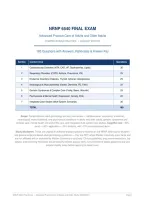
NRNP 6540 FINAL EXAM
Advanced Practice Care of Adults and Older Adults
COMPREHENSIVE PRACTICE • 2026/2027 EDITION
180 Questions with Answers, Rationales & Answer Key
Section Content Area Questions
1 Cardiovascular Disorders (HTN, CAD, HF, Dysrhythmias, Lipids) 30
2 Respiratory Disorders (COPD, Asthma, Pneumonia, PE) 25
3 Endocrine Disorders (Diabetes, Thyroid, Adrenal, Osteoporosis) 25
4 Neurological & Musculoskeletal (Stroke, Dementia, PD, Falls) 25
5 Geriatric Syndromes & Complex Care (Frailty, Beers, Wounds) 25
6 Psychosocial & Mental Health (Depression, Anxiety, EOL) 20
7 Integrated Case Studies (Multi-System Scenarios) 30
TOTAL 180
Scope: Comprehensive adult-gerontology primary care review — cardiovascular, respiratory, endocrine,
neurological, musculoskeletal, and psychosocial conditions in adults and older adults, geriatric syndromes and
complex care, mental health and end-of-life care, and integrated multi-system case studies. Cognitive mix: ~30%
recall • ~50% application • ~20% analysis, with ~75% scenario-based items.
Study disclaimer. These are original AI-authored practice questions modeled on the NRNP 6540 course blueprint
and general evidence-based adult-gerontology guidelines — they are NOT actual Walden University exam items and
are not affiliated with or endorsed by Walden University or any body. Clinical guidelines, drug recommendations, lab
targets, and screening thresholds are periodically revised; always verify current evidence-based guidelines and your
program/facility policy before applying to patient care.
NRNP 6540 Final Exam — Advanced Practice Care of Adults and Older Adults (2026/2027) Page 1
, Section 1: Cardiovascular Disorders — Hypertension, CAD, Heart Failure, Dysrhythmias,
Lipids (30 questions)
Q1. A 68-year-old with newly diagnosed stage 2 hypertension (BP 158/96) and type 2 diabetes has no
contraindications. Which first-line agent best addresses both conditions?
A. An ACE inhibitor such as lisinopril
B. Hydralazine monotherapy
C. A short-acting nifedipine
D. Clonidine as first-line
Correct Answer: A
Rationale: An ACE inhibitor is first-line in hypertension with diabetes because of renoprotective benefits.
Hydralazine, short-acting nifedipine, and clonidine are not preferred first-line agents here.
Q2. A patient on lisinopril returns for follow-up. Which lab changes most warrant attention after starting
therapy?
A. Falling potassium and glucose
B. Rising serum potassium and creatinine
C. Falling white count
D. Rising hemoglobin
Correct Answer: B
Rationale: ACE inhibitors can raise potassium and creatinine, so both should be monitored after initiation. They
do not characteristically alter hemoglobin or white count.
Q3. An older adult with heart failure with reduced ejection fraction (HFrEF) is stable. Which combination
reflects guideline-directed medical therapy?
A. ACE inhibitor/ARB or ARNI, beta-blocker, and a mineralocorticoid receptor antagonist
B. Calcium channel blocker (verapamil) plus digoxin only
C. NSAIDs plus a decongestant
D. A short-acting nitrate alone
Correct Answer: A
Rationale: HFrEF therapy centers on RAAS inhibition (ACEi/ARB or ARNI), an evidence-based beta-blocker, and
an MRA. Non-dihydropyridine CCBs and NSAIDs can worsen HFrEF.
Q4. Which beta-blocker is appropriate for a patient with HFrEF?
A. Propranolol
B. Atenolol
C. Sotalol
D. Carvedilol
Correct Answer: D
Rationale: Carvedilol is one of the evidence-based beta-blockers proven to reduce mortality in HFrEF (along with
metoprolol succinate and bisoprolol). The others are not the preferred HFrEF agents.
NRNP 6540 Final Exam — Advanced Practice Care of Adults and Older Adults (2026/2027) Page 2
, Q5. A patient with heart failure reports a 4-lb weight gain over 2 days with increasing dyspnea and edema.
The most appropriate next step is to:
A. Increase sodium intake
B. Stop all cardiac medications
C. Assess volume status and adjust diuretic therapy
D. Start an NSAID for comfort
Correct Answer: C
Rationale: Rapid weight gain with dyspnea and edema signals fluid overload, warranting assessment and diuretic
adjustment. Stopping cardiac meds, NSAIDs, and added sodium would worsen HF.
Q6. A 72-year-old with new atrial fibrillation has a CHA2DS2-VASc score of 4. The most appropriate
therapy to reduce stroke risk is:
A. No therapy
B. Aspirin 81 mg alone
C. Oral anticoagulation (e.g., a DOAC or warfarin)
D. A daily NSAID
Correct Answer: C
Rationale: A CHA2DS2-VASc of 4 indicates high stroke risk warranting oral anticoagulation. Aspirin alone is
insufficient, and no therapy or NSAIDs do not address stroke prevention.
Q7. When initiating a statin for a 60-year-old with clinical ASCVD, the appropriate intensity is:
A. A bile acid sequestrant alone
B. No statin
C. High-intensity statin therapy
D. Low-intensity statin only
Correct Answer: C
Rationale: Patients with clinical ASCVD warrant high-intensity statin therapy to maximally lower LDL.
Low-intensity or non-statin monotherapy is not the guideline-preferred approach.
Q8. A patient on a statin reports diffuse muscle aches. The most appropriate initial action is to:
A. Immediately start a fibrate
B. Evaluate symptoms and check a creatine kinase (CK) level
C. Double the statin dose
D. Ignore the complaint
Correct Answer: B
Rationale: New muscle symptoms on a statin warrant symptom evaluation and a CK level to assess for
myopathy. Adding a fibrate or increasing the dose could worsen risk.
NRNP 6540 Final Exam — Advanced Practice Care of Adults and Older Adults (2026/2027) Page 3
, Q9. A 65-year-old presents with substernal chest pressure radiating to the left arm, diaphoresis, and an
ECG showing ST-segment elevation. The priority action is to:
A. Order routine labs and send home
B. Activate emergency care for acute STEMI (call 911/emergent reperfusion)
C. Prescribe an antacid and reassure
D. Schedule an outpatient stress test next week
Correct Answer: B
Rationale: ST-elevation with typical symptoms indicates STEMI requiring emergent reperfusion. Delaying with
outpatient testing or antacids would be dangerous.
Q10. For a patient with stable angina, which medication provides rapid relief of an acute anginal episode?
A. Sublingual nitroglycerin
B. Metformin
C. A statin
D. Daily aspirin
Correct Answer: A
Rationale: Sublingual nitroglycerin relieves acute angina by vasodilation. Aspirin and statins are preventive, and
metformin is unrelated to angina relief.
Q11. According to widely used hypertension guidance, a reasonable general BP treatment goal for most
adults with hypertension and high cardiovascular risk is approximately:
A. Less than 130/80 mmHg
B. Less than 150/90 mmHg for all ages
C. No specific goal
D. Less than 160/100 mmHg
Correct Answer: A
Rationale: Current guidance targets <130/80 mmHg for many high-risk adults. Higher thresholds are less
stringent than currently recommended for high-risk patients.
Q12. A patient taking warfarin for AFib has an INR of 5.5 without bleeding. The most appropriate action is
to:
A. Add aspirin and an NSAID
B. Increase the warfarin dose
C. Hold warfarin and recheck INR, adjusting the dose per protocol
D. Continue the same dose unchanged
Correct Answer: C
Rationale: An INR of 5.5 is supratherapeutic; warfarin should be held and rechecked with dose adjustment.
Increasing the dose or adding antiplatelets/NSAIDs raises bleeding risk.
NRNP 6540 Final Exam — Advanced Practice Care of Adults and Older Adults (2026/2027) Page 4
Advanced Practice Care of Adults and Older Adults
COMPREHENSIVE PRACTICE • 2026/2027 EDITION
180 Questions with Answers, Rationales & Answer Key
Section Content Area Questions
1 Cardiovascular Disorders (HTN, CAD, HF, Dysrhythmias, Lipids) 30
2 Respiratory Disorders (COPD, Asthma, Pneumonia, PE) 25
3 Endocrine Disorders (Diabetes, Thyroid, Adrenal, Osteoporosis) 25
4 Neurological & Musculoskeletal (Stroke, Dementia, PD, Falls) 25
5 Geriatric Syndromes & Complex Care (Frailty, Beers, Wounds) 25
6 Psychosocial & Mental Health (Depression, Anxiety, EOL) 20
7 Integrated Case Studies (Multi-System Scenarios) 30
TOTAL 180
Scope: Comprehensive adult-gerontology primary care review — cardiovascular, respiratory, endocrine,
neurological, musculoskeletal, and psychosocial conditions in adults and older adults, geriatric syndromes and
complex care, mental health and end-of-life care, and integrated multi-system case studies. Cognitive mix: ~30%
recall • ~50% application • ~20% analysis, with ~75% scenario-based items.
Study disclaimer. These are original AI-authored practice questions modeled on the NRNP 6540 course blueprint
and general evidence-based adult-gerontology guidelines — they are NOT actual Walden University exam items and
are not affiliated with or endorsed by Walden University or any body. Clinical guidelines, drug recommendations, lab
targets, and screening thresholds are periodically revised; always verify current evidence-based guidelines and your
program/facility policy before applying to patient care.
NRNP 6540 Final Exam — Advanced Practice Care of Adults and Older Adults (2026/2027) Page 1
, Section 1: Cardiovascular Disorders — Hypertension, CAD, Heart Failure, Dysrhythmias,
Lipids (30 questions)
Q1. A 68-year-old with newly diagnosed stage 2 hypertension (BP 158/96) and type 2 diabetes has no
contraindications. Which first-line agent best addresses both conditions?
A. An ACE inhibitor such as lisinopril
B. Hydralazine monotherapy
C. A short-acting nifedipine
D. Clonidine as first-line
Correct Answer: A
Rationale: An ACE inhibitor is first-line in hypertension with diabetes because of renoprotective benefits.
Hydralazine, short-acting nifedipine, and clonidine are not preferred first-line agents here.
Q2. A patient on lisinopril returns for follow-up. Which lab changes most warrant attention after starting
therapy?
A. Falling potassium and glucose
B. Rising serum potassium and creatinine
C. Falling white count
D. Rising hemoglobin
Correct Answer: B
Rationale: ACE inhibitors can raise potassium and creatinine, so both should be monitored after initiation. They
do not characteristically alter hemoglobin or white count.
Q3. An older adult with heart failure with reduced ejection fraction (HFrEF) is stable. Which combination
reflects guideline-directed medical therapy?
A. ACE inhibitor/ARB or ARNI, beta-blocker, and a mineralocorticoid receptor antagonist
B. Calcium channel blocker (verapamil) plus digoxin only
C. NSAIDs plus a decongestant
D. A short-acting nitrate alone
Correct Answer: A
Rationale: HFrEF therapy centers on RAAS inhibition (ACEi/ARB or ARNI), an evidence-based beta-blocker, and
an MRA. Non-dihydropyridine CCBs and NSAIDs can worsen HFrEF.
Q4. Which beta-blocker is appropriate for a patient with HFrEF?
A. Propranolol
B. Atenolol
C. Sotalol
D. Carvedilol
Correct Answer: D
Rationale: Carvedilol is one of the evidence-based beta-blockers proven to reduce mortality in HFrEF (along with
metoprolol succinate and bisoprolol). The others are not the preferred HFrEF agents.
NRNP 6540 Final Exam — Advanced Practice Care of Adults and Older Adults (2026/2027) Page 2
, Q5. A patient with heart failure reports a 4-lb weight gain over 2 days with increasing dyspnea and edema.
The most appropriate next step is to:
A. Increase sodium intake
B. Stop all cardiac medications
C. Assess volume status and adjust diuretic therapy
D. Start an NSAID for comfort
Correct Answer: C
Rationale: Rapid weight gain with dyspnea and edema signals fluid overload, warranting assessment and diuretic
adjustment. Stopping cardiac meds, NSAIDs, and added sodium would worsen HF.
Q6. A 72-year-old with new atrial fibrillation has a CHA2DS2-VASc score of 4. The most appropriate
therapy to reduce stroke risk is:
A. No therapy
B. Aspirin 81 mg alone
C. Oral anticoagulation (e.g., a DOAC or warfarin)
D. A daily NSAID
Correct Answer: C
Rationale: A CHA2DS2-VASc of 4 indicates high stroke risk warranting oral anticoagulation. Aspirin alone is
insufficient, and no therapy or NSAIDs do not address stroke prevention.
Q7. When initiating a statin for a 60-year-old with clinical ASCVD, the appropriate intensity is:
A. A bile acid sequestrant alone
B. No statin
C. High-intensity statin therapy
D. Low-intensity statin only
Correct Answer: C
Rationale: Patients with clinical ASCVD warrant high-intensity statin therapy to maximally lower LDL.
Low-intensity or non-statin monotherapy is not the guideline-preferred approach.
Q8. A patient on a statin reports diffuse muscle aches. The most appropriate initial action is to:
A. Immediately start a fibrate
B. Evaluate symptoms and check a creatine kinase (CK) level
C. Double the statin dose
D. Ignore the complaint
Correct Answer: B
Rationale: New muscle symptoms on a statin warrant symptom evaluation and a CK level to assess for
myopathy. Adding a fibrate or increasing the dose could worsen risk.
NRNP 6540 Final Exam — Advanced Practice Care of Adults and Older Adults (2026/2027) Page 3
, Q9. A 65-year-old presents with substernal chest pressure radiating to the left arm, diaphoresis, and an
ECG showing ST-segment elevation. The priority action is to:
A. Order routine labs and send home
B. Activate emergency care for acute STEMI (call 911/emergent reperfusion)
C. Prescribe an antacid and reassure
D. Schedule an outpatient stress test next week
Correct Answer: B
Rationale: ST-elevation with typical symptoms indicates STEMI requiring emergent reperfusion. Delaying with
outpatient testing or antacids would be dangerous.
Q10. For a patient with stable angina, which medication provides rapid relief of an acute anginal episode?
A. Sublingual nitroglycerin
B. Metformin
C. A statin
D. Daily aspirin
Correct Answer: A
Rationale: Sublingual nitroglycerin relieves acute angina by vasodilation. Aspirin and statins are preventive, and
metformin is unrelated to angina relief.
Q11. According to widely used hypertension guidance, a reasonable general BP treatment goal for most
adults with hypertension and high cardiovascular risk is approximately:
A. Less than 130/80 mmHg
B. Less than 150/90 mmHg for all ages
C. No specific goal
D. Less than 160/100 mmHg
Correct Answer: A
Rationale: Current guidance targets <130/80 mmHg for many high-risk adults. Higher thresholds are less
stringent than currently recommended for high-risk patients.
Q12. A patient taking warfarin for AFib has an INR of 5.5 without bleeding. The most appropriate action is
to:
A. Add aspirin and an NSAID
B. Increase the warfarin dose
C. Hold warfarin and recheck INR, adjusting the dose per protocol
D. Continue the same dose unchanged
Correct Answer: C
Rationale: An INR of 5.5 is supratherapeutic; warfarin should be held and rechecked with dose adjustment.
Increasing the dose or adding antiplatelets/NSAIDs raises bleeding risk.
NRNP 6540 Final Exam — Advanced Practice Care of Adults and Older Adults (2026/2027) Page 4


