
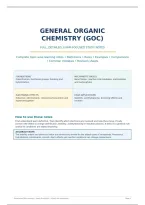
GENERAL ORGANIC
CHEMISTRY (GOC)
FULL, DETAILED, EXAM-FOCUSED STUDY NOTES
Complete topic-wise learning notes • Definitions • Rules • Examples • Comparisons
• Common mistakes • Revision sheets
FOUNDATIONS MECHANISTIC BASICS
Classification, functional groups, bonding and Bond fission, reactive intermediates, electrophiles
hybridization and nucleophiles
ELECTRONIC EFFECTS EXAM APPLICATIONS
Inductive, electromeric, resonance/mesomeric and Stability, acidity/basicity, directing effects and
hyperconjugation revision
How to use these notes
First understand each definition. Then identify which electrons are involved and how they move. Finally
connect the effect to charge distribution, stability, acidity/basicity or reaction position. A trend is a general rule
unless its conditions are stated explicitly.
ACCURACY NOTE
The stability orders and shortcuts below are introductory trends for the stated types of compounds. Resonance,
hybridization, substituents, solvent, steric effects and reaction conditions can change comparisons.
Understand the concept • Apply the effect • Check the conditions Page 1
, GENERAL ORGANIC CHEMISTRY (GOC) FULL DETAILED STUDY NOTES
1. Foundations of Organic Chemistry
1.1 Organic chemistry and carbon
Organic chemistry studies carbon compounds, especially their structures, properties, reactions and
preparation. Carbon forms an exceptionally large number of compounds due to several characteristic
properties:
• Tetravalency: carbon normally forms four covalent bonds.
• Catenation: carbon atoms form C–C chains and rings.
• Multiple bonding: carbon forms single, double and triple bonds.
• Isomerism: compounds can share a molecular formula but have different structures or spatial arrangements.
1.2 Classification of organic compounds
Class Meaning Examples / note
Acyclic / open-chain Carbon framework is not closed into a ring; may be straight or Propane, butane
branched.
Cyclic / closed-chain Atoms form a ring. Includes carbocyclic and
heterocyclic compounds
Homocyclic / Ring atoms are all carbon. Cyclohexane, benzene
carbocyclic
Alicyclic Carbocyclic but non-aromatic. Cyclopropane, cyclohexane
Aromatic Aromatic ring system. Benzene
Heterocyclic Ring contains carbon and at least one other element, e.g. N, O or S. Pyridine, furan
1.3 Saturated and unsaturated compounds
• Saturated: carbon skeleton contains only C–C single bonds; alkanes are standard examples.
• Unsaturated: contains at least one C=C or C≡C bond; alkenes and alkynes are examples.
1.4 Functional groups
A functional group is an atom or group of atoms responsible for characteristic reactions of an organic
compound. R represents an organic group; X represents a halogen.
Group Class Example
–OH Alcohol Ethanol
–CHO Aldehyde Ethanal
>C=O Ketone Propanone
–COOH Carboxylic acid Ethanoic acid
–COOR Ester Methyl ethanoate
–NH₂ Primary amine Methylamine
–CONH₂ Amide Ethanamide
–C≡N Nitrile Ethanenitrile
–X Haloalkane Chloroethane
C=C / C≡C Alkene / alkyne Ethene / ethyne
Understand the concept • Apply the effect • Check the conditions Page 2
CHEMISTRY (GOC)
FULL, DETAILED, EXAM-FOCUSED STUDY NOTES
Complete topic-wise learning notes • Definitions • Rules • Examples • Comparisons
• Common mistakes • Revision sheets
FOUNDATIONS MECHANISTIC BASICS
Classification, functional groups, bonding and Bond fission, reactive intermediates, electrophiles
hybridization and nucleophiles
ELECTRONIC EFFECTS EXAM APPLICATIONS
Inductive, electromeric, resonance/mesomeric and Stability, acidity/basicity, directing effects and
hyperconjugation revision
How to use these notes
First understand each definition. Then identify which electrons are involved and how they move. Finally
connect the effect to charge distribution, stability, acidity/basicity or reaction position. A trend is a general rule
unless its conditions are stated explicitly.
ACCURACY NOTE
The stability orders and shortcuts below are introductory trends for the stated types of compounds. Resonance,
hybridization, substituents, solvent, steric effects and reaction conditions can change comparisons.
Understand the concept • Apply the effect • Check the conditions Page 1
, GENERAL ORGANIC CHEMISTRY (GOC) FULL DETAILED STUDY NOTES
1. Foundations of Organic Chemistry
1.1 Organic chemistry and carbon
Organic chemistry studies carbon compounds, especially their structures, properties, reactions and
preparation. Carbon forms an exceptionally large number of compounds due to several characteristic
properties:
• Tetravalency: carbon normally forms four covalent bonds.
• Catenation: carbon atoms form C–C chains and rings.
• Multiple bonding: carbon forms single, double and triple bonds.
• Isomerism: compounds can share a molecular formula but have different structures or spatial arrangements.
1.2 Classification of organic compounds
Class Meaning Examples / note
Acyclic / open-chain Carbon framework is not closed into a ring; may be straight or Propane, butane
branched.
Cyclic / closed-chain Atoms form a ring. Includes carbocyclic and
heterocyclic compounds
Homocyclic / Ring atoms are all carbon. Cyclohexane, benzene
carbocyclic
Alicyclic Carbocyclic but non-aromatic. Cyclopropane, cyclohexane
Aromatic Aromatic ring system. Benzene
Heterocyclic Ring contains carbon and at least one other element, e.g. N, O or S. Pyridine, furan
1.3 Saturated and unsaturated compounds
• Saturated: carbon skeleton contains only C–C single bonds; alkanes are standard examples.
• Unsaturated: contains at least one C=C or C≡C bond; alkenes and alkynes are examples.
1.4 Functional groups
A functional group is an atom or group of atoms responsible for characteristic reactions of an organic
compound. R represents an organic group; X represents a halogen.
Group Class Example
–OH Alcohol Ethanol
–CHO Aldehyde Ethanal
>C=O Ketone Propanone
–COOH Carboxylic acid Ethanoic acid
–COOR Ester Methyl ethanoate
–NH₂ Primary amine Methylamine
–CONH₂ Amide Ethanamide
–C≡N Nitrile Ethanenitrile
–X Haloalkane Chloroethane
C=C / C≡C Alkene / alkyne Ethene / ethyne
Understand the concept • Apply the effect • Check the conditions Page 2


