
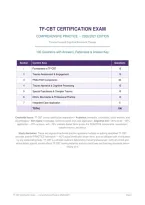
TF-CBT CERTIFICATION EXAM
COMPREHENSIVE PRACTICE • 2026/2027 EDITION
Trauma-Focused Cognitive Behavioral Therapy
100 Questions with Answers, Rationales & Answer Key
Section Content Area Questions
1 Foundations of TF-CBT 15
2 Trauma Assessment & Engagement 15
3 PRACTICE Components 30
4 Trauma Narrative & Cognitive Processing 15
5 Special Populations & Complex Trauma 10
6 Ethics, Boundaries & Professional Practice 10
7 Integrated Case Application 5
TOTAL 100
Credential focus: TF-CBT clinical certification preparation • Audience: therapists, counselors, social workers, and
psychologists • Item types: knowledge, scenario-based, and case-application. Cognitive mix: ~30% recall • ~50%
application • ~20% analysis, with ~75% scenario-based items across the PRACTICE components, assessment,
complex trauma, and ethics.
Study disclaimer. These are original AI-authored practice questions modeled on publicly described TF-CBT
concepts and the PRACTICE framework — NOT actual certification exam items, and not affiliated with or endorsed
by any credentialing body. TF-CBT is a clinical treatment delivered by trained professionals; verify all clinical and
ethical details against current official TF-CBT training materials and your local laws and licensing standards before
relying on it.
TF-CBT Certification Exam — Comprehensive Practice (2026/2027) Page 1
, Section 1: Foundations of TF-CBT — Trauma Definition, Prevalence, Impact, Evidence Base
(15 questions)
Q1. TF-CBT is best described as which type of intervention?
A. An open-ended, unstructured psychodynamic therapy
B. A structured, components-based, evidence-based treatment for trauma
C. A pharmacological treatment for PTSD
D. A purely group-based crisis intervention
Correct Answer: B
Rationale: TF-CBT is a structured, components-based, evidence-based treatment for children and adolescents
with trauma. It is not unstructured, pharmacological, or exclusively group-based.
Q2. For which population was TF-CBT originally developed and most extensively researched?
A. Children and adolescents (roughly ages 3 to 18) and their caregivers
B. Adults with chronic pain
C. Infants only
D. Older adults with dementia
Correct Answer: A
Rationale: TF-CBT was developed and validated for children and adolescents (about 3 to 18 years) and their
nonoffending caregivers. It is not designed primarily for adults with pain, older adults, or infants alone.
Q3. Which theoretical frameworks are integrated within the TF-CBT model?
A. Only classical psychoanalysis
B. Cognitive-behavioral, attachment, developmental, and family systems principles
C. Only behavioral conditioning
D. Purely biological/medical models
Correct Answer: B
Rationale: TF-CBT integrates cognitive-behavioral, attachment, developmental neurobiology, and family systems
theories. It is not a single-theory model or purely biological.
Q4. A 'complex trauma' history most accurately refers to:
A. Exposure to multiple or chronic, often interpersonal, traumatic events, usually beginning early in life
B. A brief adjustment reaction
C. Normal developmental stress
D. A single, time-limited traumatic event
Correct Answer: A
Rationale: Complex trauma involves multiple or chronic, typically interpersonal, traumas that often begin in early
childhood. A single event or ordinary stress does not constitute complex trauma.
TF-CBT Certification Exam — Comprehensive Practice (2026/2027) Page 2
, Q5. Which statement about the prevalence of childhood trauma is accurate?
A. Trauma exposure has no measurable impact on development
B. A substantial proportion of children experience at least one potentially traumatic event by adulthood
C. Exposure to potentially traumatic events in childhood is rare
D. Only children in war zones experience trauma
Correct Answer: B
Rationale: Research shows a large proportion of children experience at least one potentially traumatic event by
the time they reach adulthood. Trauma exposure is common and can significantly affect development.
Q6. According to the TF-CBT evidence base, the treatment is considered:
A. Effective only for adults
B. One of the most well-supported, evidence-based treatments for childhood trauma
C. Experimental with no research support
D. Discouraged by clinical guidelines
Correct Answer: B
Rationale: TF-CBT has strong support from numerous randomized controlled trials and is widely endorsed as an
evidence-based treatment for childhood trauma. It is not experimental or discouraged.
Q7. Which is an example of how trauma can affect a child's developing brain and behavior?
A. Accelerated healthy development in all domains
B. Immunity to future stress
C. Consistently improved concentration
D. Heightened stress-response reactivity and difficulties with emotion regulation
Correct Answer: D
Rationale: Trauma can dysregulate the stress-response system and impair emotion regulation, attention, and
behavior. It does not reliably improve concentration or accelerate healthy development.
Q8. The acronym in the core phase structure of TF-CBT, 'PRACTICE,' primarily refers to:
A. The sequential set of treatment components delivered in TF-CBT
B. A list of billing codes
C. Types of trauma
D. Names of assessment instruments
Correct Answer: A
Rationale: PRACTICE is the mnemonic for TF-CBT's treatment components (Psychoeducation, Parenting,
Relaxation, Affective modulation, Cognitive coping, Trauma narrative, In vivo, Conjoint, Enhancing safety). It is
not a set of billing codes or assessments.
Q9. A defining feature of TF-CBT's approach to caregivers is that:
A. Caregivers replace the therapist
B. Caregivers are excluded from treatment
C. Only the child attends sessions
D. Nonoffending caregivers are actively involved as key participants in treatment
Correct Answer: D
Rationale: TF-CBT actively involves nonoffending caregivers in parallel and conjoint work to support the child's
recovery. Caregivers are integral, not excluded.
TF-CBT Certification Exam — Comprehensive Practice (2026/2027) Page 3
COMPREHENSIVE PRACTICE • 2026/2027 EDITION
Trauma-Focused Cognitive Behavioral Therapy
100 Questions with Answers, Rationales & Answer Key
Section Content Area Questions
1 Foundations of TF-CBT 15
2 Trauma Assessment & Engagement 15
3 PRACTICE Components 30
4 Trauma Narrative & Cognitive Processing 15
5 Special Populations & Complex Trauma 10
6 Ethics, Boundaries & Professional Practice 10
7 Integrated Case Application 5
TOTAL 100
Credential focus: TF-CBT clinical certification preparation • Audience: therapists, counselors, social workers, and
psychologists • Item types: knowledge, scenario-based, and case-application. Cognitive mix: ~30% recall • ~50%
application • ~20% analysis, with ~75% scenario-based items across the PRACTICE components, assessment,
complex trauma, and ethics.
Study disclaimer. These are original AI-authored practice questions modeled on publicly described TF-CBT
concepts and the PRACTICE framework — NOT actual certification exam items, and not affiliated with or endorsed
by any credentialing body. TF-CBT is a clinical treatment delivered by trained professionals; verify all clinical and
ethical details against current official TF-CBT training materials and your local laws and licensing standards before
relying on it.
TF-CBT Certification Exam — Comprehensive Practice (2026/2027) Page 1
, Section 1: Foundations of TF-CBT — Trauma Definition, Prevalence, Impact, Evidence Base
(15 questions)
Q1. TF-CBT is best described as which type of intervention?
A. An open-ended, unstructured psychodynamic therapy
B. A structured, components-based, evidence-based treatment for trauma
C. A pharmacological treatment for PTSD
D. A purely group-based crisis intervention
Correct Answer: B
Rationale: TF-CBT is a structured, components-based, evidence-based treatment for children and adolescents
with trauma. It is not unstructured, pharmacological, or exclusively group-based.
Q2. For which population was TF-CBT originally developed and most extensively researched?
A. Children and adolescents (roughly ages 3 to 18) and their caregivers
B. Adults with chronic pain
C. Infants only
D. Older adults with dementia
Correct Answer: A
Rationale: TF-CBT was developed and validated for children and adolescents (about 3 to 18 years) and their
nonoffending caregivers. It is not designed primarily for adults with pain, older adults, or infants alone.
Q3. Which theoretical frameworks are integrated within the TF-CBT model?
A. Only classical psychoanalysis
B. Cognitive-behavioral, attachment, developmental, and family systems principles
C. Only behavioral conditioning
D. Purely biological/medical models
Correct Answer: B
Rationale: TF-CBT integrates cognitive-behavioral, attachment, developmental neurobiology, and family systems
theories. It is not a single-theory model or purely biological.
Q4. A 'complex trauma' history most accurately refers to:
A. Exposure to multiple or chronic, often interpersonal, traumatic events, usually beginning early in life
B. A brief adjustment reaction
C. Normal developmental stress
D. A single, time-limited traumatic event
Correct Answer: A
Rationale: Complex trauma involves multiple or chronic, typically interpersonal, traumas that often begin in early
childhood. A single event or ordinary stress does not constitute complex trauma.
TF-CBT Certification Exam — Comprehensive Practice (2026/2027) Page 2
, Q5. Which statement about the prevalence of childhood trauma is accurate?
A. Trauma exposure has no measurable impact on development
B. A substantial proportion of children experience at least one potentially traumatic event by adulthood
C. Exposure to potentially traumatic events in childhood is rare
D. Only children in war zones experience trauma
Correct Answer: B
Rationale: Research shows a large proportion of children experience at least one potentially traumatic event by
the time they reach adulthood. Trauma exposure is common and can significantly affect development.
Q6. According to the TF-CBT evidence base, the treatment is considered:
A. Effective only for adults
B. One of the most well-supported, evidence-based treatments for childhood trauma
C. Experimental with no research support
D. Discouraged by clinical guidelines
Correct Answer: B
Rationale: TF-CBT has strong support from numerous randomized controlled trials and is widely endorsed as an
evidence-based treatment for childhood trauma. It is not experimental or discouraged.
Q7. Which is an example of how trauma can affect a child's developing brain and behavior?
A. Accelerated healthy development in all domains
B. Immunity to future stress
C. Consistently improved concentration
D. Heightened stress-response reactivity and difficulties with emotion regulation
Correct Answer: D
Rationale: Trauma can dysregulate the stress-response system and impair emotion regulation, attention, and
behavior. It does not reliably improve concentration or accelerate healthy development.
Q8. The acronym in the core phase structure of TF-CBT, 'PRACTICE,' primarily refers to:
A. The sequential set of treatment components delivered in TF-CBT
B. A list of billing codes
C. Types of trauma
D. Names of assessment instruments
Correct Answer: A
Rationale: PRACTICE is the mnemonic for TF-CBT's treatment components (Psychoeducation, Parenting,
Relaxation, Affective modulation, Cognitive coping, Trauma narrative, In vivo, Conjoint, Enhancing safety). It is
not a set of billing codes or assessments.
Q9. A defining feature of TF-CBT's approach to caregivers is that:
A. Caregivers replace the therapist
B. Caregivers are excluded from treatment
C. Only the child attends sessions
D. Nonoffending caregivers are actively involved as key participants in treatment
Correct Answer: D
Rationale: TF-CBT actively involves nonoffending caregivers in parallel and conjoint work to support the child's
recovery. Caregivers are integral, not excluded.
TF-CBT Certification Exam — Comprehensive Practice (2026/2027) Page 3


