
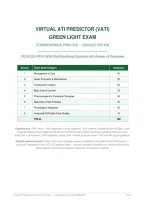
VIRTUAL ATI PREDICTOR (VATI)
GREEN LIGHT EXAM
COMPREHENSIVE PRACTICE • 2026/2027 EDITION
180 NCLEX-RN & NGN-Style Readiness Questions with Answers & Rationales
Section Client-Need Category Questions
1 Management of Care 30
2 Health Promotion & Maintenance 20
3 Psychosocial Integrity 20
4 Basic Care & Comfort 15
5 Pharmacological & Parenteral Therapies 30
6 Reduction of Risk Potential 25
7 Physiological Adaptation 25
8 Integrated NGN-Style Case Studies 15
TOTAL 180
Cognitive mix: ~30% recall • ~50% application/clinical judgment • ~20% analysis. Aligned with the NCSBN Clinical
Judgment Measurement Model and the full NCLEX-RN test plan. Section 8 presents unfolding NGN-style case
studies (MI + heart failure, COPD respiratory failure, DKA + sepsis, ischemic stroke + tPA, and AKI requiring dialysis).
Original practice material. These are AI-authored study questions modeled on the public NCLEX-RN blueprint —
not actual, copyrighted Virtual ATI / ATI predictor items — and are intended for practice only. Always verify clinical
details against current evidence-based references and program materials.
Virtual ATI Predictor (VATI) Green Light Exam — Comprehensive Practice (2026/2027) Page 1
, Section 1: Management of Care — Safety, Delegation, Legal/Ethical, Case
Management, Infection Control (30 questions)
Q1. A charge nurse is making assignments on a medical-surgical unit. Which client is most appropriate to
delegate to a licensed practical/vocational nurse (LPN/LVN)?
A. A newly admitted client requiring an admission assessment and care plan development
B. A stable client with a chronic wound requiring a routine dry dressing change
C. A client receiving a first dose of IV antibiotic who needs monitoring for reactions
D. A client being taught to self-administer insulin for the first time
Correct Answer: B
Rationale: LPN/LVNs may perform routine wound care on stable clients. Admission assessment, initial teaching,
and evaluation of a first-dose IV medication require RN-level judgment and cannot be delegated.
Q2. An RN is supervising unlicensed assistive personnel (UAP). Which task is appropriate to delegate to
the UAP?
A. Obtaining routine vital signs on a stable postoperative day-two client
B. Assessing a client's response to a new antihypertensive
C. Administering an oral medication to a stable client
D. Evaluating whether a teaching plan was effective
Correct Answer: A
Rationale: UAPs may collect vital signs on stable clients. Assessment, evaluation, and medication administration
require licensed personnel and cannot be delegated to a UAP.
Q3. The nurse discovers a medication error after administering the wrong dose. Which action should the
nurse take first?
A. Complete an incident report before anything else
B. Notify the nursing supervisor and risk management
C. Assess the client for adverse effects
D. Document the error in the client's medical record
Correct Answer: C
Rationale: Client safety is the priority, so the nurse must first assess the client for harm. The provider is then
notified, and an incident report is completed separately (never charted as part of the medical record).
Q4. A client with newly diagnosed pulmonary tuberculosis is admitted. Which type of precaution should
the nurse implement?
A. Contact precautions
B. Droplet precautions
C. Airborne precautions
D. Standard precautions only
Correct Answer: C
Rationale: Tuberculosis is transmitted by airborne droplet nuclei, requiring a negative-pressure room and an N95
respirator. Contact and droplet precautions are insufficient for airborne organisms.
Virtual ATI Predictor (VATI) Green Light Exam — Comprehensive Practice (2026/2027) Page 2
, Q5. Which client should the nurse assess first at the start of the shift?
A. A client scheduled for discharge awaiting transport
B. A postoperative client reporting incisional pain rated 6 of 10
C. A client with pneumonia and an oxygen saturation of 91% on 2 L nasal cannula
D. A client with new-onset confusion and a respiratory rate of 8/min
Correct Answer: D
Rationale: New-onset confusion with a respiratory rate of 8/min indicates a potential airway/breathing emergency
(ABCs). The other clients are stable or have expected findings that can be addressed after.
Q6. A client refuses a prescribed blood transfusion for religious reasons. The nurse's best action is to:
A. Tell the family so they can convince the client
B. Notify the provider and document the client's informed refusal
C. Administer the transfusion because it is medically necessary
D. Delay care until the client changes their mind
Correct Answer: B
Rationale: A competent adult has the right to refuse treatment (autonomy). The nurse honors the refusal, notifies
the provider, and documents it. Overriding the client's decision violates their rights.
Q7. An RN, LPN/LVN, and UAP are working together. Which assignment is most appropriate for the RN to
keep rather than delegate?
A. Recording oral intake and output
B. Reapplying antiembolism stockings
C. Reinforcing previously taught discharge instructions
D. Titrating an IV heparin infusion based on lab results
Correct Answer: D
Rationale: Titrating a high-alert IV infusion based on labs requires RN assessment and judgment. Reinforcing
teaching may be done by an LPN/LVN, and stockings/I&O; may be handled by a UAP.
Q8. Which situation requires the nurse to complete an occurrence (incident) report?
A. A client falls while ambulating to the bathroom
B. A client's family expresses satisfaction with care
C. A client is discharged with written instructions
D. A scheduled medication is administered on time
Correct Answer: A
Rationale: A client fall is an unexpected event that may cause harm and must be documented on an occurrence
report for quality-improvement tracking. Routine, expected care does not require a report.
Q9. A client with Clostridioides difficile infection is placed on contact precautions. Which action by the
nurse is correct?
A. Keep the door closed to maintain negative pressure
B. Use alcohol-based hand rub after client contact
C. Wear an N95 respirator when entering the room
D. Wash hands with soap and water after removing gloves
Correct Answer: D
Rationale: C. difficile spores are not killed by alcohol-based rubs; hand washing with soap and water is required.
An N95 and negative pressure are for airborne, not contact, precautions.
Virtual ATI Predictor (VATI) Green Light Exam — Comprehensive Practice (2026/2027) Page 3
, Q10. The nurse is developing a discharge plan for a client with heart failure. Which member of the
interdisciplinary team should the nurse consult for help arranging home oxygen and medications?
A. Physical therapist
B. Respiratory therapist
C. Registered dietitian
D. Case manager
Correct Answer: D
Rationale: The case manager coordinates community resources, home equipment, and continuity of care across
settings. Other disciplines address specific therapy needs rather than overall care coordination.
Q11. A nurse is caring for four clients. Which finding should be reported to the provider immediately?
A. A client with diabetes and a fasting glucose of 130 mg/dL
B. A client receiving heparin with a new report of black, tarry stools
C. A client with hypertension and a blood pressure of 138/86 mm Hg
D. A client 1 day post-appendectomy with a temperature of 37.6°C (99.7°F)
Correct Answer: B
Rationale: Black, tarry stools in a client on heparin suggest active GI bleeding, a potentially life-threatening
anticoagulation complication. The other findings are expected or only mildly abnormal.
Q12. When obtaining informed consent, the nurse understands that the nurse's primary role is to:
A. Provide the client with alternative treatment options
B. Witness the client's signature and confirm understanding
C. Explain the surgical procedure and its risks
D. Decide whether the client is competent to consent
Correct Answer: B
Rationale: The provider performing the procedure is responsible for explaining it and its risks/alternatives. The
nurse witnesses the signature and verifies the client understands and is consenting voluntarily.
Q13. A UAP reports a set of vital signs the RN believes is abnormal for a client. What should the RN do
first?
A. Reassess the client and vital signs personally
B. Document the vital signs as reported
C. Instruct the UAP to recheck in one hour
D. Notify the provider of the reported values
Correct Answer: A
Rationale: Because assessment and interpretation are RN responsibilities, the nurse should personally reassess
the client to validate the data before acting or notifying the provider.
Q14. A nurse suspects a coworker is diverting opioids. What is the nurse's most appropriate action?
A. Ignore it unless client harm occurs
B. Confront the coworker privately and ask them to stop
C. Document suspicions anonymously in the client's chart
D. Report the concern to the nurse manager following facility policy
Correct Answer: D
Rationale: Suspected drug diversion must be reported through the proper chain of command per policy to protect
clients and comply with legal/ethical obligations. Confrontation or ignoring the issue is inappropriate.
Virtual ATI Predictor (VATI) Green Light Exam — Comprehensive Practice (2026/2027) Page 4
GREEN LIGHT EXAM
COMPREHENSIVE PRACTICE • 2026/2027 EDITION
180 NCLEX-RN & NGN-Style Readiness Questions with Answers & Rationales
Section Client-Need Category Questions
1 Management of Care 30
2 Health Promotion & Maintenance 20
3 Psychosocial Integrity 20
4 Basic Care & Comfort 15
5 Pharmacological & Parenteral Therapies 30
6 Reduction of Risk Potential 25
7 Physiological Adaptation 25
8 Integrated NGN-Style Case Studies 15
TOTAL 180
Cognitive mix: ~30% recall • ~50% application/clinical judgment • ~20% analysis. Aligned with the NCSBN Clinical
Judgment Measurement Model and the full NCLEX-RN test plan. Section 8 presents unfolding NGN-style case
studies (MI + heart failure, COPD respiratory failure, DKA + sepsis, ischemic stroke + tPA, and AKI requiring dialysis).
Original practice material. These are AI-authored study questions modeled on the public NCLEX-RN blueprint —
not actual, copyrighted Virtual ATI / ATI predictor items — and are intended for practice only. Always verify clinical
details against current evidence-based references and program materials.
Virtual ATI Predictor (VATI) Green Light Exam — Comprehensive Practice (2026/2027) Page 1
, Section 1: Management of Care — Safety, Delegation, Legal/Ethical, Case
Management, Infection Control (30 questions)
Q1. A charge nurse is making assignments on a medical-surgical unit. Which client is most appropriate to
delegate to a licensed practical/vocational nurse (LPN/LVN)?
A. A newly admitted client requiring an admission assessment and care plan development
B. A stable client with a chronic wound requiring a routine dry dressing change
C. A client receiving a first dose of IV antibiotic who needs monitoring for reactions
D. A client being taught to self-administer insulin for the first time
Correct Answer: B
Rationale: LPN/LVNs may perform routine wound care on stable clients. Admission assessment, initial teaching,
and evaluation of a first-dose IV medication require RN-level judgment and cannot be delegated.
Q2. An RN is supervising unlicensed assistive personnel (UAP). Which task is appropriate to delegate to
the UAP?
A. Obtaining routine vital signs on a stable postoperative day-two client
B. Assessing a client's response to a new antihypertensive
C. Administering an oral medication to a stable client
D. Evaluating whether a teaching plan was effective
Correct Answer: A
Rationale: UAPs may collect vital signs on stable clients. Assessment, evaluation, and medication administration
require licensed personnel and cannot be delegated to a UAP.
Q3. The nurse discovers a medication error after administering the wrong dose. Which action should the
nurse take first?
A. Complete an incident report before anything else
B. Notify the nursing supervisor and risk management
C. Assess the client for adverse effects
D. Document the error in the client's medical record
Correct Answer: C
Rationale: Client safety is the priority, so the nurse must first assess the client for harm. The provider is then
notified, and an incident report is completed separately (never charted as part of the medical record).
Q4. A client with newly diagnosed pulmonary tuberculosis is admitted. Which type of precaution should
the nurse implement?
A. Contact precautions
B. Droplet precautions
C. Airborne precautions
D. Standard precautions only
Correct Answer: C
Rationale: Tuberculosis is transmitted by airborne droplet nuclei, requiring a negative-pressure room and an N95
respirator. Contact and droplet precautions are insufficient for airborne organisms.
Virtual ATI Predictor (VATI) Green Light Exam — Comprehensive Practice (2026/2027) Page 2
, Q5. Which client should the nurse assess first at the start of the shift?
A. A client scheduled for discharge awaiting transport
B. A postoperative client reporting incisional pain rated 6 of 10
C. A client with pneumonia and an oxygen saturation of 91% on 2 L nasal cannula
D. A client with new-onset confusion and a respiratory rate of 8/min
Correct Answer: D
Rationale: New-onset confusion with a respiratory rate of 8/min indicates a potential airway/breathing emergency
(ABCs). The other clients are stable or have expected findings that can be addressed after.
Q6. A client refuses a prescribed blood transfusion for religious reasons. The nurse's best action is to:
A. Tell the family so they can convince the client
B. Notify the provider and document the client's informed refusal
C. Administer the transfusion because it is medically necessary
D. Delay care until the client changes their mind
Correct Answer: B
Rationale: A competent adult has the right to refuse treatment (autonomy). The nurse honors the refusal, notifies
the provider, and documents it. Overriding the client's decision violates their rights.
Q7. An RN, LPN/LVN, and UAP are working together. Which assignment is most appropriate for the RN to
keep rather than delegate?
A. Recording oral intake and output
B. Reapplying antiembolism stockings
C. Reinforcing previously taught discharge instructions
D. Titrating an IV heparin infusion based on lab results
Correct Answer: D
Rationale: Titrating a high-alert IV infusion based on labs requires RN assessment and judgment. Reinforcing
teaching may be done by an LPN/LVN, and stockings/I&O; may be handled by a UAP.
Q8. Which situation requires the nurse to complete an occurrence (incident) report?
A. A client falls while ambulating to the bathroom
B. A client's family expresses satisfaction with care
C. A client is discharged with written instructions
D. A scheduled medication is administered on time
Correct Answer: A
Rationale: A client fall is an unexpected event that may cause harm and must be documented on an occurrence
report for quality-improvement tracking. Routine, expected care does not require a report.
Q9. A client with Clostridioides difficile infection is placed on contact precautions. Which action by the
nurse is correct?
A. Keep the door closed to maintain negative pressure
B. Use alcohol-based hand rub after client contact
C. Wear an N95 respirator when entering the room
D. Wash hands with soap and water after removing gloves
Correct Answer: D
Rationale: C. difficile spores are not killed by alcohol-based rubs; hand washing with soap and water is required.
An N95 and negative pressure are for airborne, not contact, precautions.
Virtual ATI Predictor (VATI) Green Light Exam — Comprehensive Practice (2026/2027) Page 3
, Q10. The nurse is developing a discharge plan for a client with heart failure. Which member of the
interdisciplinary team should the nurse consult for help arranging home oxygen and medications?
A. Physical therapist
B. Respiratory therapist
C. Registered dietitian
D. Case manager
Correct Answer: D
Rationale: The case manager coordinates community resources, home equipment, and continuity of care across
settings. Other disciplines address specific therapy needs rather than overall care coordination.
Q11. A nurse is caring for four clients. Which finding should be reported to the provider immediately?
A. A client with diabetes and a fasting glucose of 130 mg/dL
B. A client receiving heparin with a new report of black, tarry stools
C. A client with hypertension and a blood pressure of 138/86 mm Hg
D. A client 1 day post-appendectomy with a temperature of 37.6°C (99.7°F)
Correct Answer: B
Rationale: Black, tarry stools in a client on heparin suggest active GI bleeding, a potentially life-threatening
anticoagulation complication. The other findings are expected or only mildly abnormal.
Q12. When obtaining informed consent, the nurse understands that the nurse's primary role is to:
A. Provide the client with alternative treatment options
B. Witness the client's signature and confirm understanding
C. Explain the surgical procedure and its risks
D. Decide whether the client is competent to consent
Correct Answer: B
Rationale: The provider performing the procedure is responsible for explaining it and its risks/alternatives. The
nurse witnesses the signature and verifies the client understands and is consenting voluntarily.
Q13. A UAP reports a set of vital signs the RN believes is abnormal for a client. What should the RN do
first?
A. Reassess the client and vital signs personally
B. Document the vital signs as reported
C. Instruct the UAP to recheck in one hour
D. Notify the provider of the reported values
Correct Answer: A
Rationale: Because assessment and interpretation are RN responsibilities, the nurse should personally reassess
the client to validate the data before acting or notifying the provider.
Q14. A nurse suspects a coworker is diverting opioids. What is the nurse's most appropriate action?
A. Ignore it unless client harm occurs
B. Confront the coworker privately and ask them to stop
C. Document suspicions anonymously in the client's chart
D. Report the concern to the nurse manager following facility policy
Correct Answer: D
Rationale: Suspected drug diversion must be reported through the proper chain of command per policy to protect
clients and comply with legal/ethical obligations. Confrontation or ignoring the issue is inappropriate.
Virtual ATI Predictor (VATI) Green Light Exam — Comprehensive Practice (2026/2027) Page 4


