
NR 226 - Final Exam Study Outline. Study Guide. Complete.
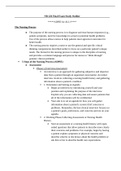
NR 226 - Final Exam Study Outline. Study Guide. Complete. The Nursing Process o The purpose of the nursing process is to diagnose and treat human responses (e.g., patient symptoms, need for knowledge) to actual or potential health problems. Use of the process allows nurses to help patients meet agreed-on outcomes for better health. o The nursing process requires a nurse to use the general and specific critical thinking competencies described earlier to focus on a particular patient's unique needs. The format for the nursing process is unique to the discipline of nursing and provides a common language and process for nurses to “think through” patients' clinical problems 5 Steps of the Nursing Process (ADPIE) o Assessment Phases of interview/assessment An interview is an approach for gathering subjective and objective data from a patient through an organized conversation. An initial interview involves collecting a nursing health history and gathering information about a patient's condition 1. Orientation and Setting an Agenda o Begin an interview by introducing yourself and your position and explaining the purpose of the interview. Explain why you are collecting data and assure patients that all of the information will be confidential. o Your aim is to set an agenda for how you will gather information about a patient's current chief concerns or problems. Remember, the best clinical interview focuses on a patient's goals, preferences, and concerns and not on your agenda. 2. Working Phase-Collecting Assessment or Nursing Health History o Start an assessment or a nursing health history with openended questions that allow patients to describe more clearly their concerns and problems. For example, begin by having a patient explain symptoms or physical concerns and describe what he or she knows about the health problem or ask him or her to describe health care expectations. o Use attentive listening and other therapeutic communication techniques that encourage a patient to tell his or her story. 3. Terminating an Interview o Termination of an interview requires skill. You summarize your discussion with a patient and check for accuracy of the information collected. Give your patient a clue that the interview is coming to an end. For example, say, “I have just two more questions. We'll be finished in a few more minutes.” o This helps a patient maintain direct attention without being distracted by wondering when the interview will end. Methods of obtaining data An assessment is necessary for you to gather information to make accurate judgments about a patient's current condition. Your information comes from: The patient through interview, observations, and physical examination. Family members or significant others' reports and response to interviews. Other members of the health care team. Medical record information (e.g., patient history, laboratory work, x-ray film results, multidisciplinary consultations). Scientific and medical literature (evidence about disease conditions, assessment techniques, and standards). Subjective Data Subjective data are your patients' verbal descriptions of their health problems. For example, Mr. Lawson's self-report of pain at the area where his incision slightly separated is an example of subjective data. Subjective data include patients' feelings, perceptions, and self-report of symptoms. Only patients provide subjective data relevant to their health condition. The data often reflect physiological changes, which you further explore through objective review of body systems. Objective Data Objective data are observations or measurements of a patient's health status. Inspecting the condition of a surgical incision or wound, describing an observed behavior, and measuring blood pressure are examples of objective data.
Document information
- Uploaded on
- August 13, 2021
- Number of pages
- 63
- Written in
- 2021/2022
- Type
- Other
- Person
- Unknown


