
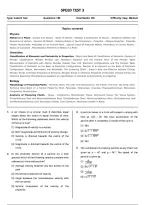
SPEED TEST 3
Type: Custom Test Questions: 180 Total Marks: 720 Difficulty: Easy, Medium
Topics covered
Physics
Motion in a Plane - Scalars and Vectors , Types of Vectors , Addition & Subtraction of Vectors , Analytical addition and
Resolution of Vectors , General 2D Motion , Relative Motion in Two Dimensions , Projectile – Oblique Projectile , Projectile
Thrown Horizontally, Projectiles on an Inclined Plane , Special Cases Of Projectile Motion, Kinematics of Circular Motion ,
Radius of Curvature , Miscellaneous Problems in Motion in a Plane
Chemistry
Classification of Elements and Periodicity in Properties - Object and Need of Classification of Elements, Genesis of
Periodic Classification, Modern Periodic Law, Moseley’s Equation and the Present Form of the Periodic Table,
Nomenclature of Elements with Atomic Number Greater than 100, Electronic Configurations and The Periodic Table,
Classification of Elements on the Basis of Electronic Configurations, Position of an Element on the Basis of Electronic
Configuration, Metals, Non-metals and Metalloids, The Screening Effect , Slater’s Rule and Effective Nuclear Charge,
Periodic Trends in Periodic Properties of Elements, Periodic Trends in Chemical Properties of Elements, Periodic Trends and
Chemical Reactivity, Miscellaneous questions on classification of elements and periodicity in properties
Biology
Morphology of Flowering Plants - The Root, Stem, The Leaf, The Inflorescence, The Flower, The Fruit, The Seed, Semi-
Technical Description of a Typical Flowering Plant, Fabaceae, Solanaceae, Liliaceae, Poaceae/Graminae, Malvaceae,
Compositae, Brassicaceae
Anatomy of Flowering Plants - Tissue - Introduction, Meristematic Tissue, Permanent Tissue, The Tissue System,
Dicotyledonous Root and Monocotyledonous Root, Dicotyledonous Stem, Monocotyledonous Stem, Dicotyledonous Leaf
and Monocotyledonous Leaf, Secondary Growth, Cork Cambium, Secondary Growth in Roots
1. A car moves on a circular road. It describes equal 3. A particle moves in a circle with speed v varying with
angles about the centre in equal intervals of time. time as v(t) = 2t . The total acceleration of the
Which of the following statement about the velocity
particle after it completes 2 rounds of the cycle is
of the car is true?
(1) 16π
(1) Magnitude of velocity is constant.
(2) Both magnitude and direction of velocity change. (2) 2√ 1 + 64π
2
(3) Velocity is directed towards the centre of the (3) 2√ 1 + 49π
2
circle.
(4) 14π
(4) Magnitude is directed towards the centre of the
circle. 4. The coordinate of a moving particle at any time t are
given by x = ct
2
and y = bt
2
. The speed of the
2. In the projectile motion of a particle on a level
ground, which of the following remains constant with particle is given by :
reference to time and position? (1) 2t
√ c 2 +b 2
(1) Average velocity between any two points on the (2) 2
2t√ c + b
2
path
(3) t
(2) Horizontal component of velocity √ c 2 +b 2
(4) t√ c 2 + b 2
(3) Angle between the instantaneous velocity with
the horizontal
(4) Vertical component of the velocity of the
projectile
,5. A person sitting in an open car moving at constant 10. A particle is moving in a radius R with constant
velocity throws a ball vertically up into air. The ball speed v. The magnitude of average acceleration after
falls
half revolution is
(1) Outside the car
(1) 2π
(2) In the car ahead of the person
Rv
(2) 2π
(3) In the car to the side of the person Rv
2
(3)
2
2v
(4) Exactly in the hand which threw it up πR
(4) 2v
6. Wind is blowing - with and steamer is heading
2
πR
N E
due east. In which direction is the flag fluttering? 11. A stone is just released from the window of a train
(1) North moving along a horizontal straight track. The stone
will hit the ground following a:
(2) North-West
(3) South (1) Circular path
(4) South-West (2) Straight line path
(3) Hyperbolic path
7. A ball is projected at an angle 60 with the horizontal
∘
(4) Parabolic path
with speed 30 m s / . After certain time it makes an
12. Keeping the velocity of projection constant, the angle
angle 45
∘
with the horizontal. The speed of ball at
of projection is increased from 0 to 90 , then the
∘ ∘
that moment is
horizontal range of the projectile
(1) 30√ 2 m/s
(1) Goes on increasing upto 90 ∘
(2) 15√ 2 m/s
(2) Decreases upto 90 ∘
(3) 30 m/s
(3) Increases upto 45 and decreases afterwards
∘
(4) 15
m/s
√2
(4) Decreases upto 45 and increases afterwards
∘
8. The x and y coordinates of the particle at any time
13. A particle leaves the origin with initial velocity
are x = 5t − 2t and y = 10t respectively, where x
2
v = (3^
i)m/s and a constant acceleration
and y are in meters and t in seconds. The
a = (−1^
i − 0.5^
j)m/s
2
.The position vector of
acceleration of the particle at t = 2s is
particle, when it reaches its maximum x-coordinate,
(1) 5 m/s
2
is
(2) −4 m/s
2 9
(1) (^
i −^
j)m
2
(3) −8 m/s
2
^
9 j
(2) (^
i − )m
(4) 0 2 2
9
9. → (3) (−^
i +^
j)m
The angle made by the vector A =^
i +^
j with x- axis 2
is 9 ^
i
(4) ( −^
j)m
2 2
(1) 45
∘
(2) 90
∘
(3) 30
∘
(4) 22.5
∘
,14. Assertion: A projectile that traverses a parabolic 18. Read the Statement − A and Statement − B
path show deviation from its idealised trajectory in carefully to mark the correct option given below:
the presence of air resistance.
The average velocity of a The direction of the
Reason: Air resistance affect the motion of the particle is the total path average velocity vector is
projectile. length divided by the determined by the
(1) Both Assertion and Reason are correct and total time taken. direction of the
Reason is the correct explanation of the displacement vector.
Assertion.
(1) Both Statement A and Statement B are true.
(2) Both Assertion and Reason are correct but
(2) Statement A is true, but Statement B is false.
Reason is not the correct explanation of the
(3) Statement A is false, but Statement B is true.
Assertion.
(4) Both Statement A and Statement B are false.
(3) Assertion is correct but Reason is incorrect.
(4) Assertion is incorrect but reason is correct. 19. Assertion: If the sum of the two unit vectors is also a
unit vector, then magnitude of their difference is root
15. The y-component of vector A is +3.0m, if A makes
of three.
an angle of 30
∘
counter clockwise from the positive
Y -axis, the magnitude of A is (assume A is in XY - Reason: To find resultant of two vectors, we use
plane) parallelogram law of vector addition.
(1) 2√ 3 m
(1) Both Assertion and Reason are correct and
Reason is the correct explanation of the
(2) √ 11 m
Assertion.
(3) √ 15 m (2) Both Assertion and Reason are correct but
Reason is not the correct explanation of the
(4) √ 21 m
Assertion.
16. A planet is moving in a circular orbit. It completes 2 (3) Assertion is correct but Reason is incorrect.
revolutions in 360 days. What is its angular (4) Assertion is incorrect but reason is correct.
frequency?
20. A bomb is dropped on an enemy post on the ground
(1) 1.5 × 10
−2
rad/ day
by an aeroplane flying horizontally with a velocity of
(2) 2.5 × 10
−2
rad/ day 60kmh at a height of 490 m. At the time of
−1
(3) 3.5 × 10
−2
rad/ day dropping the bomb, the horizontal distance of the
aeroplane from the enemy post, so that the bomb
(4) 4.5 × 10
−2
rad/ day
hits the target is
17. 400
Unit vectors are used to (1) ( )m
If and are unit vectors
^
i ^
j 3
along x -axis and y-axis indicate direction only. 500
(2) ( )m
respectively, the 3
magnitude of vector (3) (
1700
)m
j will be √ 2.
^ 3
i −^
(4) 498 m
(1) Statement A is correct but Statement B is
21. A child travelling in a train throws a ball outside with
incorrect.
a speed V . According to a child who is standing on
(2) Statement A is incorrect but Statement B is
the ground, the speed of the ball is
correct.
(3) Both Statements are correct. (1) Same as V
(4) Both Statements are incorrect. (2) Greater than V
(3) Less than V
(4) None of these
, 22. Consider the following vectors. 24. Consider the velocity-time graph. It represents the
motion of
(1) A projectile projected vertically upward, from a
point
(2) An electron in the hydrogen atom
(3) A car with constant acceleration along a straight
road
Choose the correct vectors.
(4) A bullet fired horizontally from the top of a tower
→
(1) E = A − B
→ → and A→ = D
→ + C→
25. Assertion: In projectile motion, the angle between
(2) → → → and A→ = −D
→ + C→
−E = −A + B
the instantaneous velocity and acceleration at the
→
(3) E = −A − B
→ → and E
→ → →
= −B + D + C
→ highest point is 180 . ∘
→
(4) E = −A − B → → and E
→ → →
= −B + C − D →
Reason: At the highest point, velocity of projectile
23. A body lying initially at point (3, 7) starts moving with will be in horizontal direction only.
a constant acceleration of . Its position after 3s is
4^
i
(1) Both assertion and reason are correct and reason
isthe correct explanation of assertion.
given by the coordinates:
(2) Both assertion and reason are correct but reason
(1) (7, 18)
is not the correct explanation of assertion.
(2) (7, 3)
(3) Assertion is correct but reason is incorrect.
(3) (3, 7) (4) Assertion is incorrect but reason is correct.
(4) (21, 7)
26. A car is travelling with linear velocity v on a circular
road of radius r. If its velocity is increasing at a rate
of a ms , then the resultant acceleration will be
−2
2
v
(1) √( 2
− a )
r2
4
v
(2) √(
2
+ a2 )
r
4
v
(3) √(
2
2
− a )
r
2
v
(4) √(
2
+ a2 )
r
Type: Custom Test Questions: 180 Total Marks: 720 Difficulty: Easy, Medium
Topics covered
Physics
Motion in a Plane - Scalars and Vectors , Types of Vectors , Addition & Subtraction of Vectors , Analytical addition and
Resolution of Vectors , General 2D Motion , Relative Motion in Two Dimensions , Projectile – Oblique Projectile , Projectile
Thrown Horizontally, Projectiles on an Inclined Plane , Special Cases Of Projectile Motion, Kinematics of Circular Motion ,
Radius of Curvature , Miscellaneous Problems in Motion in a Plane
Chemistry
Classification of Elements and Periodicity in Properties - Object and Need of Classification of Elements, Genesis of
Periodic Classification, Modern Periodic Law, Moseley’s Equation and the Present Form of the Periodic Table,
Nomenclature of Elements with Atomic Number Greater than 100, Electronic Configurations and The Periodic Table,
Classification of Elements on the Basis of Electronic Configurations, Position of an Element on the Basis of Electronic
Configuration, Metals, Non-metals and Metalloids, The Screening Effect , Slater’s Rule and Effective Nuclear Charge,
Periodic Trends in Periodic Properties of Elements, Periodic Trends in Chemical Properties of Elements, Periodic Trends and
Chemical Reactivity, Miscellaneous questions on classification of elements and periodicity in properties
Biology
Morphology of Flowering Plants - The Root, Stem, The Leaf, The Inflorescence, The Flower, The Fruit, The Seed, Semi-
Technical Description of a Typical Flowering Plant, Fabaceae, Solanaceae, Liliaceae, Poaceae/Graminae, Malvaceae,
Compositae, Brassicaceae
Anatomy of Flowering Plants - Tissue - Introduction, Meristematic Tissue, Permanent Tissue, The Tissue System,
Dicotyledonous Root and Monocotyledonous Root, Dicotyledonous Stem, Monocotyledonous Stem, Dicotyledonous Leaf
and Monocotyledonous Leaf, Secondary Growth, Cork Cambium, Secondary Growth in Roots
1. A car moves on a circular road. It describes equal 3. A particle moves in a circle with speed v varying with
angles about the centre in equal intervals of time. time as v(t) = 2t . The total acceleration of the
Which of the following statement about the velocity
particle after it completes 2 rounds of the cycle is
of the car is true?
(1) 16π
(1) Magnitude of velocity is constant.
(2) Both magnitude and direction of velocity change. (2) 2√ 1 + 64π
2
(3) Velocity is directed towards the centre of the (3) 2√ 1 + 49π
2
circle.
(4) 14π
(4) Magnitude is directed towards the centre of the
circle. 4. The coordinate of a moving particle at any time t are
given by x = ct
2
and y = bt
2
. The speed of the
2. In the projectile motion of a particle on a level
ground, which of the following remains constant with particle is given by :
reference to time and position? (1) 2t
√ c 2 +b 2
(1) Average velocity between any two points on the (2) 2
2t√ c + b
2
path
(3) t
(2) Horizontal component of velocity √ c 2 +b 2
(4) t√ c 2 + b 2
(3) Angle between the instantaneous velocity with
the horizontal
(4) Vertical component of the velocity of the
projectile
,5. A person sitting in an open car moving at constant 10. A particle is moving in a radius R with constant
velocity throws a ball vertically up into air. The ball speed v. The magnitude of average acceleration after
falls
half revolution is
(1) Outside the car
(1) 2π
(2) In the car ahead of the person
Rv
(2) 2π
(3) In the car to the side of the person Rv
2
(3)
2
2v
(4) Exactly in the hand which threw it up πR
(4) 2v
6. Wind is blowing - with and steamer is heading
2
πR
N E
due east. In which direction is the flag fluttering? 11. A stone is just released from the window of a train
(1) North moving along a horizontal straight track. The stone
will hit the ground following a:
(2) North-West
(3) South (1) Circular path
(4) South-West (2) Straight line path
(3) Hyperbolic path
7. A ball is projected at an angle 60 with the horizontal
∘
(4) Parabolic path
with speed 30 m s / . After certain time it makes an
12. Keeping the velocity of projection constant, the angle
angle 45
∘
with the horizontal. The speed of ball at
of projection is increased from 0 to 90 , then the
∘ ∘
that moment is
horizontal range of the projectile
(1) 30√ 2 m/s
(1) Goes on increasing upto 90 ∘
(2) 15√ 2 m/s
(2) Decreases upto 90 ∘
(3) 30 m/s
(3) Increases upto 45 and decreases afterwards
∘
(4) 15
m/s
√2
(4) Decreases upto 45 and increases afterwards
∘
8. The x and y coordinates of the particle at any time
13. A particle leaves the origin with initial velocity
are x = 5t − 2t and y = 10t respectively, where x
2
v = (3^
i)m/s and a constant acceleration
and y are in meters and t in seconds. The
a = (−1^
i − 0.5^
j)m/s
2
.The position vector of
acceleration of the particle at t = 2s is
particle, when it reaches its maximum x-coordinate,
(1) 5 m/s
2
is
(2) −4 m/s
2 9
(1) (^
i −^
j)m
2
(3) −8 m/s
2
^
9 j
(2) (^
i − )m
(4) 0 2 2
9
9. → (3) (−^
i +^
j)m
The angle made by the vector A =^
i +^
j with x- axis 2
is 9 ^
i
(4) ( −^
j)m
2 2
(1) 45
∘
(2) 90
∘
(3) 30
∘
(4) 22.5
∘
,14. Assertion: A projectile that traverses a parabolic 18. Read the Statement − A and Statement − B
path show deviation from its idealised trajectory in carefully to mark the correct option given below:
the presence of air resistance.
The average velocity of a The direction of the
Reason: Air resistance affect the motion of the particle is the total path average velocity vector is
projectile. length divided by the determined by the
(1) Both Assertion and Reason are correct and total time taken. direction of the
Reason is the correct explanation of the displacement vector.
Assertion.
(1) Both Statement A and Statement B are true.
(2) Both Assertion and Reason are correct but
(2) Statement A is true, but Statement B is false.
Reason is not the correct explanation of the
(3) Statement A is false, but Statement B is true.
Assertion.
(4) Both Statement A and Statement B are false.
(3) Assertion is correct but Reason is incorrect.
(4) Assertion is incorrect but reason is correct. 19. Assertion: If the sum of the two unit vectors is also a
unit vector, then magnitude of their difference is root
15. The y-component of vector A is +3.0m, if A makes
of three.
an angle of 30
∘
counter clockwise from the positive
Y -axis, the magnitude of A is (assume A is in XY - Reason: To find resultant of two vectors, we use
plane) parallelogram law of vector addition.
(1) 2√ 3 m
(1) Both Assertion and Reason are correct and
Reason is the correct explanation of the
(2) √ 11 m
Assertion.
(3) √ 15 m (2) Both Assertion and Reason are correct but
Reason is not the correct explanation of the
(4) √ 21 m
Assertion.
16. A planet is moving in a circular orbit. It completes 2 (3) Assertion is correct but Reason is incorrect.
revolutions in 360 days. What is its angular (4) Assertion is incorrect but reason is correct.
frequency?
20. A bomb is dropped on an enemy post on the ground
(1) 1.5 × 10
−2
rad/ day
by an aeroplane flying horizontally with a velocity of
(2) 2.5 × 10
−2
rad/ day 60kmh at a height of 490 m. At the time of
−1
(3) 3.5 × 10
−2
rad/ day dropping the bomb, the horizontal distance of the
aeroplane from the enemy post, so that the bomb
(4) 4.5 × 10
−2
rad/ day
hits the target is
17. 400
Unit vectors are used to (1) ( )m
If and are unit vectors
^
i ^
j 3
along x -axis and y-axis indicate direction only. 500
(2) ( )m
respectively, the 3
magnitude of vector (3) (
1700
)m
j will be √ 2.
^ 3
i −^
(4) 498 m
(1) Statement A is correct but Statement B is
21. A child travelling in a train throws a ball outside with
incorrect.
a speed V . According to a child who is standing on
(2) Statement A is incorrect but Statement B is
the ground, the speed of the ball is
correct.
(3) Both Statements are correct. (1) Same as V
(4) Both Statements are incorrect. (2) Greater than V
(3) Less than V
(4) None of these
, 22. Consider the following vectors. 24. Consider the velocity-time graph. It represents the
motion of
(1) A projectile projected vertically upward, from a
point
(2) An electron in the hydrogen atom
(3) A car with constant acceleration along a straight
road
Choose the correct vectors.
(4) A bullet fired horizontally from the top of a tower
→
(1) E = A − B
→ → and A→ = D
→ + C→
25. Assertion: In projectile motion, the angle between
(2) → → → and A→ = −D
→ + C→
−E = −A + B
the instantaneous velocity and acceleration at the
→
(3) E = −A − B
→ → and E
→ → →
= −B + D + C
→ highest point is 180 . ∘
→
(4) E = −A − B → → and E
→ → →
= −B + C − D →
Reason: At the highest point, velocity of projectile
23. A body lying initially at point (3, 7) starts moving with will be in horizontal direction only.
a constant acceleration of . Its position after 3s is
4^
i
(1) Both assertion and reason are correct and reason
isthe correct explanation of assertion.
given by the coordinates:
(2) Both assertion and reason are correct but reason
(1) (7, 18)
is not the correct explanation of assertion.
(2) (7, 3)
(3) Assertion is correct but reason is incorrect.
(3) (3, 7) (4) Assertion is incorrect but reason is correct.
(4) (21, 7)
26. A car is travelling with linear velocity v on a circular
road of radius r. If its velocity is increasing at a rate
of a ms , then the resultant acceleration will be
−2
2
v
(1) √( 2
− a )
r2
4
v
(2) √(
2
+ a2 )
r
4
v
(3) √(
2
2
− a )
r
2
v
(4) √(
2
+ a2 )
r


