
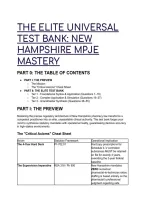
THE ELITE UNIVERSAL
TEST BANK: NEW
HAMPSHIRE MPJE
MASTERY
PART 0: THE TABLE OF CONTENTS
● PART I: THE PREVIEW
○ The Mission
○ The "Critical Axioms" Cheat Sheet
● PART II: THE ELITE TEST BANK
○ Tier 1 - Foundational Syntax & Application (Questions 1–18)
○ Tier 2 - Complex Application & Simulation (Questions 19–37)
○ Tier 3 - Grandmaster Synthesis (Questions 38–55)
PART I: THE PREVIEW
Mastering the precise regulatory architecture of New Hampshire pharmacy law transforms a
competent practitioner into an elite, unassailable clinical authority. This test bank forges your
mind to synthesize statutory mandates with operational reality, guaranteeing decisive accuracy
in high-stakes environments.
The "Critical Axioms" Cheat Sheet
Axiom Statutory Framework Operational Implication
The 4-Year Hard Deck Ph 702.01 Hardcopy prescriptions for
Schedule II–V controlled
substances MUST be retained
on file for exactly 4 years,
overriding the 2-year federal
baseline.
The Supervision Imperative RSA 318 / Ph 800 New Hampshire mandates
ZERO numerical
pharmacist-to-technician ratios;
staffing is based entirely on the
pharmacist's professional
judgment regarding safe
,Axiom Statutory Framework Operational Implication
supervision.
The PIC Transition Ph 704.13 A new Pharmacist-in-Charge
(PIC) MUST complete a written
inventory of all controlled
substances within exactly 3
days of assuming the role.
The Tiered Technician RSA 318:16-b / Ph 800 Certified Pharmacy Technicians
Doctrine (CPhTs) are restricted to
Flu/COVID-19 vaccines;
Licensed Advanced Pharmacy
Technicians (LAPTs) administer
all CDC-approved vaccines
(18+) and perform
tech-check-tech, but cannot
verify compounds.
The 34-Day Baseline RSA 318-B:9 Schedule II and III prescriptions
are limited to a maximum
34-day supply, with a singular
90-day exception for ADHD or
narcolepsy treatments.
PART II: THE ELITE TEST BANK
Tier 1 - Foundational Syntax & Application
Q1: A patient presents a hardcopy prescription for a Schedule II controlled substance. After
dispensing the medication, how long must the pharmacy retain the physical hardcopy on file
under New Hampshire Administrative Code Ph 702.01? Based on the principles of New
Hampshire record retention, which action is the MOST ACCURATE? A) Retain the physical
hardcopy prescription on file for 2 years alongside standard DEA inventories. B) Scan the
hardcopy immediately and shred the physical document, retaining the digital copy for 2 years.
C) Retain the physical hardcopy prescription on file for exactly 4 years. D) Retain the physical
hardcopy prescription indefinitely in an on-site secure vault.
● Answer: C (Retain the physical hardcopy prescription on file for exactly 4 years.)
● Distractor Analysis:
○ A is incorrect: Standard operational records (like DEA biennial logs) require 2-year
retention, but NH state law strictly extends hardcopy C-II–V retention.
○ B is incorrect: Electronic reproduction on demand is permitted for other records, but
hardcopy C-II–V prescriptions must be physically retained if not originally electronic.
○ D is incorrect: Indefinite retention is an operational liability and a legacy analytical
error not supported by statute.
The Mentor's Analysis: State law frequently overrides federal minimums. When facing controlled
substance recordkeeping, the immediate priority is adhering to the most stringent standard. By
utilizing the 4-year statutory mandate, you bypass the common trap of applying federal 2-year
rules universally. Professional Intuition: Always default to the stricter standard; in New
Hampshire, hardcopy controlled substance prescriptions demand a 4-year retention
lifecycle.
, Q2: A retail pharmacy manager is scheduling staff for the upcoming flu season and wishes to
maximize prescription output. Based on the principles of New Hampshire pharmacy supervision
(RSA 318), what is the MAXIMUM permissible ratio of pharmacy technicians to a single
supervising pharmacist? A) One pharmacist to two technicians (1:2). B) One pharmacist to four
technicians, provided at least two are certified (1:4). C) One pharmacist to six technicians (1:6).
D) There is no statutory numerical ratio; staffing is based on the pharmacist's professional
judgment.
● Answer: D (There is no statutory numerical ratio; staffing is based on the pharmacist's
professional judgment.)
● Distractor Analysis:
○ A is incorrect: This is a legacy standard used in other jurisdictions, fundamentally
inapplicable to NH.
○ B is incorrect: This mirrors structured ratios in states like Massachusetts,
representing a novice jurisdictional mix-up.
○ C is incorrect: This is the maximum ratio in states like Colorado, not NH.
The Mentor's Analysis: New Hampshire trusts clinical authority over arbitrary numbers. When
facing workforce allocation, the immediate priority is ensuring safe, direct supervision. By
utilizing professional judgment, you bypass the common trap of artificially restricting operations
based on out-of-state metrics. Professional Intuition: New Hampshire places no statutory
ratio on technicians; the supervising pharmacist's clinical judgment is the sole metric of
compliance.
Q3: A patient submits a prescription for dextroamphetamine/amphetamine (Adderall) for the
treatment of Attention Deficit Hyperactivity Disorder (ADHD). Based on the principles of RSA
318-B:9, what is the MAXIMUM day supply the pharmacist may legally dispense upon a single
filling? A) 30 days B) 34 days C) 90 days D) 6 months
● Answer: C (90 days)
● Distractor Analysis:
○ A is incorrect: Thirty days is a common federal misconception; NH relies on specific
days-supply metrics.
○ B is incorrect: While 34 days is the standard maximum for C-II and C-III drugs in
NH, ADHD and narcolepsy trigger a statutory exception.
○ D is incorrect: Six months is the expiration timeframe for a controlled prescription,
not the dispensing limit per fill.
The Mentor's Analysis: Regulatory exceptions define advanced practice. When facing stimulant
prescriptions for specific diagnoses, the immediate priority is verifying the clinical indication. By
utilizing the 90-day statutory exception, you bypass the common trap of erroneously truncating
legitimate chronic therapy to 34 days. Professional Intuition: The NH C-II/C-III hard deck is 34
days, but amphetamines and methylphenidate for ADHD/Narcolepsy unlock a 90-day
supply exception.
Q4: A Certified Pharmacy Technician (CPhT) is approached by a 45-year-old patient requesting
a Hepatitis B vaccination. Based on the principles of RSA 318:16-b, which action is the MOST
APPROPRIATE? A) Administer the vaccine, as CPhTs may administer any CDC-recommended
vaccine to adults over 18. B) Refuse the administration, as CPhTs are only authorized to
administer influenza and COVID-19 vaccines to the general public. C) Administer the vaccine
only if a Licensed Advanced Pharmacy Technician (LAPT) verifies the dose first. D) Refuse the
administration, as only pharmacists and pharmacy interns may administer injections in New
Hampshire.
● Answer: B (Refuse the administration, as CPhTs are only authorized to administer
TEST BANK: NEW
HAMPSHIRE MPJE
MASTERY
PART 0: THE TABLE OF CONTENTS
● PART I: THE PREVIEW
○ The Mission
○ The "Critical Axioms" Cheat Sheet
● PART II: THE ELITE TEST BANK
○ Tier 1 - Foundational Syntax & Application (Questions 1–18)
○ Tier 2 - Complex Application & Simulation (Questions 19–37)
○ Tier 3 - Grandmaster Synthesis (Questions 38–55)
PART I: THE PREVIEW
Mastering the precise regulatory architecture of New Hampshire pharmacy law transforms a
competent practitioner into an elite, unassailable clinical authority. This test bank forges your
mind to synthesize statutory mandates with operational reality, guaranteeing decisive accuracy
in high-stakes environments.
The "Critical Axioms" Cheat Sheet
Axiom Statutory Framework Operational Implication
The 4-Year Hard Deck Ph 702.01 Hardcopy prescriptions for
Schedule II–V controlled
substances MUST be retained
on file for exactly 4 years,
overriding the 2-year federal
baseline.
The Supervision Imperative RSA 318 / Ph 800 New Hampshire mandates
ZERO numerical
pharmacist-to-technician ratios;
staffing is based entirely on the
pharmacist's professional
judgment regarding safe
,Axiom Statutory Framework Operational Implication
supervision.
The PIC Transition Ph 704.13 A new Pharmacist-in-Charge
(PIC) MUST complete a written
inventory of all controlled
substances within exactly 3
days of assuming the role.
The Tiered Technician RSA 318:16-b / Ph 800 Certified Pharmacy Technicians
Doctrine (CPhTs) are restricted to
Flu/COVID-19 vaccines;
Licensed Advanced Pharmacy
Technicians (LAPTs) administer
all CDC-approved vaccines
(18+) and perform
tech-check-tech, but cannot
verify compounds.
The 34-Day Baseline RSA 318-B:9 Schedule II and III prescriptions
are limited to a maximum
34-day supply, with a singular
90-day exception for ADHD or
narcolepsy treatments.
PART II: THE ELITE TEST BANK
Tier 1 - Foundational Syntax & Application
Q1: A patient presents a hardcopy prescription for a Schedule II controlled substance. After
dispensing the medication, how long must the pharmacy retain the physical hardcopy on file
under New Hampshire Administrative Code Ph 702.01? Based on the principles of New
Hampshire record retention, which action is the MOST ACCURATE? A) Retain the physical
hardcopy prescription on file for 2 years alongside standard DEA inventories. B) Scan the
hardcopy immediately and shred the physical document, retaining the digital copy for 2 years.
C) Retain the physical hardcopy prescription on file for exactly 4 years. D) Retain the physical
hardcopy prescription indefinitely in an on-site secure vault.
● Answer: C (Retain the physical hardcopy prescription on file for exactly 4 years.)
● Distractor Analysis:
○ A is incorrect: Standard operational records (like DEA biennial logs) require 2-year
retention, but NH state law strictly extends hardcopy C-II–V retention.
○ B is incorrect: Electronic reproduction on demand is permitted for other records, but
hardcopy C-II–V prescriptions must be physically retained if not originally electronic.
○ D is incorrect: Indefinite retention is an operational liability and a legacy analytical
error not supported by statute.
The Mentor's Analysis: State law frequently overrides federal minimums. When facing controlled
substance recordkeeping, the immediate priority is adhering to the most stringent standard. By
utilizing the 4-year statutory mandate, you bypass the common trap of applying federal 2-year
rules universally. Professional Intuition: Always default to the stricter standard; in New
Hampshire, hardcopy controlled substance prescriptions demand a 4-year retention
lifecycle.
, Q2: A retail pharmacy manager is scheduling staff for the upcoming flu season and wishes to
maximize prescription output. Based on the principles of New Hampshire pharmacy supervision
(RSA 318), what is the MAXIMUM permissible ratio of pharmacy technicians to a single
supervising pharmacist? A) One pharmacist to two technicians (1:2). B) One pharmacist to four
technicians, provided at least two are certified (1:4). C) One pharmacist to six technicians (1:6).
D) There is no statutory numerical ratio; staffing is based on the pharmacist's professional
judgment.
● Answer: D (There is no statutory numerical ratio; staffing is based on the pharmacist's
professional judgment.)
● Distractor Analysis:
○ A is incorrect: This is a legacy standard used in other jurisdictions, fundamentally
inapplicable to NH.
○ B is incorrect: This mirrors structured ratios in states like Massachusetts,
representing a novice jurisdictional mix-up.
○ C is incorrect: This is the maximum ratio in states like Colorado, not NH.
The Mentor's Analysis: New Hampshire trusts clinical authority over arbitrary numbers. When
facing workforce allocation, the immediate priority is ensuring safe, direct supervision. By
utilizing professional judgment, you bypass the common trap of artificially restricting operations
based on out-of-state metrics. Professional Intuition: New Hampshire places no statutory
ratio on technicians; the supervising pharmacist's clinical judgment is the sole metric of
compliance.
Q3: A patient submits a prescription for dextroamphetamine/amphetamine (Adderall) for the
treatment of Attention Deficit Hyperactivity Disorder (ADHD). Based on the principles of RSA
318-B:9, what is the MAXIMUM day supply the pharmacist may legally dispense upon a single
filling? A) 30 days B) 34 days C) 90 days D) 6 months
● Answer: C (90 days)
● Distractor Analysis:
○ A is incorrect: Thirty days is a common federal misconception; NH relies on specific
days-supply metrics.
○ B is incorrect: While 34 days is the standard maximum for C-II and C-III drugs in
NH, ADHD and narcolepsy trigger a statutory exception.
○ D is incorrect: Six months is the expiration timeframe for a controlled prescription,
not the dispensing limit per fill.
The Mentor's Analysis: Regulatory exceptions define advanced practice. When facing stimulant
prescriptions for specific diagnoses, the immediate priority is verifying the clinical indication. By
utilizing the 90-day statutory exception, you bypass the common trap of erroneously truncating
legitimate chronic therapy to 34 days. Professional Intuition: The NH C-II/C-III hard deck is 34
days, but amphetamines and methylphenidate for ADHD/Narcolepsy unlock a 90-day
supply exception.
Q4: A Certified Pharmacy Technician (CPhT) is approached by a 45-year-old patient requesting
a Hepatitis B vaccination. Based on the principles of RSA 318:16-b, which action is the MOST
APPROPRIATE? A) Administer the vaccine, as CPhTs may administer any CDC-recommended
vaccine to adults over 18. B) Refuse the administration, as CPhTs are only authorized to
administer influenza and COVID-19 vaccines to the general public. C) Administer the vaccine
only if a Licensed Advanced Pharmacy Technician (LAPT) verifies the dose first. D) Refuse the
administration, as only pharmacists and pharmacy interns may administer injections in New
Hampshire.
● Answer: B (Refuse the administration, as CPhTs are only authorized to administer


