
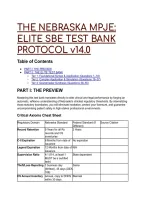
THE NEBRASKA MPJE:
ELITE SBE TEST BANK
PROTOCOL v14.0
Table of Contents
● PART I: THE PREVIEW
● PART II: THE ELITE TEST BANK
○ Tier 1: Foundational Syntax & Application (Questions 1–18)
○ Tier 2: Complex Application & Simulation (Questions 19–37)
○ Tier 3: Grandmaster Synthesis (Questions 38–55)
PART I: THE PREVIEW
Mastering this test bank translates directly to elite clinical and legal performance by forging an
automatic, reflexive understanding of Nebraska's strictest regulatory thresholds. By internalizing
these statutory boundaries, you will eliminate hesitation, protect your licensure, and guarantee
uncompromising patient safety in high-stakes professional environments.
Critical Axioms Cheat Sheet
Regulatory Domain Nebraska Standard Federal Standard (If Source Citation
Different)
Record Retention 5 Years for all Rx 2 Years
records and CS
inventories
C-II Expiration 6 Months from date of No expiration
issuance
Legend Expiration 12 Months from date of N/A
issuance
Supervision Ratio 4:1 (If 4, at least 1 State dependent
MUST be a certified
tech)
Theft/Loss Reporting 1 business day Same
(Written), 45 days (DEA
106)
CS Annual Inventory Annual, copy to DHHS Biennial
within 30 days
,PART II: THE ELITE TEST BANK
Tier 1: Foundational Syntax & Application <a name="tier-1"></a>
Q1: A newly hired pharmacy technician has completed their onboarding paperwork and is
scheduled for their first shift tomorrow. Based on the principles of the Nebraska Uniform
Credentialing Act, which action is the MANDATORY prerequisite prior to the technician
beginning work? A) Completion of a board-approved national certification exam. B) Submission
of a technician registration application within 30 days of the hire date. C) Registration by the
Department of Health and Human Services (DHHS) as a pharmacy technician. D) Registration
with the Pharmacy Technician Certification Board (PTCB).
● Answer: C (Registration by the Department of Health and Human Services (DHHS) as a
pharmacy technician)
● Distractor Analysis:
○ A is incorrect: National certification is required within one year of initial registration,
not prior to starting work.
○ B is incorrect: Legacy laws allowed a 30-day grace period, but current Nebraska
law requires DHHS registration to be issued before the first day of work.
○ D is incorrect: PTCB is a certifying body, not the state regulatory agency
responsible for issuing the legal registration.
The Mentor's Analysis: State registration is the absolute legal prerequisite for pharmacy
technician practice in Nebraska. When facing technician onboarding, the immediate priority is
securing DHHS registration before any active duties commence. By utilizing the strict
pre-employment registration mandate, you bypass the common trap of relying on outdated
30-day grace period regulations. Professional Intuition: No DHHS registration, no workflow
access. Certification follows within one year.
Q2: A patient attempts to refill a prescription for cyclobenzaprine. The original prescription was
issued on January 1st of the current year. Based on the principles of Nebraska law, on what
date does this prescription EXPIRE? A) June 30th B) December 31st C) March 31st D) It does
not expire as long as refills remain.
● Answer: B (December 31st)
● Distractor Analysis:
○ A is incorrect: Six months is the expiration timeline for controlled substances.
○ C is incorrect: Three months has no basis in Nebraska expiration statutes.
○ D is incorrect: All non-controlled legend prescriptions explicitly expire 12 months
from the date of issuance .
The Mentor's Analysis: Prescription validity is strictly tethered to the date of issuance. When
facing a non-controlled refill request, the immediate priority is verifying the 12-month window. By
utilizing the exact statutory expiration date, you bypass the common trap of filling based solely
on available refills in the software. Professional Intuition: Legend drugs die at 12 months;
controlled substances die at 6 months.
Q3: A physician issues a prescription for Adderall (C-II). Based on the principles of the
Nebraska Uniform Controlled Substances Act, how long is this prescription valid from the date of
issuance? A) 30 days B) 60 days C) 6 months D) 12 months
● Answer: C (6 months)
● Distractor Analysis:
○ A is incorrect: Some states limit C-IIs to 30 days, but Nebraska permits 6 months.
, ○ B is incorrect: 60 days is the validity window for C-II partial fills in LTCF or terminally
ill patients, not the base expiration.
○ D is incorrect: 12 months applies only to non-controlled legend drugs .
The Mentor's Analysis: Schedule II prescriptions in Nebraska share the same expiration timeline
as lower-schedule controlled substances. When facing a C-II validation, the immediate priority is
calculating the 6-month deadline. By utilizing the 6-month statutory limit, you bypass the
common trap of confusing Nebraska law with stricter neighboring jurisdictions. Professional
Intuition: All controlled substance prescriptions in Nebraska expire 6 months from the
date of issuance.
Q4: A prescriber writes a prescription for alprazolam (C-IV) with "PRN" refills. Based on the
principles of Nebraska and Federal law, what is the MAXIMUM number of times this prescription
may be refilled? A) Zero; controlled substances cannot have PRN refills. B) 5 times within 6
months. C) 11 times within 12 months. D) As many times as needed within 6 months.
● Answer: B (5 times within 6 months.)
● Distractor Analysis:
○ A is incorrect: "PRN" is legally interpreted as authorizing up to the maximum legal
limit for that drug class.
○ C is incorrect: This describes the maximum limit for a non-controlled legend drug.
○ D is incorrect: C-III and C-IV prescriptions are strictly capped at 5 refills regardless
of patient need.
The Mentor's Analysis: Schedule III and IV drugs have rigid refill ceilings to prevent long-term
diversion. When facing an open-ended refill authorization on a C-IV, the immediate priority is
capping the dispenses. By utilizing the 5-refill ceiling, you bypass the common trap of treating
PRN on a controlled substance like a maintenance blood pressure medication. Professional
Intuition: C-III and C-IV prescriptions hit a hard wall at 5 refills or 6 months, whichever
comes first.
Q5: A pharmacy discovers a significant loss of oxycodone during a routine inventory count.
Based on the principles of DEA regulations, what is the FIRST mandatory action the
pharmacist-in-charge must take? A) Submit DEA Form 106 electronically within 15 days. B)
Notify the local DEA Field Division Office in writing within 1 business day. C) Submit DEA Form
106 electronically within 45 days. D) Notify the Nebraska Board of Pharmacy within 72 hours.
● Answer: B (Notify the local DEA Field Division Office in writing within 1 business day.)
● Distractor Analysis:
○ A is incorrect: The 15-day timeline was a proposed rule; the final rule expanded it to
45 days.
○ C is incorrect: While Form 106 must be submitted electronically within 45 days, it is
the second step. The preliminary written notice is the first required action.
○ D is incorrect: State notification does not supersede the immediate federal 1-day
mandate.
The Mentor's Analysis: Theft or significant loss triggers a non-negotiable, two-step federal
reporting protocol. When facing missing controlled inventory, the immediate priority is
establishing an official timeline with the DEA. By utilizing the 1-business-day written notice rule,
you bypass the common trap of waiting to complete the full investigation before communicating
with the agency. Professional Intuition: Write the DEA on Day 1; file the electronic Form 106
by Day 45.
Q6: A prescriber writes a prescription for a brand-name antihypertensive. Based on the
principles of the Nebraska Drug Product Selection Act, which exact phrase must the prescriber
write to legally PROHIBIT the pharmacist from substituting a generic equivalent? A) "Brand
ELITE SBE TEST BANK
PROTOCOL v14.0
Table of Contents
● PART I: THE PREVIEW
● PART II: THE ELITE TEST BANK
○ Tier 1: Foundational Syntax & Application (Questions 1–18)
○ Tier 2: Complex Application & Simulation (Questions 19–37)
○ Tier 3: Grandmaster Synthesis (Questions 38–55)
PART I: THE PREVIEW
Mastering this test bank translates directly to elite clinical and legal performance by forging an
automatic, reflexive understanding of Nebraska's strictest regulatory thresholds. By internalizing
these statutory boundaries, you will eliminate hesitation, protect your licensure, and guarantee
uncompromising patient safety in high-stakes professional environments.
Critical Axioms Cheat Sheet
Regulatory Domain Nebraska Standard Federal Standard (If Source Citation
Different)
Record Retention 5 Years for all Rx 2 Years
records and CS
inventories
C-II Expiration 6 Months from date of No expiration
issuance
Legend Expiration 12 Months from date of N/A
issuance
Supervision Ratio 4:1 (If 4, at least 1 State dependent
MUST be a certified
tech)
Theft/Loss Reporting 1 business day Same
(Written), 45 days (DEA
106)
CS Annual Inventory Annual, copy to DHHS Biennial
within 30 days
,PART II: THE ELITE TEST BANK
Tier 1: Foundational Syntax & Application <a name="tier-1"></a>
Q1: A newly hired pharmacy technician has completed their onboarding paperwork and is
scheduled for their first shift tomorrow. Based on the principles of the Nebraska Uniform
Credentialing Act, which action is the MANDATORY prerequisite prior to the technician
beginning work? A) Completion of a board-approved national certification exam. B) Submission
of a technician registration application within 30 days of the hire date. C) Registration by the
Department of Health and Human Services (DHHS) as a pharmacy technician. D) Registration
with the Pharmacy Technician Certification Board (PTCB).
● Answer: C (Registration by the Department of Health and Human Services (DHHS) as a
pharmacy technician)
● Distractor Analysis:
○ A is incorrect: National certification is required within one year of initial registration,
not prior to starting work.
○ B is incorrect: Legacy laws allowed a 30-day grace period, but current Nebraska
law requires DHHS registration to be issued before the first day of work.
○ D is incorrect: PTCB is a certifying body, not the state regulatory agency
responsible for issuing the legal registration.
The Mentor's Analysis: State registration is the absolute legal prerequisite for pharmacy
technician practice in Nebraska. When facing technician onboarding, the immediate priority is
securing DHHS registration before any active duties commence. By utilizing the strict
pre-employment registration mandate, you bypass the common trap of relying on outdated
30-day grace period regulations. Professional Intuition: No DHHS registration, no workflow
access. Certification follows within one year.
Q2: A patient attempts to refill a prescription for cyclobenzaprine. The original prescription was
issued on January 1st of the current year. Based on the principles of Nebraska law, on what
date does this prescription EXPIRE? A) June 30th B) December 31st C) March 31st D) It does
not expire as long as refills remain.
● Answer: B (December 31st)
● Distractor Analysis:
○ A is incorrect: Six months is the expiration timeline for controlled substances.
○ C is incorrect: Three months has no basis in Nebraska expiration statutes.
○ D is incorrect: All non-controlled legend prescriptions explicitly expire 12 months
from the date of issuance .
The Mentor's Analysis: Prescription validity is strictly tethered to the date of issuance. When
facing a non-controlled refill request, the immediate priority is verifying the 12-month window. By
utilizing the exact statutory expiration date, you bypass the common trap of filling based solely
on available refills in the software. Professional Intuition: Legend drugs die at 12 months;
controlled substances die at 6 months.
Q3: A physician issues a prescription for Adderall (C-II). Based on the principles of the
Nebraska Uniform Controlled Substances Act, how long is this prescription valid from the date of
issuance? A) 30 days B) 60 days C) 6 months D) 12 months
● Answer: C (6 months)
● Distractor Analysis:
○ A is incorrect: Some states limit C-IIs to 30 days, but Nebraska permits 6 months.
, ○ B is incorrect: 60 days is the validity window for C-II partial fills in LTCF or terminally
ill patients, not the base expiration.
○ D is incorrect: 12 months applies only to non-controlled legend drugs .
The Mentor's Analysis: Schedule II prescriptions in Nebraska share the same expiration timeline
as lower-schedule controlled substances. When facing a C-II validation, the immediate priority is
calculating the 6-month deadline. By utilizing the 6-month statutory limit, you bypass the
common trap of confusing Nebraska law with stricter neighboring jurisdictions. Professional
Intuition: All controlled substance prescriptions in Nebraska expire 6 months from the
date of issuance.
Q4: A prescriber writes a prescription for alprazolam (C-IV) with "PRN" refills. Based on the
principles of Nebraska and Federal law, what is the MAXIMUM number of times this prescription
may be refilled? A) Zero; controlled substances cannot have PRN refills. B) 5 times within 6
months. C) 11 times within 12 months. D) As many times as needed within 6 months.
● Answer: B (5 times within 6 months.)
● Distractor Analysis:
○ A is incorrect: "PRN" is legally interpreted as authorizing up to the maximum legal
limit for that drug class.
○ C is incorrect: This describes the maximum limit for a non-controlled legend drug.
○ D is incorrect: C-III and C-IV prescriptions are strictly capped at 5 refills regardless
of patient need.
The Mentor's Analysis: Schedule III and IV drugs have rigid refill ceilings to prevent long-term
diversion. When facing an open-ended refill authorization on a C-IV, the immediate priority is
capping the dispenses. By utilizing the 5-refill ceiling, you bypass the common trap of treating
PRN on a controlled substance like a maintenance blood pressure medication. Professional
Intuition: C-III and C-IV prescriptions hit a hard wall at 5 refills or 6 months, whichever
comes first.
Q5: A pharmacy discovers a significant loss of oxycodone during a routine inventory count.
Based on the principles of DEA regulations, what is the FIRST mandatory action the
pharmacist-in-charge must take? A) Submit DEA Form 106 electronically within 15 days. B)
Notify the local DEA Field Division Office in writing within 1 business day. C) Submit DEA Form
106 electronically within 45 days. D) Notify the Nebraska Board of Pharmacy within 72 hours.
● Answer: B (Notify the local DEA Field Division Office in writing within 1 business day.)
● Distractor Analysis:
○ A is incorrect: The 15-day timeline was a proposed rule; the final rule expanded it to
45 days.
○ C is incorrect: While Form 106 must be submitted electronically within 45 days, it is
the second step. The preliminary written notice is the first required action.
○ D is incorrect: State notification does not supersede the immediate federal 1-day
mandate.
The Mentor's Analysis: Theft or significant loss triggers a non-negotiable, two-step federal
reporting protocol. When facing missing controlled inventory, the immediate priority is
establishing an official timeline with the DEA. By utilizing the 1-business-day written notice rule,
you bypass the common trap of waiting to complete the full investigation before communicating
with the agency. Professional Intuition: Write the DEA on Day 1; file the electronic Form 106
by Day 45.
Q6: A prescriber writes a prescription for a brand-name antihypertensive. Based on the
principles of the Nebraska Drug Product Selection Act, which exact phrase must the prescriber
write to legally PROHIBIT the pharmacist from substituting a generic equivalent? A) "Brand


