
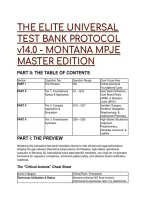
THE ELITE UNIVERSAL
TEST BANK PROTOCOL
v14.0 - MONTANA MPJE
MASTER EDITION
PART 0: THE TABLE OF CONTENTS
Section Cognitive Tier Question Range Core Focus Area
PART I The Preview N/A Critical Axioms &
Foundational Laws
PART II Tier 1: Foundational Q1 – Q18 Hard Deck Definitions,
Syntax & Application Core Board Rules
(ARM), & Statutory
Limits (MCA)
PART II Tier 2: Complex Q19 – Q37 Variable Changes,
Application & Workflow Delegation,
Simulation Telepharmacy, &
Institutional Pharmacy
PART II Tier 3: Grandmaster Q38 – Q55 High-Stakes Situational
Synthesis Judgment,
Polypharmacy,
Interstate Licensure, &
Liability
PART I: THE PREVIEW
Mastering this exhaustive test bank translates directly to elite clinical and legal performance,
bridging the gap between theoretical jurisprudence and flawless, high-stakes operational
execution in Montana. By internalizing these state-specific mandates, you forge an invulnerable
framework for regulatory compliance, advanced patient safety, and absolute board certification
readiness.
The "Critical Axioms" Cheat Sheet
Axiom Category Critical Rule / Framework
Technician Utilization & Ratios Montana enforces NO fixed numeric
pharmacist-to-technician ratio; it is determined
,Axiom Category Critical Rule / Framework
strictly by the Pharmacist-in-Charge (PIC) via a
documented Technician Utilization Plan (TUP).
Interns do not count against this ratio.
Pharmacist Prescribing (SB 112) Pharmacists possess independent prescribing
authority under ARM 24.174.505, requiring
strict adherence to statutory limitations and
established care protocols.
Medical Practitioner Dispensing Practitioners may dispense medications directly
to their own patients upon registration, but are
strictly prohibited from dispensing controlled
substances or mailing dispensed drugs.
Out-of-State Mail Order Out-of-state pharmacies must be licensed in
MT, maintain a toll-free number (at least 6
days/40 hours weekly), and have a PIC
licensed in their home state (MT license not
required).
Record Retention Prescription records, controlled substance
inventories, and transfer audit trails must be
maintained for exactly two (2) years under ARM
24.174.
PART II: THE ELITE TEST BANK
Tier 1: Foundational Syntax & Application
Q1: A newly appointed Pharmacist-in-Charge (PIC) at a high-volume community pharmacy is
drafting the weekly schedule. The pharmacy employs eight technicians and two pharmacists.
Based on the principles of the Montana Board of Pharmacy regulations, which action is the
MOST APPROPRIATE regarding staffing? A) The PIC must schedule at least two pharmacists
to maintain the mandatory 1:4 state ratio. B) The PIC must apply to the Board for a specific ratio
waiver to allow a 1:8 configuration. C) The PIC may schedule the staff according to the
pharmacy's documented Technician Utilization Plan (TUP). D) The PIC must count any working
pharmacy interns against the maximum allowable technician ratio.
● Answer: C (The PIC may schedule the staff according to the pharmacy's documented
Technician Utilization Plan (TUP).)
● Distractor Analysis:
○ A is incorrect: The previous 1:4 hard-cap ratio was removed effective March 2022.
○ B is incorrect: Waivers are obsolete; the PIC dictates the ratio based on safety and
the TUP.
○ D is incorrect: Pharmacy interns explicitly do not count toward any staffing ratio
considerations.
The Mentor's Analysis: Montana operates on a safety-driven, outcomes-based model rather
than arbitrary headcount limits. By utilizing a customized Technician Utilization Plan (TUP), you
bypass the common trap of relying on outdated legacy constraints. Professional Intuition: The
PIC dictates the technician ratio based solely on verifiable safety metrics and the
approved TUP.
Q2: A licensed physician in Montana wishes to dispense a Schedule III controlled substance
, directly to a patient from their private clinic. Based on the principles of the Montana Medical
Practitioner Dispensing framework, which conclusion is UNEQUIVOCALLY TRUE? A) The
practitioner may dispense the drug if they possess a valid DEA registration and a Board
dispenser registration. B) The practitioner may dispense the drug only if the patient signs a
waiver of pharmacy counseling. C) The practitioner is strictly prohibited from dispensing
controlled substances directly to a patient. D) The practitioner may dispense a maximum of a
72-hour supply in an emergency.
● Answer: C (The practitioner is strictly prohibited from dispensing controlled substances
directly to a patient.)
● Distractor Analysis:
○ A is incorrect: Even with DEA and Board registrations, MCA 37-2-104 explicitly
forbids medical practitioners from dispensing controlled substances.
○ B is incorrect: Patient consent cannot override the statutory prohibition on controlled
substance dispensing by practitioners.
○ D is incorrect: While emergency exceptions existed in older laws, the current
framework strictly bars controlled substance dispensing (except for specific waivers
like naloxone).
The Mentor's Analysis: Medical practitioner dispensing is heavily regulated to prevent
conflict-of-interest and diversion. When facing clinical dispensing, the immediate priority is
verifying drug schedules. By utilizing statutory boundaries, you bypass the common trap of
confusing prescribing rights with dispensing rights. Professional Intuition: Medical practitioners
in Montana may dispense legend drugs but are absolutely barred from dispensing
controlled substances.
Q3: A Montana pharmacist is completing their annual license renewal. They have accumulated
15 hours of continuing education (CE), with zero hours obtained via live programs. Based on the
principles of ARM 24.174.2104, what is the REQUIRED action to maintain compliance? A)
Submit the 15 hours, as this meets the absolute minimum state requirement. B) Carry over 5
hours from the previous year to reach the required 20 hours. C) Complete an additional 5 hours
of CE, because 20 total hours are required when taking no live programs. D) Obtain a waiver
from the Board since the live CE requirement was permanently eliminated.
● Answer: C (Complete an additional 5 hours of CE, because 20 total hours are required
when taking no live programs.)
● Distractor Analysis:
○ A is incorrect: 15 hours is only sufficient if at least 5 of those hours are from an
approved live program.
○ B is incorrect: Montana explicitly prohibits the carry-over of CE credit from one
renewal period to the next.
○ D is incorrect: While live CE was waived during specific periods (e.g., 2022), the
baseline law requires 20 hours if live requirements are unmet.
The Mentor's Analysis: CE requirements balance ongoing education with practical flexibility.
When facing renewal, the immediate priority is calculating the live-to-total ratio. By utilizing the
15/5 or 20/0 rule, you bypass the common trap of assuming a flat 15-hour minimum.
Professional Intuition: If a pharmacist completes zero live CE hours, their annual
requirement automatically increases from 15 to 20 hours.
Q4: A pharmacy technician receives a transferred prescription for a patient. Based on the
principles of Patient Counseling (ARM 24.174.903), who is LEGALLY AUTHORIZED to make
the initial offer to counsel? A) Only the Pharmacist-in-Charge. B) Only a licensed pharmacist or
a registered intern. C) Pharmacy personnel, including technicians, may make the offer to
TEST BANK PROTOCOL
v14.0 - MONTANA MPJE
MASTER EDITION
PART 0: THE TABLE OF CONTENTS
Section Cognitive Tier Question Range Core Focus Area
PART I The Preview N/A Critical Axioms &
Foundational Laws
PART II Tier 1: Foundational Q1 – Q18 Hard Deck Definitions,
Syntax & Application Core Board Rules
(ARM), & Statutory
Limits (MCA)
PART II Tier 2: Complex Q19 – Q37 Variable Changes,
Application & Workflow Delegation,
Simulation Telepharmacy, &
Institutional Pharmacy
PART II Tier 3: Grandmaster Q38 – Q55 High-Stakes Situational
Synthesis Judgment,
Polypharmacy,
Interstate Licensure, &
Liability
PART I: THE PREVIEW
Mastering this exhaustive test bank translates directly to elite clinical and legal performance,
bridging the gap between theoretical jurisprudence and flawless, high-stakes operational
execution in Montana. By internalizing these state-specific mandates, you forge an invulnerable
framework for regulatory compliance, advanced patient safety, and absolute board certification
readiness.
The "Critical Axioms" Cheat Sheet
Axiom Category Critical Rule / Framework
Technician Utilization & Ratios Montana enforces NO fixed numeric
pharmacist-to-technician ratio; it is determined
,Axiom Category Critical Rule / Framework
strictly by the Pharmacist-in-Charge (PIC) via a
documented Technician Utilization Plan (TUP).
Interns do not count against this ratio.
Pharmacist Prescribing (SB 112) Pharmacists possess independent prescribing
authority under ARM 24.174.505, requiring
strict adherence to statutory limitations and
established care protocols.
Medical Practitioner Dispensing Practitioners may dispense medications directly
to their own patients upon registration, but are
strictly prohibited from dispensing controlled
substances or mailing dispensed drugs.
Out-of-State Mail Order Out-of-state pharmacies must be licensed in
MT, maintain a toll-free number (at least 6
days/40 hours weekly), and have a PIC
licensed in their home state (MT license not
required).
Record Retention Prescription records, controlled substance
inventories, and transfer audit trails must be
maintained for exactly two (2) years under ARM
24.174.
PART II: THE ELITE TEST BANK
Tier 1: Foundational Syntax & Application
Q1: A newly appointed Pharmacist-in-Charge (PIC) at a high-volume community pharmacy is
drafting the weekly schedule. The pharmacy employs eight technicians and two pharmacists.
Based on the principles of the Montana Board of Pharmacy regulations, which action is the
MOST APPROPRIATE regarding staffing? A) The PIC must schedule at least two pharmacists
to maintain the mandatory 1:4 state ratio. B) The PIC must apply to the Board for a specific ratio
waiver to allow a 1:8 configuration. C) The PIC may schedule the staff according to the
pharmacy's documented Technician Utilization Plan (TUP). D) The PIC must count any working
pharmacy interns against the maximum allowable technician ratio.
● Answer: C (The PIC may schedule the staff according to the pharmacy's documented
Technician Utilization Plan (TUP).)
● Distractor Analysis:
○ A is incorrect: The previous 1:4 hard-cap ratio was removed effective March 2022.
○ B is incorrect: Waivers are obsolete; the PIC dictates the ratio based on safety and
the TUP.
○ D is incorrect: Pharmacy interns explicitly do not count toward any staffing ratio
considerations.
The Mentor's Analysis: Montana operates on a safety-driven, outcomes-based model rather
than arbitrary headcount limits. By utilizing a customized Technician Utilization Plan (TUP), you
bypass the common trap of relying on outdated legacy constraints. Professional Intuition: The
PIC dictates the technician ratio based solely on verifiable safety metrics and the
approved TUP.
Q2: A licensed physician in Montana wishes to dispense a Schedule III controlled substance
, directly to a patient from their private clinic. Based on the principles of the Montana Medical
Practitioner Dispensing framework, which conclusion is UNEQUIVOCALLY TRUE? A) The
practitioner may dispense the drug if they possess a valid DEA registration and a Board
dispenser registration. B) The practitioner may dispense the drug only if the patient signs a
waiver of pharmacy counseling. C) The practitioner is strictly prohibited from dispensing
controlled substances directly to a patient. D) The practitioner may dispense a maximum of a
72-hour supply in an emergency.
● Answer: C (The practitioner is strictly prohibited from dispensing controlled substances
directly to a patient.)
● Distractor Analysis:
○ A is incorrect: Even with DEA and Board registrations, MCA 37-2-104 explicitly
forbids medical practitioners from dispensing controlled substances.
○ B is incorrect: Patient consent cannot override the statutory prohibition on controlled
substance dispensing by practitioners.
○ D is incorrect: While emergency exceptions existed in older laws, the current
framework strictly bars controlled substance dispensing (except for specific waivers
like naloxone).
The Mentor's Analysis: Medical practitioner dispensing is heavily regulated to prevent
conflict-of-interest and diversion. When facing clinical dispensing, the immediate priority is
verifying drug schedules. By utilizing statutory boundaries, you bypass the common trap of
confusing prescribing rights with dispensing rights. Professional Intuition: Medical practitioners
in Montana may dispense legend drugs but are absolutely barred from dispensing
controlled substances.
Q3: A Montana pharmacist is completing their annual license renewal. They have accumulated
15 hours of continuing education (CE), with zero hours obtained via live programs. Based on the
principles of ARM 24.174.2104, what is the REQUIRED action to maintain compliance? A)
Submit the 15 hours, as this meets the absolute minimum state requirement. B) Carry over 5
hours from the previous year to reach the required 20 hours. C) Complete an additional 5 hours
of CE, because 20 total hours are required when taking no live programs. D) Obtain a waiver
from the Board since the live CE requirement was permanently eliminated.
● Answer: C (Complete an additional 5 hours of CE, because 20 total hours are required
when taking no live programs.)
● Distractor Analysis:
○ A is incorrect: 15 hours is only sufficient if at least 5 of those hours are from an
approved live program.
○ B is incorrect: Montana explicitly prohibits the carry-over of CE credit from one
renewal period to the next.
○ D is incorrect: While live CE was waived during specific periods (e.g., 2022), the
baseline law requires 20 hours if live requirements are unmet.
The Mentor's Analysis: CE requirements balance ongoing education with practical flexibility.
When facing renewal, the immediate priority is calculating the live-to-total ratio. By utilizing the
15/5 or 20/0 rule, you bypass the common trap of assuming a flat 15-hour minimum.
Professional Intuition: If a pharmacist completes zero live CE hours, their annual
requirement automatically increases from 15 to 20 hours.
Q4: A pharmacy technician receives a transferred prescription for a patient. Based on the
principles of Patient Counseling (ARM 24.174.903), who is LEGALLY AUTHORIZED to make
the initial offer to counsel? A) Only the Pharmacist-in-Charge. B) Only a licensed pharmacist or
a registered intern. C) Pharmacy personnel, including technicians, may make the offer to


