
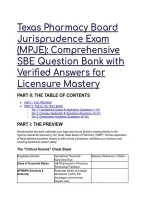
Texas Pharmacy Board
Jurisprudence Exam
(MPJE): Comprehensive
SBE Question Bank with
Verified Answers for
Licensure Mastery
PART 0: THE TABLE OF CONTENTS
● PART I: THE PREVIEW
● PART II: THE ELITE TEST BANK
○ Tier 1: Foundational Syntax & Application (Questions 1–18)
○ Tier 2: Complex Application & Simulation (Questions 19–37)
○ Tier 3: Grandmaster Synthesis (Questions 38–55)
PART I: THE PREVIEW
Mastering this test bank calibrates your legal and clinical decision-making directly to the
rigorous standards required by the Texas State Board of Pharmacy (TSBP). Precise application
of these statutes translates directly to elite clinical compliance, shielding your licensure and
ensuring paramount patient safety.
The "Critical Axioms" Cheat Sheet
Regulatory Domain Operational Threshold / Statutory Reference / Citation
Hard-Deck Rule
Class A Personnel Ratios 1:6 (Pharmacist to Pharmacy
Technicians/Trainees).
APRN/PA Schedule II Restricted strictly to hospital
Authority admissions (>24h), ED
discharges, and terminal
hospice care.
,Regulatory Domain Operational Threshold / Statutory Reference / Citation
Hard-Deck Rule
Mandatory PMP Verification MUST review the PMP before
dispensing opioids,
benzodiazepines, barbiturates,
or carisoprodol (excludes
cancer/hospice).
Inventory Imperatives Exact counts for Schedule II;
Estimated for CIII-CV unless
the container holds >1,000
units.
Generic Substitution Dispense generic unless
Mandate prescriber writes "brand
medically necessary"; label
must state "Substituted for
brand prescribed".
Disaster Emergency Refills 30-day maximum supply for
non-CII drugs during a
governor-declared disaster (72
hours for standard
emergencies).
Telepharmacy & EDK Remote telepharmacy sites
Geography capped at 2 per provider. EDK
provider pharmacies must be
within 20 miles of the LTCF.
PART II: THE ELITE TEST BANK
Tier 1: Foundational Syntax & Application (Questions 1–18)
Q1: A Class A community pharmacy in Texas is planning its staffing schedule for a high-volume
Monday. There will be two licensed pharmacists on duty. Based on the principles of TSBP
personnel ratios, which number represents the MAXIMUM amount of pharmacy technicians and
trainees that can be scheduled to work simultaneously under their supervision? A) Four B) Eight
C) Twelve D) Ten
● Answer: C (Twelve)
● Distractor Analysis:
○ A is incorrect: Four reflects an outdated 1:4 legacy ratio that has since been
expanded by the TSBP for Class A settings.
○ B is incorrect: Eight is a mathematically possible number of technicians but fails to
maximize the legal limit of the current ratio per pharmacist.
○ D is incorrect: Ten represents a calculation error, assuming a 1:5 ratio which applies
only in highly specific legacy or restricted compounding settings, not a standard
Class A pharmacy.
The Mentor's Analysis: Texas law authorizes a 1:6 pharmacist-to-pharmacy technician ratio in
Class A settings. When facing staffing optimizations, the immediate priority is calculating the
aggregate limit based on total licensed pharmacists on duty. By utilizing the 1:6 multiplier, you
bypass the common trap of referencing outdated 1:4 legacy rules. Professional Intuition:
, Multiply total on-duty pharmacists by six to establish your maximum legal Class A
technician ceiling.
Q2: A pharmacist is offered the Pharmacist-in-Charge (PIC) position at a newly opening Class A
pharmacy. They are currently the PIC at another Class A pharmacy. Under standard operational
conditions, which conclusion is the MOST APPROPRIATE regarding their eligibility? A) They
may serve as PIC for both pharmacies indefinitely if they work at least 20 hours per week at
each. B) They may serve as PIC for both pharmacies during an emergency for up to 30
consecutive days. C) They are legally prohibited from serving as a PIC at more than one Class
A pharmacy under any circumstances. D) They may serve as PIC for a Class A and a Class B
pharmacy simultaneously.
● Answer: B (They may serve as PIC for both pharmacies during an emergency for up to 30
consecutive days.)
● Distractor Analysis:
○ A is incorrect: Standard TSBP rules dictate a pharmacist may be PIC for only one
Class A pharmacy on a full-time basis, precluding indefinite dual-PIC status.
○ C is incorrect: TSBP rules contain a specific emergency provision allowing dual-PIC
status for a strictly limited duration despite standard prohibitions.
○ D is incorrect: A Class A PIC is strictly prohibited by statute from serving
simultaneously as a PIC of a Class B (Nuclear) pharmacy.
The Mentor's Analysis: The PIC bears total legal responsibility for a pharmacy's compliance.
When facing PIC staffing emergencies, the immediate priority is adhering to the 30-day statutory
limit. By utilizing the emergency exception rule, you bypass the common trap of assuming
absolute prohibition. Professional Intuition: A single PIC can bridge two Class A pharmacies
solely during a 30-day emergency window, provided they work 10 hours weekly at each.
Q3: An Advanced Practice Registered Nurse (APRN) operating in a Texas outpatient pain
management clinic transmits a prescription for hydrocodone/acetaminophen (Schedule II) for a
chronic pain patient. Based on the principles of TSBP prescriptive delegation, which action is
REQUIRED by the pharmacist? A) Fill the prescription for a maximum 30-day supply. B) Fill the
prescription only if the collaborating physician's DEA is also on the prescription. C) Refuse to fill
the prescription as it exceeds the APRN's legal authority. D) Fill the prescription for a maximum
7-day supply.
● Answer: C (Refuse to fill the prescription as it exceeds the APRN's legal authority.)
● Distractor Analysis:
○ A is incorrect: APRNs in Texas outpatient clinics possess zero prescriptive authority
for Schedule II substances, making any supply duration completely invalid.
○ B is incorrect: A collaborating physician's DEA does not grant the APRN authority to
issue Schedule II prescriptions in an unauthorized outpatient setting.
○ D is incorrect: While states like Florida possess a 7-day Schedule II limit for
APRNs, Texas strictly prohibits outpatient Schedule II prescribing by APRNs
entirely.
The Mentor's Analysis: APRN Schedule II prescribing in Texas is geographically and
situationally restricted to specific high-acuity environments. When facing an APRN Schedule II
prescription, the immediate priority is verifying the practice setting (ED, hospital admission, or
hospice). By utilizing the facility-based limitation rule, you bypass the common trap of applying
general controlled substance protocols to restricted mid-level practitioners. Professional
Intuition: In Texas, APRN/PA Schedule II authority is legally isolated to hospital
admissions (>24h), emergency departments, and terminal hospice care.
Q4: A Class A pharmacy is conducting its annual controlled substance inventory on May 1st.
Jurisprudence Exam
(MPJE): Comprehensive
SBE Question Bank with
Verified Answers for
Licensure Mastery
PART 0: THE TABLE OF CONTENTS
● PART I: THE PREVIEW
● PART II: THE ELITE TEST BANK
○ Tier 1: Foundational Syntax & Application (Questions 1–18)
○ Tier 2: Complex Application & Simulation (Questions 19–37)
○ Tier 3: Grandmaster Synthesis (Questions 38–55)
PART I: THE PREVIEW
Mastering this test bank calibrates your legal and clinical decision-making directly to the
rigorous standards required by the Texas State Board of Pharmacy (TSBP). Precise application
of these statutes translates directly to elite clinical compliance, shielding your licensure and
ensuring paramount patient safety.
The "Critical Axioms" Cheat Sheet
Regulatory Domain Operational Threshold / Statutory Reference / Citation
Hard-Deck Rule
Class A Personnel Ratios 1:6 (Pharmacist to Pharmacy
Technicians/Trainees).
APRN/PA Schedule II Restricted strictly to hospital
Authority admissions (>24h), ED
discharges, and terminal
hospice care.
,Regulatory Domain Operational Threshold / Statutory Reference / Citation
Hard-Deck Rule
Mandatory PMP Verification MUST review the PMP before
dispensing opioids,
benzodiazepines, barbiturates,
or carisoprodol (excludes
cancer/hospice).
Inventory Imperatives Exact counts for Schedule II;
Estimated for CIII-CV unless
the container holds >1,000
units.
Generic Substitution Dispense generic unless
Mandate prescriber writes "brand
medically necessary"; label
must state "Substituted for
brand prescribed".
Disaster Emergency Refills 30-day maximum supply for
non-CII drugs during a
governor-declared disaster (72
hours for standard
emergencies).
Telepharmacy & EDK Remote telepharmacy sites
Geography capped at 2 per provider. EDK
provider pharmacies must be
within 20 miles of the LTCF.
PART II: THE ELITE TEST BANK
Tier 1: Foundational Syntax & Application (Questions 1–18)
Q1: A Class A community pharmacy in Texas is planning its staffing schedule for a high-volume
Monday. There will be two licensed pharmacists on duty. Based on the principles of TSBP
personnel ratios, which number represents the MAXIMUM amount of pharmacy technicians and
trainees that can be scheduled to work simultaneously under their supervision? A) Four B) Eight
C) Twelve D) Ten
● Answer: C (Twelve)
● Distractor Analysis:
○ A is incorrect: Four reflects an outdated 1:4 legacy ratio that has since been
expanded by the TSBP for Class A settings.
○ B is incorrect: Eight is a mathematically possible number of technicians but fails to
maximize the legal limit of the current ratio per pharmacist.
○ D is incorrect: Ten represents a calculation error, assuming a 1:5 ratio which applies
only in highly specific legacy or restricted compounding settings, not a standard
Class A pharmacy.
The Mentor's Analysis: Texas law authorizes a 1:6 pharmacist-to-pharmacy technician ratio in
Class A settings. When facing staffing optimizations, the immediate priority is calculating the
aggregate limit based on total licensed pharmacists on duty. By utilizing the 1:6 multiplier, you
bypass the common trap of referencing outdated 1:4 legacy rules. Professional Intuition:
, Multiply total on-duty pharmacists by six to establish your maximum legal Class A
technician ceiling.
Q2: A pharmacist is offered the Pharmacist-in-Charge (PIC) position at a newly opening Class A
pharmacy. They are currently the PIC at another Class A pharmacy. Under standard operational
conditions, which conclusion is the MOST APPROPRIATE regarding their eligibility? A) They
may serve as PIC for both pharmacies indefinitely if they work at least 20 hours per week at
each. B) They may serve as PIC for both pharmacies during an emergency for up to 30
consecutive days. C) They are legally prohibited from serving as a PIC at more than one Class
A pharmacy under any circumstances. D) They may serve as PIC for a Class A and a Class B
pharmacy simultaneously.
● Answer: B (They may serve as PIC for both pharmacies during an emergency for up to 30
consecutive days.)
● Distractor Analysis:
○ A is incorrect: Standard TSBP rules dictate a pharmacist may be PIC for only one
Class A pharmacy on a full-time basis, precluding indefinite dual-PIC status.
○ C is incorrect: TSBP rules contain a specific emergency provision allowing dual-PIC
status for a strictly limited duration despite standard prohibitions.
○ D is incorrect: A Class A PIC is strictly prohibited by statute from serving
simultaneously as a PIC of a Class B (Nuclear) pharmacy.
The Mentor's Analysis: The PIC bears total legal responsibility for a pharmacy's compliance.
When facing PIC staffing emergencies, the immediate priority is adhering to the 30-day statutory
limit. By utilizing the emergency exception rule, you bypass the common trap of assuming
absolute prohibition. Professional Intuition: A single PIC can bridge two Class A pharmacies
solely during a 30-day emergency window, provided they work 10 hours weekly at each.
Q3: An Advanced Practice Registered Nurse (APRN) operating in a Texas outpatient pain
management clinic transmits a prescription for hydrocodone/acetaminophen (Schedule II) for a
chronic pain patient. Based on the principles of TSBP prescriptive delegation, which action is
REQUIRED by the pharmacist? A) Fill the prescription for a maximum 30-day supply. B) Fill the
prescription only if the collaborating physician's DEA is also on the prescription. C) Refuse to fill
the prescription as it exceeds the APRN's legal authority. D) Fill the prescription for a maximum
7-day supply.
● Answer: C (Refuse to fill the prescription as it exceeds the APRN's legal authority.)
● Distractor Analysis:
○ A is incorrect: APRNs in Texas outpatient clinics possess zero prescriptive authority
for Schedule II substances, making any supply duration completely invalid.
○ B is incorrect: A collaborating physician's DEA does not grant the APRN authority to
issue Schedule II prescriptions in an unauthorized outpatient setting.
○ D is incorrect: While states like Florida possess a 7-day Schedule II limit for
APRNs, Texas strictly prohibits outpatient Schedule II prescribing by APRNs
entirely.
The Mentor's Analysis: APRN Schedule II prescribing in Texas is geographically and
situationally restricted to specific high-acuity environments. When facing an APRN Schedule II
prescription, the immediate priority is verifying the practice setting (ED, hospital admission, or
hospice). By utilizing the facility-based limitation rule, you bypass the common trap of applying
general controlled substance protocols to restricted mid-level practitioners. Professional
Intuition: In Texas, APRN/PA Schedule II authority is legally isolated to hospital
admissions (>24h), emergency departments, and terminal hospice care.
Q4: A Class A pharmacy is conducting its annual controlled substance inventory on May 1st.


