
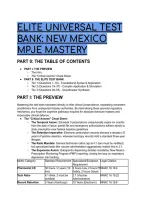
ELITE UNIVERSAL TEST
BANK: NEW MEXICO
MPJE MASTERY
PART 0: THE TABLE OF CONTENTS
● PART I: THE PREVIEW
○ The Intro
○ The "Critical Axioms" Cheat Sheet
● PART II: THE ELITE TEST BANK
○ Tier 1 (Questions 1–18) - Foundational Syntax & Application
○ Tier 2 (Questions 19–37) - Complex Application & Simulation
○ Tier 3 (Questions 38–55) - Grandmaster Synthesis
PART I: THE PREVIEW
Mastering this test bank translates directly to elite clinical jurisprudence, separating competent
practitioners from undisputed industry authorities. By internalizing these granular regulatory
mechanics, you forge the cognitive pathways required for absolute licensure mastery and
impeccable clinical defense.
● The "Critical Axioms" Cheat Sheet:
○ The Temporal Axiom: Schedule II prescriptions unequivocally expire six months
from the date of issue; partial fills and emergency authorizations adhere strictly to
state preemption over federal baseline guidelines.
○ The Retention Imperative: Electronic prescription records demand a decade (10
years) of pristine retention, whereas hardcopy records hold a standard three-year
lifespan.
○ The Ratio Mandate: General technician ratios cap at 4:1 (two must be certified),
but specialized tasks like vaccine administration aggressively restrict this to 2:1.
○ The Expansion Axiom: Gabapentin dispensing dictates mandatory New Mexico
Prescription Monitoring Program (PMP) reporting, closing the loop on respiratory
depression risk tracking.
Metric Category Standard Requirement Specialized/Exception Legal Citation
Requirement
Pharmacist CE 30 hours / 2 years (10 2 hours Law, 2 hours Pt NMAC 16.19.4
live) Safety, 2 hours Opioid
Tech Ratio 4:1 (Max, 2 must be 2:1 (Vaccine NMAC 16.19.22
certified) Administration)
Record Retention 3 Years (Hardcopy) 10 Years (Electronic) NMAC 16.19.6
,Metric Category Standard Requirement Specialized/Exception Legal Citation
Requirement
CS Refill Limit 75% depletion (Direct 66% (90-day mail) / NMAC 16.19.20
Retail) 50% (30-day mail)
PART II: THE ELITE TEST BANK
Tier 1 (Questions 1–18) - Foundational Syntax & Application
Q1: A pharmacist is renewing their New Mexico license and compiling their continuing education
(CE) credits. Based on the principles of the Pharmacy Act, which requirement is the MINIMUM
standard? A) 15 live contact hours every year B) 20 contact hours with 5 hours of opioid specific
education C) 30 contact hours every two years, including 10 live hours, 2 in patient safety, 2 in
law, and 2 in opioid-specific education D) 30 contact hours every two years, excluding live CE
requirements if working in a remote setting
● Answer: C (30 contact hours every two years, including 10 live hours, 2 in patient safety, 2
in law, and 2 in opioid-specific education)
● Distractor Analysis:
○ A is incorrect: This reflects an outdated annual requirement and ignores the
two-year renewal cycle.
○ B is incorrect: This mirrors the Pharmacist Clinician CE requirement, not the
standard pharmacist requirement.
○ D is incorrect: Live CE hours are a hard legal requirement without remote setting
exemptions.
The Mentor's Analysis: Licensure renewal hinges on strict adherence to the biennial 30-hour
rule, mathematically segmented to ensure diverse clinical competence. When facing licensure
audits, the immediate priority is verifying category-specific compliance. By utilizing the 30-hour
framework, you bypass the common trap of confusing standard pharmacist CE with specialized
prescriptive authority requirements. Professional Intuition: Always verify the triad of mandated
subjects: Law, Patient Safety, and Opioid Education.
Q2: A prescriber issues a Schedule II prescription for severe acute pain. Based on the principles
of NMAC 16.19.20, which action is the ONLY legal timeline for filling this document? A) Within
21 days of issue B) Within 72 hours of issue C) Within six months of the issue date D) Within
one year of the issue date
● Answer: C (Within six months of the issue date)
● Distractor Analysis:
○ A is incorrect: This is a legacy federal metric commonly misapplied by novices to
Schedule II timelines.
○ B is incorrect: This timeline applies to the remainder of an emergency partial fill, not
the initial prescription validity.
○ D is incorrect: This is the validity period for non-controlled legend drugs, completely
inappropriate for Schedule II substances.
The Mentor's Analysis: Schedule II prescriptions carry a strict expiration clock tied to the date of
issuance. When facing aged prescriptions, the immediate priority is calculating exact calendar
days from issuance. By utilizing the six-month statutory limit, you bypass the common trap of
treating Schedule II drugs with standard legend drug laxity. Professional Intuition: Schedule II
and Schedule III-V prescriptions share the exact same six-month expiration deadline in
New Mexico.
, Q3: A pharmacy manager is scheduling staff for the weekend shift. Based on the principles of
NMAC 16.19.22, which staffing model is the MOST APPROPRIATE? A) One pharmacist
supervising five non-certified technicians B) One pharmacist supervising three non-certified
technicians C) One pharmacist supervising four technicians, provided at least two are nationally
certified D) One pharmacist supervising four certified technicians administering vaccines
● Answer: C (One pharmacist supervising four technicians, provided at least two are
nationally certified)
● Distractor Analysis:
○ A is incorrect: This violently violates the absolute maximum ratio of 4:1.
○ B is incorrect: While under the 4:1 maximum, the board dictates that in a 4:1 ratio,
at least two must be certified.
○ D is incorrect: Vaccine administration ratios are strictly limited to 2:1, rendering four
vaccinators per pharmacist illegal.
The Mentor's Analysis: Ratios exist to prevent cognitive overload and ensure patient safety.
When facing staffing shortages, the immediate priority is mapping credential status to ratio
limits. By utilizing the 4:1 certification rule, you bypass the common trap of ignoring technician
credentialing variables in staffing matrixes. Professional Intuition: Volume requires
certification; always anchor standard practice at 4:1 (two certified) and clinical tasks at
2:1.
Q4: A pharmacy generates purely electronic prescription records. Based on the principles of
NMAC 16.19.6.22, which retention timeline is the FIRST compliance standard? A) 3 years in the
original format B) 5 years backed up on a remote server C) 10 years maintained in the original
format received D) 7 years per federal DEA standards
● Answer: C (10 years maintained in the original format received)
● Distractor Analysis:
○ A is incorrect: Three years is the standard for hardcopy prescriptions, not electronic
data.
○ B is incorrect: This is a fabricated timeframe based on standard corporate tax
retention laws.
○ D is incorrect: Federal DEA standard is two years; New Mexico aggressively
supersedes this.
The Mentor's Analysis: Digital records mandate extended accountability. When facing data
server migrations, the immediate priority is securing long-term chain-of-trust continuity. By
utilizing the 10-year electronic retention rule, you bypass the common trap of defaulting to the
shorter hardcopy or federal guidelines. Professional Intuition: Format dictates retention:
Hardcopy is 3 years; Electronic is 10 years.
Q5: A patient is prescribed gabapentin for neuropathic pain. Based on the principles of NMAC
16.19.29, which action is the MANDATORY step for the dispensing pharmacist? A) Verify the
patient's identity with a state-issued ID B) Limit the prescription to a 30-day supply C) Report the
dispensed prescription to the state Prescription Monitoring Program (PMP) D) Affix a strict
federal Schedule V warning label
● Answer: C (Report the dispensed prescription to the state Prescription Monitoring
Program (PMP))
● Distractor Analysis:
○ A is incorrect: Identification is standard for controlled substances, but not the
specific mandate for gabapentin.
○ B is incorrect: Gabapentin does not carry a statutory 30-day supply limit in New
Mexico.
BANK: NEW MEXICO
MPJE MASTERY
PART 0: THE TABLE OF CONTENTS
● PART I: THE PREVIEW
○ The Intro
○ The "Critical Axioms" Cheat Sheet
● PART II: THE ELITE TEST BANK
○ Tier 1 (Questions 1–18) - Foundational Syntax & Application
○ Tier 2 (Questions 19–37) - Complex Application & Simulation
○ Tier 3 (Questions 38–55) - Grandmaster Synthesis
PART I: THE PREVIEW
Mastering this test bank translates directly to elite clinical jurisprudence, separating competent
practitioners from undisputed industry authorities. By internalizing these granular regulatory
mechanics, you forge the cognitive pathways required for absolute licensure mastery and
impeccable clinical defense.
● The "Critical Axioms" Cheat Sheet:
○ The Temporal Axiom: Schedule II prescriptions unequivocally expire six months
from the date of issue; partial fills and emergency authorizations adhere strictly to
state preemption over federal baseline guidelines.
○ The Retention Imperative: Electronic prescription records demand a decade (10
years) of pristine retention, whereas hardcopy records hold a standard three-year
lifespan.
○ The Ratio Mandate: General technician ratios cap at 4:1 (two must be certified),
but specialized tasks like vaccine administration aggressively restrict this to 2:1.
○ The Expansion Axiom: Gabapentin dispensing dictates mandatory New Mexico
Prescription Monitoring Program (PMP) reporting, closing the loop on respiratory
depression risk tracking.
Metric Category Standard Requirement Specialized/Exception Legal Citation
Requirement
Pharmacist CE 30 hours / 2 years (10 2 hours Law, 2 hours Pt NMAC 16.19.4
live) Safety, 2 hours Opioid
Tech Ratio 4:1 (Max, 2 must be 2:1 (Vaccine NMAC 16.19.22
certified) Administration)
Record Retention 3 Years (Hardcopy) 10 Years (Electronic) NMAC 16.19.6
,Metric Category Standard Requirement Specialized/Exception Legal Citation
Requirement
CS Refill Limit 75% depletion (Direct 66% (90-day mail) / NMAC 16.19.20
Retail) 50% (30-day mail)
PART II: THE ELITE TEST BANK
Tier 1 (Questions 1–18) - Foundational Syntax & Application
Q1: A pharmacist is renewing their New Mexico license and compiling their continuing education
(CE) credits. Based on the principles of the Pharmacy Act, which requirement is the MINIMUM
standard? A) 15 live contact hours every year B) 20 contact hours with 5 hours of opioid specific
education C) 30 contact hours every two years, including 10 live hours, 2 in patient safety, 2 in
law, and 2 in opioid-specific education D) 30 contact hours every two years, excluding live CE
requirements if working in a remote setting
● Answer: C (30 contact hours every two years, including 10 live hours, 2 in patient safety, 2
in law, and 2 in opioid-specific education)
● Distractor Analysis:
○ A is incorrect: This reflects an outdated annual requirement and ignores the
two-year renewal cycle.
○ B is incorrect: This mirrors the Pharmacist Clinician CE requirement, not the
standard pharmacist requirement.
○ D is incorrect: Live CE hours are a hard legal requirement without remote setting
exemptions.
The Mentor's Analysis: Licensure renewal hinges on strict adherence to the biennial 30-hour
rule, mathematically segmented to ensure diverse clinical competence. When facing licensure
audits, the immediate priority is verifying category-specific compliance. By utilizing the 30-hour
framework, you bypass the common trap of confusing standard pharmacist CE with specialized
prescriptive authority requirements. Professional Intuition: Always verify the triad of mandated
subjects: Law, Patient Safety, and Opioid Education.
Q2: A prescriber issues a Schedule II prescription for severe acute pain. Based on the principles
of NMAC 16.19.20, which action is the ONLY legal timeline for filling this document? A) Within
21 days of issue B) Within 72 hours of issue C) Within six months of the issue date D) Within
one year of the issue date
● Answer: C (Within six months of the issue date)
● Distractor Analysis:
○ A is incorrect: This is a legacy federal metric commonly misapplied by novices to
Schedule II timelines.
○ B is incorrect: This timeline applies to the remainder of an emergency partial fill, not
the initial prescription validity.
○ D is incorrect: This is the validity period for non-controlled legend drugs, completely
inappropriate for Schedule II substances.
The Mentor's Analysis: Schedule II prescriptions carry a strict expiration clock tied to the date of
issuance. When facing aged prescriptions, the immediate priority is calculating exact calendar
days from issuance. By utilizing the six-month statutory limit, you bypass the common trap of
treating Schedule II drugs with standard legend drug laxity. Professional Intuition: Schedule II
and Schedule III-V prescriptions share the exact same six-month expiration deadline in
New Mexico.
, Q3: A pharmacy manager is scheduling staff for the weekend shift. Based on the principles of
NMAC 16.19.22, which staffing model is the MOST APPROPRIATE? A) One pharmacist
supervising five non-certified technicians B) One pharmacist supervising three non-certified
technicians C) One pharmacist supervising four technicians, provided at least two are nationally
certified D) One pharmacist supervising four certified technicians administering vaccines
● Answer: C (One pharmacist supervising four technicians, provided at least two are
nationally certified)
● Distractor Analysis:
○ A is incorrect: This violently violates the absolute maximum ratio of 4:1.
○ B is incorrect: While under the 4:1 maximum, the board dictates that in a 4:1 ratio,
at least two must be certified.
○ D is incorrect: Vaccine administration ratios are strictly limited to 2:1, rendering four
vaccinators per pharmacist illegal.
The Mentor's Analysis: Ratios exist to prevent cognitive overload and ensure patient safety.
When facing staffing shortages, the immediate priority is mapping credential status to ratio
limits. By utilizing the 4:1 certification rule, you bypass the common trap of ignoring technician
credentialing variables in staffing matrixes. Professional Intuition: Volume requires
certification; always anchor standard practice at 4:1 (two certified) and clinical tasks at
2:1.
Q4: A pharmacy generates purely electronic prescription records. Based on the principles of
NMAC 16.19.6.22, which retention timeline is the FIRST compliance standard? A) 3 years in the
original format B) 5 years backed up on a remote server C) 10 years maintained in the original
format received D) 7 years per federal DEA standards
● Answer: C (10 years maintained in the original format received)
● Distractor Analysis:
○ A is incorrect: Three years is the standard for hardcopy prescriptions, not electronic
data.
○ B is incorrect: This is a fabricated timeframe based on standard corporate tax
retention laws.
○ D is incorrect: Federal DEA standard is two years; New Mexico aggressively
supersedes this.
The Mentor's Analysis: Digital records mandate extended accountability. When facing data
server migrations, the immediate priority is securing long-term chain-of-trust continuity. By
utilizing the 10-year electronic retention rule, you bypass the common trap of defaulting to the
shorter hardcopy or federal guidelines. Professional Intuition: Format dictates retention:
Hardcopy is 3 years; Electronic is 10 years.
Q5: A patient is prescribed gabapentin for neuropathic pain. Based on the principles of NMAC
16.19.29, which action is the MANDATORY step for the dispensing pharmacist? A) Verify the
patient's identity with a state-issued ID B) Limit the prescription to a 30-day supply C) Report the
dispensed prescription to the state Prescription Monitoring Program (PMP) D) Affix a strict
federal Schedule V warning label
● Answer: C (Report the dispensed prescription to the state Prescription Monitoring
Program (PMP))
● Distractor Analysis:
○ A is incorrect: Identification is standard for controlled substances, but not the
specific mandate for gabapentin.
○ B is incorrect: Gabapentin does not carry a statutory 30-day supply limit in New
Mexico.


