BIO 325 Genetics Problem Set 4 Questions and Answers 2026/27 Latest - UT
Austin
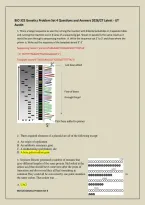
1. This is a Sanger sequence as seen by running the reaction with dideoxynucleotides in 4 separate tubes
and running the reactions out in 4 lanes of a sequencing gel. Shown in parallel is the same result as it
would be seen through a sequencing machine. A. Write the sequence out 5’ to 3’ and show where the
primer is. Write out the sequence of the template strand 5’-3’
Sequencing result 5’ primer ATAAAAAACTCAGAACGGCTTCGTA3’
[ 3’ TATTTTTTGAGTCTTGCCGAAGCAT 5’ ]
Template strand 5’ TACGAAGCCGTTCTGAGTTTTTTAT 3’
3’ Last base added
Flow of bases
through the gel
First base added to primer
5’
2. Three required elements of a plasmid are all of the following except:
A. An origin of replication
B. An antibiotic resistance gene
C. A multicloning (polylinker) site
D. A beta galactosidase gene
3. Seymore Benzer generated a number of mutants that
gave different lengths of the same protein. He looked at the
amino acid that should have come next after the point of
truncation and discovered they all had something in
common.They could all be converted by one point mutation to
the same codon. That codon was …
A. UAG
BIO 325 Genetics Problem Set 4
Austin
1. This is a Sanger sequence as seen by running the reaction with dideoxynucleotides in 4 separate tubes
and running the reactions out in 4 lanes of a sequencing gel. Shown in parallel is the same result as it
would be seen through a sequencing machine. A. Write the sequence out 5’ to 3’ and show where the
primer is. Write out the sequence of the template strand 5’-3’
Sequencing result 5’ primer ATAAAAAACTCAGAACGGCTTCGTA3’
[ 3’ TATTTTTTGAGTCTTGCCGAAGCAT 5’ ]
Template strand 5’ TACGAAGCCGTTCTGAGTTTTTTAT 3’
3’ Last base added
Flow of bases
through the gel
First base added to primer
5’
2. Three required elements of a plasmid are all of the following except:
A. An origin of replication
B. An antibiotic resistance gene
C. A multicloning (polylinker) site
D. A beta galactosidase gene
3. Seymore Benzer generated a number of mutants that
gave different lengths of the same protein. He looked at the
amino acid that should have come next after the point of
truncation and discovered they all had something in
common.They could all be converted by one point mutation to
the same codon. That codon was …
A. UAG
BIO 325 Genetics Problem Set 4