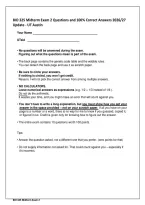
BIO 325 Midterm Exam 2 Questions and 100% Correct Answers 2026/27
Update - UT Austin
Your Name
UTeid
• No questions will be answered during the exam.
Figuring out what the questions mean is part of the exam.
• The back page contains the genetic code table and the wobble rules.
You can detach the back page and use it as scratch paper.
• Be sure to circle your answers.
If nothing is circled, you won’t get credit.
Reason: I will not pick the correct answer from among multiple answers.
• NO CALCULATORS.
Leave numerical answers as expressions (e.g. 1/2 × 1/3 instead of 1/6 ).
Do not do the arithmetic.
It wastes your time, and you might make an error that will count against you.
• You don’t have to write a long explanation, but you must show how you got your
answer in the space provided – not on your scratch paper. If all you have on your
page is a number or a word, there is no way for me to know if you guessed, copied it,
or figured it out. Credit is given only for knowing how to figure out the answer.
• The entire exam contains 10 questions worth 100 points.
Tips:
• Answer the question asked, not a different one that you prefer. (zero points for that)
• Do not supply information not asked for. That could count against you – especially if
it’s incorrect.
BIO 325 Midterm Exam 2
, This is exactly homework problem 5-12.
1. Suppose that in a snake, the dominant allele of gene S causes smooth skin while the
recessive s allele control scaly skin, and the dominant O allele causes orange skin,
while the recessive o allele causes tan skin. Both S and O are autosomal genes.
Male snakes from a pure-breeding smooth orange line were crossed with female
snakes from a pure-breeding scaly tan line. The F1 were crossed with scaly tan snakes
of the opposite sex. Their progeny (the F2) were 445 smooth orange, 53 smooth tan, 47
scaly orange, and 455 scaly tan.
a. Are the S and O genes on the same chromosome? (Yes or no and explain.) If yes,
how far apart are they in map units? (10 points)
YES
S O / S O × s o / s o → S O / s o F1
S O / s o F1 × s o / s o → 445 S O / s o
455 s o / s o
53 S o / s o
47 s O / s o
The second cross is testcross. Each of the four phenotypic classes of progeny comes from a
different gamete type of the dihybrid F1. If genes S and O were on different chromosomes, their
alleles would assort independently into gametes, and there would be equal numbers of all
four gamete types. Clearly, that’s not the case here so the two genes are linked – they are on
the same chromosome.
The testcross progeny (the F2) present in the largest numbers are from parental gametes (S O and
s o), and the others are from recombinant gametes (S o and s O).
RF = (53 + 47) / (53 + 47 + 445 + 455)
The genes are (53 + 47) / (53 + 47 + 445 + 455) m.u. apart.
(= 100/ 1000 = 1/10 = 10%
The two genes are 10 m.u. apart.)
b. If smooth tan male F2 are crossed with scaly orange female F2, what phenotypes are
expected in their progeny and in what proportions? (5 points)
So/so ♂ × sO/so♀
♂ gamete types are S o and s o in equal proportions.
♀ gamete types are s O and s o in equal proportions.
♂ ♀ s O (1/2) s o (1/2)
S o (1/2) Ss Oo (1/4) Ss oo (1/4)
smooth orange smooth tan
s o (1/2) ss Oo (1/4) ss oo (1/4)
scaly orange scaly tan
Note that the fact that the two genes are linked are irrelevant here because in both parents, the P
and R gametes are indistinguishable. To be able to tell the P and R gamete types of a parent apart,
the parent must be a dihybrid – the parent must have two different alleles of both genes. So, the
answer would be 1:1:1:1 regardless of the RF between the two genes.
BIO 325 Midterm Exam 2
Update - UT Austin
Your Name
UTeid
• No questions will be answered during the exam.
Figuring out what the questions mean is part of the exam.
• The back page contains the genetic code table and the wobble rules.
You can detach the back page and use it as scratch paper.
• Be sure to circle your answers.
If nothing is circled, you won’t get credit.
Reason: I will not pick the correct answer from among multiple answers.
• NO CALCULATORS.
Leave numerical answers as expressions (e.g. 1/2 × 1/3 instead of 1/6 ).
Do not do the arithmetic.
It wastes your time, and you might make an error that will count against you.
• You don’t have to write a long explanation, but you must show how you got your
answer in the space provided – not on your scratch paper. If all you have on your
page is a number or a word, there is no way for me to know if you guessed, copied it,
or figured it out. Credit is given only for knowing how to figure out the answer.
• The entire exam contains 10 questions worth 100 points.
Tips:
• Answer the question asked, not a different one that you prefer. (zero points for that)
• Do not supply information not asked for. That could count against you – especially if
it’s incorrect.
BIO 325 Midterm Exam 2
, This is exactly homework problem 5-12.
1. Suppose that in a snake, the dominant allele of gene S causes smooth skin while the
recessive s allele control scaly skin, and the dominant O allele causes orange skin,
while the recessive o allele causes tan skin. Both S and O are autosomal genes.
Male snakes from a pure-breeding smooth orange line were crossed with female
snakes from a pure-breeding scaly tan line. The F1 were crossed with scaly tan snakes
of the opposite sex. Their progeny (the F2) were 445 smooth orange, 53 smooth tan, 47
scaly orange, and 455 scaly tan.
a. Are the S and O genes on the same chromosome? (Yes or no and explain.) If yes,
how far apart are they in map units? (10 points)
YES
S O / S O × s o / s o → S O / s o F1
S O / s o F1 × s o / s o → 445 S O / s o
455 s o / s o
53 S o / s o
47 s O / s o
The second cross is testcross. Each of the four phenotypic classes of progeny comes from a
different gamete type of the dihybrid F1. If genes S and O were on different chromosomes, their
alleles would assort independently into gametes, and there would be equal numbers of all
four gamete types. Clearly, that’s not the case here so the two genes are linked – they are on
the same chromosome.
The testcross progeny (the F2) present in the largest numbers are from parental gametes (S O and
s o), and the others are from recombinant gametes (S o and s O).
RF = (53 + 47) / (53 + 47 + 445 + 455)
The genes are (53 + 47) / (53 + 47 + 445 + 455) m.u. apart.
(= 100/ 1000 = 1/10 = 10%
The two genes are 10 m.u. apart.)
b. If smooth tan male F2 are crossed with scaly orange female F2, what phenotypes are
expected in their progeny and in what proportions? (5 points)
So/so ♂ × sO/so♀
♂ gamete types are S o and s o in equal proportions.
♀ gamete types are s O and s o in equal proportions.
♂ ♀ s O (1/2) s o (1/2)
S o (1/2) Ss Oo (1/4) Ss oo (1/4)
smooth orange smooth tan
s o (1/2) ss Oo (1/4) ss oo (1/4)
scaly orange scaly tan
Note that the fact that the two genes are linked are irrelevant here because in both parents, the P
and R gametes are indistinguishable. To be able to tell the P and R gamete types of a parent apart,
the parent must be a dihybrid – the parent must have two different alleles of both genes. So, the
answer would be 1:1:1:1 regardless of the RF between the two genes.
BIO 325 Midterm Exam 2