
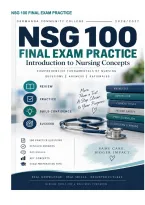
NSG 100 FINAL EXAM PRACTICE
, TABLE OF CONTENTS
NSG 100 Final Exam Practice — Introduction to Nursing Concepts
• • Nursing Foundations & Nursing Process
• • Assessment, Vital Signs & Clinical Judgment
• • Therapeutic Communication & Patient Education
• • Safety, Falls & Emergency Response
• • Infection Control & Sterile Technique
• • Medication Administration & Medication Safety
• • Mobility, Positioning & Skin Integrity
• • Oxygenation, Aspiration & Respiratory Care
• • Nutrition, Hydration & Elimination
• • Pain, Comfort, Hygiene & Sleep
• • Ethics, Consent, Privacy & Patient Rights
• • Delegation, Documentation & Evaluation
• • Comprehensive Prioritization
NSG 100 Final Exam Practice • 2
, Comprehensive Fundamentals of Nursing Practice Questions, Answers & Detailed Rationales | Germanna
Community College | 2026/2027
Question 1
Morning assessment reveals a patient who is difficult to arouse, breathing 8 times/min, and has an oxygen
saturation of 84%. Which nursing action has the highest priority?
A. Complete the full head-to-toe assessment
B. Review the patient's nutritional intake
C. Immediately assess and support airway and breathing
D. Obtain the patient's complete health history
Correct Answer: C
Rationale: Bradypnea, decreased responsiveness, and severe hypoxemia indicate an immediate threat to oxygenation.
Airway and breathing must be assessed and supported before routine history-taking or other nonurgent assessments.
The nurse should rapidly evaluate respiratory status and initiate appropriate interventions and escalation.
🩺 Clinical Pearl: Physiologic instability always takes priority over completion of routine nursing tasks.
🎯 Exam Strategy: When respiratory compromise is present, think Airway → Breathing → Circulation.
Question 2
Which action represents the assessment phase of the nursing process?
A. Collecting the patient's symptoms, vital signs, and physical-examination findings
B. Establishing measurable patient outcomes
C. Carrying out prescribed nursing interventions
D. Determining whether goals were achieved
Correct Answer: A
Rationale: Assessment involves systematically collecting subjective and objective information about the patient's
health status. These data are analyzed before nursing diagnoses, outcomes, and interventions are established.
Evaluation occurs after care has been implemented.
🩺 Clinical Pearl: Accurate assessment provides the foundation for every later nursing decision.
🎯 Exam Strategy: Remember ADPIE: Assessment, Diagnosis, Planning, Implementation, Evaluation.
Question 3
Before administering an oral medication, which action best demonstrates safe nursing practice?
A. Ask the patient whether the medication looks familiar
B. Compare the medication with another patient's prescription
C. Administer the medication before checking allergies to avoid delay
D. Verify the patient's identity using at least two approved identifiers
Correct Answer: D
Rationale: Patient identification is a fundamental medication-safety step and should use at least two approved
identifiers according to institutional policy. Room number alone is not an acceptable identifier. The nurse should also
verify medication rights, allergies, and the medication order before administration.
🩺 Clinical Pearl: Correct medication given to the wrong patient is still a medication error.
🎯 Exam Strategy: Medication questions frequently begin with identify the correct patient.
NSG 100 Final Exam Practice • 3
,Question 4
While assisting with hygiene, the nurse notices redness over the sacrum that does not blanch when pressed. Which
response is most appropriate?
A. Massage the area vigorously
B. Relieve pressure and perform a focused skin assessment
C. Cover the area and reassess in several days
D. Keep the patient in the same position to avoid friction
Correct Answer: B
Rationale: Nonblanchable erythema over a pressure-prone area indicates pressure-related tissue injury and requires
immediate pressure relief and further assessment. Massage can damage vulnerable tissue. Repositioning, moisture
control, nutrition, mobility, and skin surveillance are important preventive measures.
🩺 Clinical Pearl: Pressure injury prevention begins before the skin opens.
🎯 Exam Strategy: Nonblanchable redness + bony prominence = relieve pressure.
Question 5
Which patient statement best represents subjective data?
A. Temperature is 38.2°C
B. Respiratory rate is 24/min
C. “My incision feels like it is burning.”
D. The wound measures 3 cm × 2 cm
Correct Answer: C
Rationale: Subjective data describe symptoms, sensations, beliefs, and experiences reported by the patient. Pain
quality such as “burning” cannot be independently measured by the nurse. Temperature, respiratory rate, and wound
dimensions are objective findings.
🩺 Clinical Pearl: Symptoms = subjective; signs and measurements = objective.
🎯 Exam Strategy: If the information comes from what the patient feels or reports, think subjective.
Question 6
During an interview, the patient says, “I have been feeling strange lately.” Which response by the nurse is best?
A. “You probably mean that you are tired.”
B. “Tell me what you mean by feeling strange.”
C. “Is the problem caused by stress?”
D. “Would you say it is serious?”
Correct Answer: B
Rationale: Clarification helps the nurse understand vague or ambiguous patient statements without inserting
assumptions. Asking the patient to explain “strange” allows the symptoms to be described in the patient's own words.
Leading questions may distort the information obtained.
🩺 Clinical Pearl: Never assume what a vague patient statement means.
🎯 Exam Strategy: Vague information calls for clarification, not interpretation.
NSG 100 Final Exam Practice • 4
,Question 7
A patient with suspected Clostridioides difficile infection has frequent watery diarrhea. Which infection-control
intervention is most appropriate?
A. Use contact precautions and wash hands with soap and water after care
B. Use only a surgical mask when entering the room
C. Place the patient on airborne precautions
D. Use alcohol-based hand rub as the preferred method after visibly contaminated care
Correct Answer: A
Rationale: C. difficile requires contact precautions because spores can contaminate the environment and spread by
direct or indirect contact. Soap and water physically remove spores more effectively than relying on alcohol-based hand
rub alone. Appropriate gown, gloves, environmental cleaning, and hand hygiene are essential.
🩺 Clinical Pearl: Spore-forming organisms require special attention to handwashing and environmental cleaning.
🎯 Exam Strategy: C. difficile = contact precautions + soap and water.
Question 8
The nurse enters a room and finds a patient lying on the floor beside the bed. What should the nurse do first?
A. Immediately lift the patient back into bed
B. Complete an incident report
C. Call the patient's family
D. Assess the patient for injury and physiologic stability
Correct Answer: D
Rationale: The patient's condition must be assessed before moving them unless the environment presents immediate
danger. The nurse should evaluate responsiveness, airway, breathing, circulation, pain, neurologic status, and possible
injury. Documentation and incident reporting follow after patient safety has been addressed.
🩺 Clinical Pearl: After a fall, assess before moving whenever possible.
🎯 Exam Strategy: Patient condition comes before paperwork.
Question 9
Which action most effectively reduces transmission of microorganisms between patients during routine care?
A. Wearing gloves continuously throughout the shift
B. Administering prophylactic antibiotics to all patients
C. Performing hand hygiene at appropriate moments
D. Keeping every patient in a private room
Correct Answer: C
Rationale: Hand hygiene is one of the most effective measures for preventing healthcare-associated transmission of
microorganisms. Gloves do not replace hand hygiene and should be changed appropriately between tasks and patients.
Routine antibiotics are not an infection-control substitute and may contribute to resistance.
🩺 Clinical Pearl: Clean hands protect both patients and healthcare workers.
🎯 Exam Strategy: When asked for the single most important general infection-prevention action, choose hand
hygiene.
NSG 100 Final Exam Practice • 5
,Question 10
While transferring a weak patient from bed to chair, which nursing action best promotes safety?
A. Assess mobility and strength before attempting the transfer
B. Pull the patient upward by the arms
C. Encourage the patient to stand before applying nonskid footwear
D. Perform the transfer alone regardless of the patient's ability
Correct Answer: A
Rationale: Safe transfers begin with assessing strength, balance, weight-bearing ability, cognition, and the assistance
required. Appropriate footwear, body mechanics, assistive equipment, and additional personnel may be necessary.
Pulling on the arms can cause injury to both patient and nurse.
🩺 Clinical Pearl: Match the transfer method to the patient's actual mobility ability.
🎯 Exam Strategy: Before moving a patient, assess first.
Question 11
A postoperative patient reports pain rated 8/10 but is smiling while speaking with a visitor. How should the nurse
respond?
A. Record the pain as mild because the patient appears comfortable
B. Accept the patient's report and perform a focused pain assessment
C. Wait for an increased heart rate before treating the pain
D. Ask the visitor to determine whether the pain is genuine
Correct Answer: B
Rationale: Pain is subjective, and behavior does not reliably determine its intensity. Patients differ in coping strategies,
cultural expression, previous pain experience, and outward behavior. The nurse should accept a reliable self-report and
assess pain location, quality, timing, severity, aggravating factors, and functional effect.
🩺 Clinical Pearl: The patient's self-report is the primary indicator of pain when communication is reliable.
🎯 Exam Strategy: Never invalidate pain solely because the patient “doesn't look like” they are hurting.
Question 12
A patient becomes dizzy when standing from bed. Which action is most appropriate?
A. Encourage the patient to walk quickly to improve circulation
B. Continue ambulation because dizziness is expected
C. Ask the patient to close their eyes and keep walking
D. Assist the patient to a safe position and assess blood pressure and symptoms
Correct Answer: D
Rationale: New dizziness with position change increases fall risk and may indicate orthostatic hypotension or impaired
perfusion. The nurse should protect the patient from falling, return them to a safe position, and evaluate vital signs and
associated symptoms before attempting further ambulation.
🩺 Clinical Pearl: Fall prevention begins by responding to early warning symptoms such as dizziness.
🎯 Exam Strategy: Safety first—stop, support, assess.
NSG 100 Final Exam Practice • 6
,Question 13
Which intervention best helps prevent complications of immobility?
A. Encourage regular repositioning and progressive mobility as tolerated
B. Restrict fluid intake to reduce toileting needs
C. Keep the knees flexed continuously
D. Limit range-of-motion activity to prevent fatigue
Correct Answer: A
Rationale: Repositioning and progressive mobility help prevent pressure injuries, venous stasis, muscle weakness,
contractures, pulmonary complications, and constipation. Prolonged immobility affects nearly every body system,
making early safe mobility an important nursing intervention.
🩺 Clinical Pearl: Mobility supports skin integrity, circulation, respiratory function, elimination, and muscle strength.
🎯 Exam Strategy: For immobility complications, think move, reposition, and maintain function.
Question 14
Which observation most strongly suggests that a patient may be experiencing fluid-volume deficit?
A. Bounding pulse with peripheral edema
B. Moist mucous membranes and stable urine output
C. Dry mucous membranes, tachycardia, and decreased urine output
D. Crackles and jugular venous distention
Correct Answer: C
Rationale: Dry mucous membranes, increased heart rate, and reduced urine output can occur when circulating fluid
volume is inadequate. Assessment should also consider blood pressure, orthostatic symptoms, intake and output,
weight trends, medications, and laboratory findings when available.
🩺 Clinical Pearl: Hydration status is determined from a cluster of findings, not skin turgor alone.
🎯 Exam Strategy: Dry + tachycardic + low urine output suggests fluid deficit.
Question 15
During feeding, a patient begins coughing repeatedly and develops a wet, gurgling voice. What should the nurse do?
A. Encourage the patient to drink water rapidly
B. Stop feeding and assess swallowing and airway safety
C. Continue feeding smaller bites without further assessment
D. Place the patient flat in bed
Correct Answer: B
Rationale: Coughing and a wet voice during eating may indicate aspiration or impaired swallowing. Oral intake should be
stopped until airway safety and swallowing ability are evaluated. Continuing feeding could increase the risk of material
entering the airway.
🩺 Clinical Pearl: Coughing, choking, or voice changes with eating are important aspiration warning signs.
🎯 Exam Strategy: Possible aspiration = stop intake first.
NSG 100 Final Exam Practice • 7
,Question 16
Which position best promotes lung expansion in a patient experiencing shortness of breath?
A. Flat supine position
B. Trendelenburg position
C. Prone with the head turned sideways
D. Upright or high-Fowler position
Correct Answer: D
Rationale: An upright position lowers pressure from abdominal contents on the diaphragm and generally promotes
thoracic expansion. Patients with respiratory distress often breathe more effectively when sitting upright. Additional
oxygenation and respiratory interventions depend on the assessment findings and orders.
🩺 Clinical Pearl: Positioning is a rapid nonpharmacologic intervention for many patients with dyspnea.
🎯 Exam Strategy: Difficulty breathing usually points toward upright positioning.
Question 17
The nurse finds a patient's urinary drainage bag resting on the bed above the level of the bladder. Which action is
appropriate?
A. Place the drainage bag below bladder level without allowing it to touch the floor
B. Disconnect the tubing to empty urine into the bedpan
C. Place the drainage bag on the patient's abdomen
D. Clamp the catheter tubing continuously
Correct Answer: A
Rationale: A urinary drainage system should remain closed, with the collection bag below bladder level to promote
gravity drainage and reduce urine backflow. The bag should not rest on the floor because contamination increases
infection risk.
🩺 Clinical Pearl: Closed drainage + unobstructed flow + bag below bladder = core catheter-care principles.
🎯 Exam Strategy: Urinary drainage should always flow downhill.
Question 18
Which assessment finding is most concerning for constipation?
A. Soft formed stool every other day without discomfort
B. Bowel movement after breakfast each morning
C. Hard dry stool accompanied by straining and abdominal discomfort
D. Increased bowel sounds after eating
Correct Answer: C
Rationale: Constipation commonly involves hard, dry stools, difficulty passing stool, straining, decreased frequency
relative to the individual's pattern, or a sensation of incomplete evacuation. Normal bowel frequency varies
considerably, so stool characteristics and difficulty are often more useful than frequency alone.
🩺 Clinical Pearl: “Normal” bowel frequency is individualized.
🎯 Exam Strategy: Hard stool + straining + discomfort = constipation.
NSG 100 Final Exam Practice • 8
,Question 19
A patient receiving opioid medication is at increased risk for which common adverse effect that should be
anticipated in the nursing plan?
A. Constipation
B. Excessive urine production
C. Persistent diarrhea
D. Increased bowel motility
Correct Answer: A
Rationale: Opioids reduce gastrointestinal motility and commonly produce constipation. Preventive measures may
include mobility, hydration when appropriate, dietary measures, and prescribed bowel-management therapies. The
nurse should also monitor for sedation and respiratory depression.
🩺 Clinical Pearl: Constipation prevention is often easier than treating established opioid-induced constipation.
🎯 Exam Strategy: Opioids commonly slow the bowel.
Question 20
During medication administration, the patient states, “This pill doesn't look like the one I usually take.” What should
the nurse do?
A. Tell the patient that medication appearance frequently changes and administer it
B. Ask another patient whether the medication looks correct
C. Document refusal before checking the medication
D. Hold administration until the medication order and preparation have been verified
Correct Answer: D
Rationale: A patient questioning a medication should be taken seriously because it may identify a medication
discrepancy or error. The nurse should pause administration and verify the medication against the order, medication
record, pharmacy information, and other appropriate sources before proceeding.
🩺 Clinical Pearl: Patients can be an important final safety check in medication administration.
🎯 Exam Strategy: Medication uncertainty = stop and verify.
Question 21
Which action best protects patient confidentiality?
A. Discussing the patient's condition in the elevator with another nurse
B. Leaving the electronic record open at the nurses' station
C. Sharing health information only with authorized individuals involved in care
D. Posting an unusual clinical case on social media without the patient's name
Correct Answer: C
Rationale: Patient information should be accessed and disclosed only for legitimate healthcare purposes and to
authorized individuals. Public conversations, unsecured electronic records, and social-media posts can violate
confidentiality even when obvious identifiers are omitted.
🩺 Clinical Pearl: Privacy applies to verbal, written, electronic, and photographic information.
🎯 Exam Strategy: Share only what is necessary with people who are authorized to receive it.
NSG 100 Final Exam Practice • 9
,Question 22
The patient says, “I don't understand why I need this procedure.” Which nursing response best supports informed
decision-making?
A. “The provider already ordered it, so you should sign the form.”
B. “I'll make sure your questions are addressed before you decide whether to proceed.”
C. “Everyone with your condition has this procedure.”
D. “Signing the form means there are no risks.”
Correct Answer: B
Rationale: Valid informed consent requires that the patient receive understandable information about the procedure,
potential risks, benefits, alternatives, and the opportunity to ask questions. The nurse should not pressure the patient or
provide misleading reassurance. Questions requiring additional procedural explanation should be addressed by the
appropriate provider.
🩺 Clinical Pearl: Consent must be informed and voluntary.
🎯 Exam Strategy: Unanswered questions before consent = clarify before proceeding.
Question 23
Following an intervention for shortness of breath, oxygen saturation improves from 86% to 95% and the patient can
speak in full sentences. Which nursing-process step is being demonstrated?
A. Evaluation
B. Diagnosis
C. Planning
D. Assessment only
Correct Answer: A
Rationale: Evaluation determines whether an intervention achieved the desired outcome. Comparing the patient's
respiratory status after treatment with baseline findings demonstrates whether care was effective and whether further
intervention is necessary.
🩺 Clinical Pearl: Evaluation requires comparison between the expected outcome and actual response.
🎯 Exam Strategy: When the question asks whether an intervention worked, think evaluation.
Question 24
Which task is most appropriate to assign to trained assistive personnel for a stable patient, according to facility
policy and the individual's demonstrated competency?
A. Perform the initial nursing assessment
B. Obtain and report routine vital signs
C. Interpret abnormal laboratory results
D. Develop the nursing plan of care
Correct Answer: B
Rationale: Routine, predictable tasks such as obtaining vital signs from a stable patient may be assigned to
appropriately trained assistive personnel when consistent with law and facility policy. Nursing assessment, clinical
interpretation, nursing judgment, and care planning remain responsibilities of the licensed nurse.
🩺 Clinical Pearl: The nurse may assign a task but remains responsible for appropriate supervision and follow-up.
🎯 Exam Strategy: Delegate routine and predictable tasks, not nursing judgment.
NSG 100 Final Exam Practice • 10
, TABLE OF CONTENTS
NSG 100 Final Exam Practice — Introduction to Nursing Concepts
• • Nursing Foundations & Nursing Process
• • Assessment, Vital Signs & Clinical Judgment
• • Therapeutic Communication & Patient Education
• • Safety, Falls & Emergency Response
• • Infection Control & Sterile Technique
• • Medication Administration & Medication Safety
• • Mobility, Positioning & Skin Integrity
• • Oxygenation, Aspiration & Respiratory Care
• • Nutrition, Hydration & Elimination
• • Pain, Comfort, Hygiene & Sleep
• • Ethics, Consent, Privacy & Patient Rights
• • Delegation, Documentation & Evaluation
• • Comprehensive Prioritization
NSG 100 Final Exam Practice • 2
, Comprehensive Fundamentals of Nursing Practice Questions, Answers & Detailed Rationales | Germanna
Community College | 2026/2027
Question 1
Morning assessment reveals a patient who is difficult to arouse, breathing 8 times/min, and has an oxygen
saturation of 84%. Which nursing action has the highest priority?
A. Complete the full head-to-toe assessment
B. Review the patient's nutritional intake
C. Immediately assess and support airway and breathing
D. Obtain the patient's complete health history
Correct Answer: C
Rationale: Bradypnea, decreased responsiveness, and severe hypoxemia indicate an immediate threat to oxygenation.
Airway and breathing must be assessed and supported before routine history-taking or other nonurgent assessments.
The nurse should rapidly evaluate respiratory status and initiate appropriate interventions and escalation.
🩺 Clinical Pearl: Physiologic instability always takes priority over completion of routine nursing tasks.
🎯 Exam Strategy: When respiratory compromise is present, think Airway → Breathing → Circulation.
Question 2
Which action represents the assessment phase of the nursing process?
A. Collecting the patient's symptoms, vital signs, and physical-examination findings
B. Establishing measurable patient outcomes
C. Carrying out prescribed nursing interventions
D. Determining whether goals were achieved
Correct Answer: A
Rationale: Assessment involves systematically collecting subjective and objective information about the patient's
health status. These data are analyzed before nursing diagnoses, outcomes, and interventions are established.
Evaluation occurs after care has been implemented.
🩺 Clinical Pearl: Accurate assessment provides the foundation for every later nursing decision.
🎯 Exam Strategy: Remember ADPIE: Assessment, Diagnosis, Planning, Implementation, Evaluation.
Question 3
Before administering an oral medication, which action best demonstrates safe nursing practice?
A. Ask the patient whether the medication looks familiar
B. Compare the medication with another patient's prescription
C. Administer the medication before checking allergies to avoid delay
D. Verify the patient's identity using at least two approved identifiers
Correct Answer: D
Rationale: Patient identification is a fundamental medication-safety step and should use at least two approved
identifiers according to institutional policy. Room number alone is not an acceptable identifier. The nurse should also
verify medication rights, allergies, and the medication order before administration.
🩺 Clinical Pearl: Correct medication given to the wrong patient is still a medication error.
🎯 Exam Strategy: Medication questions frequently begin with identify the correct patient.
NSG 100 Final Exam Practice • 3
,Question 4
While assisting with hygiene, the nurse notices redness over the sacrum that does not blanch when pressed. Which
response is most appropriate?
A. Massage the area vigorously
B. Relieve pressure and perform a focused skin assessment
C. Cover the area and reassess in several days
D. Keep the patient in the same position to avoid friction
Correct Answer: B
Rationale: Nonblanchable erythema over a pressure-prone area indicates pressure-related tissue injury and requires
immediate pressure relief and further assessment. Massage can damage vulnerable tissue. Repositioning, moisture
control, nutrition, mobility, and skin surveillance are important preventive measures.
🩺 Clinical Pearl: Pressure injury prevention begins before the skin opens.
🎯 Exam Strategy: Nonblanchable redness + bony prominence = relieve pressure.
Question 5
Which patient statement best represents subjective data?
A. Temperature is 38.2°C
B. Respiratory rate is 24/min
C. “My incision feels like it is burning.”
D. The wound measures 3 cm × 2 cm
Correct Answer: C
Rationale: Subjective data describe symptoms, sensations, beliefs, and experiences reported by the patient. Pain
quality such as “burning” cannot be independently measured by the nurse. Temperature, respiratory rate, and wound
dimensions are objective findings.
🩺 Clinical Pearl: Symptoms = subjective; signs and measurements = objective.
🎯 Exam Strategy: If the information comes from what the patient feels or reports, think subjective.
Question 6
During an interview, the patient says, “I have been feeling strange lately.” Which response by the nurse is best?
A. “You probably mean that you are tired.”
B. “Tell me what you mean by feeling strange.”
C. “Is the problem caused by stress?”
D. “Would you say it is serious?”
Correct Answer: B
Rationale: Clarification helps the nurse understand vague or ambiguous patient statements without inserting
assumptions. Asking the patient to explain “strange” allows the symptoms to be described in the patient's own words.
Leading questions may distort the information obtained.
🩺 Clinical Pearl: Never assume what a vague patient statement means.
🎯 Exam Strategy: Vague information calls for clarification, not interpretation.
NSG 100 Final Exam Practice • 4
,Question 7
A patient with suspected Clostridioides difficile infection has frequent watery diarrhea. Which infection-control
intervention is most appropriate?
A. Use contact precautions and wash hands with soap and water after care
B. Use only a surgical mask when entering the room
C. Place the patient on airborne precautions
D. Use alcohol-based hand rub as the preferred method after visibly contaminated care
Correct Answer: A
Rationale: C. difficile requires contact precautions because spores can contaminate the environment and spread by
direct or indirect contact. Soap and water physically remove spores more effectively than relying on alcohol-based hand
rub alone. Appropriate gown, gloves, environmental cleaning, and hand hygiene are essential.
🩺 Clinical Pearl: Spore-forming organisms require special attention to handwashing and environmental cleaning.
🎯 Exam Strategy: C. difficile = contact precautions + soap and water.
Question 8
The nurse enters a room and finds a patient lying on the floor beside the bed. What should the nurse do first?
A. Immediately lift the patient back into bed
B. Complete an incident report
C. Call the patient's family
D. Assess the patient for injury and physiologic stability
Correct Answer: D
Rationale: The patient's condition must be assessed before moving them unless the environment presents immediate
danger. The nurse should evaluate responsiveness, airway, breathing, circulation, pain, neurologic status, and possible
injury. Documentation and incident reporting follow after patient safety has been addressed.
🩺 Clinical Pearl: After a fall, assess before moving whenever possible.
🎯 Exam Strategy: Patient condition comes before paperwork.
Question 9
Which action most effectively reduces transmission of microorganisms between patients during routine care?
A. Wearing gloves continuously throughout the shift
B. Administering prophylactic antibiotics to all patients
C. Performing hand hygiene at appropriate moments
D. Keeping every patient in a private room
Correct Answer: C
Rationale: Hand hygiene is one of the most effective measures for preventing healthcare-associated transmission of
microorganisms. Gloves do not replace hand hygiene and should be changed appropriately between tasks and patients.
Routine antibiotics are not an infection-control substitute and may contribute to resistance.
🩺 Clinical Pearl: Clean hands protect both patients and healthcare workers.
🎯 Exam Strategy: When asked for the single most important general infection-prevention action, choose hand
hygiene.
NSG 100 Final Exam Practice • 5
,Question 10
While transferring a weak patient from bed to chair, which nursing action best promotes safety?
A. Assess mobility and strength before attempting the transfer
B. Pull the patient upward by the arms
C. Encourage the patient to stand before applying nonskid footwear
D. Perform the transfer alone regardless of the patient's ability
Correct Answer: A
Rationale: Safe transfers begin with assessing strength, balance, weight-bearing ability, cognition, and the assistance
required. Appropriate footwear, body mechanics, assistive equipment, and additional personnel may be necessary.
Pulling on the arms can cause injury to both patient and nurse.
🩺 Clinical Pearl: Match the transfer method to the patient's actual mobility ability.
🎯 Exam Strategy: Before moving a patient, assess first.
Question 11
A postoperative patient reports pain rated 8/10 but is smiling while speaking with a visitor. How should the nurse
respond?
A. Record the pain as mild because the patient appears comfortable
B. Accept the patient's report and perform a focused pain assessment
C. Wait for an increased heart rate before treating the pain
D. Ask the visitor to determine whether the pain is genuine
Correct Answer: B
Rationale: Pain is subjective, and behavior does not reliably determine its intensity. Patients differ in coping strategies,
cultural expression, previous pain experience, and outward behavior. The nurse should accept a reliable self-report and
assess pain location, quality, timing, severity, aggravating factors, and functional effect.
🩺 Clinical Pearl: The patient's self-report is the primary indicator of pain when communication is reliable.
🎯 Exam Strategy: Never invalidate pain solely because the patient “doesn't look like” they are hurting.
Question 12
A patient becomes dizzy when standing from bed. Which action is most appropriate?
A. Encourage the patient to walk quickly to improve circulation
B. Continue ambulation because dizziness is expected
C. Ask the patient to close their eyes and keep walking
D. Assist the patient to a safe position and assess blood pressure and symptoms
Correct Answer: D
Rationale: New dizziness with position change increases fall risk and may indicate orthostatic hypotension or impaired
perfusion. The nurse should protect the patient from falling, return them to a safe position, and evaluate vital signs and
associated symptoms before attempting further ambulation.
🩺 Clinical Pearl: Fall prevention begins by responding to early warning symptoms such as dizziness.
🎯 Exam Strategy: Safety first—stop, support, assess.
NSG 100 Final Exam Practice • 6
,Question 13
Which intervention best helps prevent complications of immobility?
A. Encourage regular repositioning and progressive mobility as tolerated
B. Restrict fluid intake to reduce toileting needs
C. Keep the knees flexed continuously
D. Limit range-of-motion activity to prevent fatigue
Correct Answer: A
Rationale: Repositioning and progressive mobility help prevent pressure injuries, venous stasis, muscle weakness,
contractures, pulmonary complications, and constipation. Prolonged immobility affects nearly every body system,
making early safe mobility an important nursing intervention.
🩺 Clinical Pearl: Mobility supports skin integrity, circulation, respiratory function, elimination, and muscle strength.
🎯 Exam Strategy: For immobility complications, think move, reposition, and maintain function.
Question 14
Which observation most strongly suggests that a patient may be experiencing fluid-volume deficit?
A. Bounding pulse with peripheral edema
B. Moist mucous membranes and stable urine output
C. Dry mucous membranes, tachycardia, and decreased urine output
D. Crackles and jugular venous distention
Correct Answer: C
Rationale: Dry mucous membranes, increased heart rate, and reduced urine output can occur when circulating fluid
volume is inadequate. Assessment should also consider blood pressure, orthostatic symptoms, intake and output,
weight trends, medications, and laboratory findings when available.
🩺 Clinical Pearl: Hydration status is determined from a cluster of findings, not skin turgor alone.
🎯 Exam Strategy: Dry + tachycardic + low urine output suggests fluid deficit.
Question 15
During feeding, a patient begins coughing repeatedly and develops a wet, gurgling voice. What should the nurse do?
A. Encourage the patient to drink water rapidly
B. Stop feeding and assess swallowing and airway safety
C. Continue feeding smaller bites without further assessment
D. Place the patient flat in bed
Correct Answer: B
Rationale: Coughing and a wet voice during eating may indicate aspiration or impaired swallowing. Oral intake should be
stopped until airway safety and swallowing ability are evaluated. Continuing feeding could increase the risk of material
entering the airway.
🩺 Clinical Pearl: Coughing, choking, or voice changes with eating are important aspiration warning signs.
🎯 Exam Strategy: Possible aspiration = stop intake first.
NSG 100 Final Exam Practice • 7
,Question 16
Which position best promotes lung expansion in a patient experiencing shortness of breath?
A. Flat supine position
B. Trendelenburg position
C. Prone with the head turned sideways
D. Upright or high-Fowler position
Correct Answer: D
Rationale: An upright position lowers pressure from abdominal contents on the diaphragm and generally promotes
thoracic expansion. Patients with respiratory distress often breathe more effectively when sitting upright. Additional
oxygenation and respiratory interventions depend on the assessment findings and orders.
🩺 Clinical Pearl: Positioning is a rapid nonpharmacologic intervention for many patients with dyspnea.
🎯 Exam Strategy: Difficulty breathing usually points toward upright positioning.
Question 17
The nurse finds a patient's urinary drainage bag resting on the bed above the level of the bladder. Which action is
appropriate?
A. Place the drainage bag below bladder level without allowing it to touch the floor
B. Disconnect the tubing to empty urine into the bedpan
C. Place the drainage bag on the patient's abdomen
D. Clamp the catheter tubing continuously
Correct Answer: A
Rationale: A urinary drainage system should remain closed, with the collection bag below bladder level to promote
gravity drainage and reduce urine backflow. The bag should not rest on the floor because contamination increases
infection risk.
🩺 Clinical Pearl: Closed drainage + unobstructed flow + bag below bladder = core catheter-care principles.
🎯 Exam Strategy: Urinary drainage should always flow downhill.
Question 18
Which assessment finding is most concerning for constipation?
A. Soft formed stool every other day without discomfort
B. Bowel movement after breakfast each morning
C. Hard dry stool accompanied by straining and abdominal discomfort
D. Increased bowel sounds after eating
Correct Answer: C
Rationale: Constipation commonly involves hard, dry stools, difficulty passing stool, straining, decreased frequency
relative to the individual's pattern, or a sensation of incomplete evacuation. Normal bowel frequency varies
considerably, so stool characteristics and difficulty are often more useful than frequency alone.
🩺 Clinical Pearl: “Normal” bowel frequency is individualized.
🎯 Exam Strategy: Hard stool + straining + discomfort = constipation.
NSG 100 Final Exam Practice • 8
,Question 19
A patient receiving opioid medication is at increased risk for which common adverse effect that should be
anticipated in the nursing plan?
A. Constipation
B. Excessive urine production
C. Persistent diarrhea
D. Increased bowel motility
Correct Answer: A
Rationale: Opioids reduce gastrointestinal motility and commonly produce constipation. Preventive measures may
include mobility, hydration when appropriate, dietary measures, and prescribed bowel-management therapies. The
nurse should also monitor for sedation and respiratory depression.
🩺 Clinical Pearl: Constipation prevention is often easier than treating established opioid-induced constipation.
🎯 Exam Strategy: Opioids commonly slow the bowel.
Question 20
During medication administration, the patient states, “This pill doesn't look like the one I usually take.” What should
the nurse do?
A. Tell the patient that medication appearance frequently changes and administer it
B. Ask another patient whether the medication looks correct
C. Document refusal before checking the medication
D. Hold administration until the medication order and preparation have been verified
Correct Answer: D
Rationale: A patient questioning a medication should be taken seriously because it may identify a medication
discrepancy or error. The nurse should pause administration and verify the medication against the order, medication
record, pharmacy information, and other appropriate sources before proceeding.
🩺 Clinical Pearl: Patients can be an important final safety check in medication administration.
🎯 Exam Strategy: Medication uncertainty = stop and verify.
Question 21
Which action best protects patient confidentiality?
A. Discussing the patient's condition in the elevator with another nurse
B. Leaving the electronic record open at the nurses' station
C. Sharing health information only with authorized individuals involved in care
D. Posting an unusual clinical case on social media without the patient's name
Correct Answer: C
Rationale: Patient information should be accessed and disclosed only for legitimate healthcare purposes and to
authorized individuals. Public conversations, unsecured electronic records, and social-media posts can violate
confidentiality even when obvious identifiers are omitted.
🩺 Clinical Pearl: Privacy applies to verbal, written, electronic, and photographic information.
🎯 Exam Strategy: Share only what is necessary with people who are authorized to receive it.
NSG 100 Final Exam Practice • 9
,Question 22
The patient says, “I don't understand why I need this procedure.” Which nursing response best supports informed
decision-making?
A. “The provider already ordered it, so you should sign the form.”
B. “I'll make sure your questions are addressed before you decide whether to proceed.”
C. “Everyone with your condition has this procedure.”
D. “Signing the form means there are no risks.”
Correct Answer: B
Rationale: Valid informed consent requires that the patient receive understandable information about the procedure,
potential risks, benefits, alternatives, and the opportunity to ask questions. The nurse should not pressure the patient or
provide misleading reassurance. Questions requiring additional procedural explanation should be addressed by the
appropriate provider.
🩺 Clinical Pearl: Consent must be informed and voluntary.
🎯 Exam Strategy: Unanswered questions before consent = clarify before proceeding.
Question 23
Following an intervention for shortness of breath, oxygen saturation improves from 86% to 95% and the patient can
speak in full sentences. Which nursing-process step is being demonstrated?
A. Evaluation
B. Diagnosis
C. Planning
D. Assessment only
Correct Answer: A
Rationale: Evaluation determines whether an intervention achieved the desired outcome. Comparing the patient's
respiratory status after treatment with baseline findings demonstrates whether care was effective and whether further
intervention is necessary.
🩺 Clinical Pearl: Evaluation requires comparison between the expected outcome and actual response.
🎯 Exam Strategy: When the question asks whether an intervention worked, think evaluation.
Question 24
Which task is most appropriate to assign to trained assistive personnel for a stable patient, according to facility
policy and the individual's demonstrated competency?
A. Perform the initial nursing assessment
B. Obtain and report routine vital signs
C. Interpret abnormal laboratory results
D. Develop the nursing plan of care
Correct Answer: B
Rationale: Routine, predictable tasks such as obtaining vital signs from a stable patient may be assigned to
appropriately trained assistive personnel when consistent with law and facility policy. Nursing assessment, clinical
interpretation, nursing judgment, and care planning remain responsibilities of the licensed nurse.
🩺 Clinical Pearl: The nurse may assign a task but remains responsible for appropriate supervision and follow-up.
🎯 Exam Strategy: Delegate routine and predictable tasks, not nursing judgment.
NSG 100 Final Exam Practice • 10


