
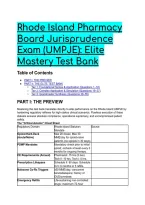
Rhode Island Pharmacy
Board Jurisprudence
Exam (UMPJE): Elite
Mastery Test Bank
Table of Contents
● PART I: THE PREVIEW
● PART II: THE ELITE TEST BANK
○ Tier 1: Foundational Syntax & Application (Questions 1–18)
○ Tier 2: Complex Application & Simulation (Questions 19–37)
○ Tier 3: Grandmaster Synthesis (Questions 38–55)
PART I: THE PREVIEW
Mastering this test bank translates directly to elite performance on the Rhode Island UMPJE by
hardwiring regulatory reflexes for high-stakes clinical scenarios. Flawless execution of these
statutes ensures absolute compliance, operational supremacy, and uncompromised patient
safety.
The "Critical Axioms" Cheat Sheet
Regulatory Domain Rhode Island Statutory Source
Mandate
Opioid Hard-Deck Max 20 doses; Max 30
(Acute/Naïve) MME/day for opioid-naïve
patients (no opioids in 30 days).
PDMP Mandates Mandatory check prior to initial
opioid; recheck at least every 3
months for ongoing therapy.
CE Requirements (Annual) Pharmacist: 15 hrs (5 live).
Tech II: 10 hrs. Tech I: 0 hrs.
Prescription Lifespans Schedule II: 90 days. Schedule
III-V: 6 months or 5 refills.
Naloxone Co-Rx Triggers ≥50 MME/day; concurrent
benzodiazepine; history of
OUD/overdose.
Emergency Refills Life-sustaining non-controlled
drugs: maximum 72-hour
,Regulatory Domain Rhode Island Statutory Source
Mandate
supply.
EPCS Mandate E-prescribing mandatory for all
CII-CVs since Jan 2020, with
strict exceptions.
PART II: THE ELITE TEST BANK
Tier 1: Foundational Syntax & Application
Q1: A Rhode Island pharmacist receives a new electronic prescription for an opioid-naïve adult
patient requiring acute pain management following a minor fracture. Based on the principles of
Rhode Island Opioid Prescribing Limits, which prescription parameter is the MAXIMUM allowed
by law? A) 30 doses, not exceeding 50 MME/day B) 20 doses, not exceeding 30 MME/day C)
14-day supply, not exceeding 90 MME/day D) 7-day supply, not exceeding 50 MME/day
● Answer: B (20 doses, not exceeding 30 MME/day)
● Distractor Analysis:
○ A is incorrect: This exceeds both the 20-dose limit and the 30 MME/day acute pain
threshold mandated by the state .
○ C is incorrect: This reflects legacy limits from other jurisdictions, violating Rhode
Island's stricter acute pain initial limits.
○ D is incorrect: Represents a common misunderstanding of neighboring state laws
(e.g., 7-day limits) rather than RI's specific dose/MME limits.
The Mentor's Analysis: Rhode Island law strictly dictates that an initial opioid prescription for
acute pain in an opioid-naïve adult cannot exceed 30 MME per day and a maximum of 20
doses. When facing acute pain management scenarios, the immediate priority is calculating the
MME and dose count. By utilizing the 30 MME/20-dose hard deck, you bypass the common trap
of confusing RI law with general 7-day statutory limits. Professional Intuition: Always calculate
MME and total doses for opioid-naïve acute pain prescriptions; reject any initial Rx exceeding
30 MME/day or 20 doses.
Q2: A patient presents a Schedule II prescription written on January 1. Based on the principles
of the Rhode Island Uniform Controlled Substances Act, on which date is the prescription FIRST
considered void and legally invalid for dispensing? A) January 31 (30 days) B) April 1 (90 days)
C) July 1 (6 months) D) December 31 (1 year)
● Answer: B (April 1 (90 days))
● Distractor Analysis:
○ A is incorrect: Represents legacy state rules or standard limits for multiple partial
fills, not the total lifespan of a CII prescription in RI.
○ C is incorrect: Six months is the expiration timeline for Schedule III-V prescriptions,
not Schedule II.
○ D is incorrect: One year is the federal and state expiration for non-controlled legend
drugs.
The Mentor's Analysis: Schedule II prescriptions in Rhode Island expire 90 days from the date
of issuance. When facing delayed presentations of CII prescriptions, the immediate priority is
verifying the date written against the current calendar date. By utilizing the 90-day expiration
rule, you bypass the common trap of applying the 6-month CIII-CV rule to CIIs. Professional
Intuition: Schedule II prescriptions are legally dead on day 91.
, Q3: A pharmacist is seeking to renew their Rhode Island pharmacist license. Based on the
principles of Rhode Island Department of Health regulations, what is the EXACT annual
continuing education (CE) requirement? A) 15 hours total, with at least 5 hours of live instruction
B) 15 hours total, all of which may be home study C) 30 hours biennially, with 10 hours of live
instruction D) 10 hours annually, with 2 hours of pharmacy law
● Answer: A (15 hours total, with at least 5 hours of live instruction)
● Distractor Analysis:
○ B is incorrect: Rhode Island explicitly requires a portion of the CE to be live,
prohibiting 100% home study.
○ C is incorrect: While the license renewal cycle is biennial, the CE requirement is
strictly 15 hours annually.
○ D is incorrect: Ten hours annually is the requirement for a Pharmacy Technician II,
not a pharmacist.
The Mentor's Analysis: Pharmacists in Rhode Island must complete 15 hours of CE each
calendar year, with a minimum of 5 hours via live instruction. When facing licensure renewal, the
immediate priority is verifying annual, not biennial, hour accumulation. By utilizing the 15/5
annual rule, you bypass the common trap of biennial aggregation errors. Professional
Intuition: 15 hours every single year, with 5 hours live—no exceptions.
Q4: A Pharmacy Technician II wishes to renew their Rhode Island license. Based on the
principles of Rhode Island Board of Pharmacy rules, what action is REQUIRED? A) Complete
15 hours of CE annually. B) Complete 20 hours of CE biennially. C) Complete 10 hours of CE
annually. D) Complete 0 hours of CE, as long as national certification is maintained.
● Answer: C (Complete 10 hours of CE annually.)
● Distractor Analysis:
○ A is incorrect: This is the pharmacist requirement.
○ B is incorrect: This is a PTCB national requirement, but the state mandates
documentation of 10 hours per calendar year .
○ D is incorrect: This applies to a Pharmacy Technician I, not a Technician II.
The Mentor's Analysis: Tech II licensure requires 10 hours of CE per calendar year. When facing
technician credentialing, the immediate priority is distinguishing between Tech I (no CE) and
Tech II (10 hours). By utilizing this distinction, you bypass the common trap of confusing national
biennial cycles with state annual mandates. Professional Intuition: Tech II status dictates a
strict 10 hours of CE per year.
Q5: A prescriber writes an order for a 30-day supply of a Schedule III controlled substance with
5 refills. Based on the principles of Rhode Island law, which parameter is the MOST
ACCURATE regarding its expiration? A) It expires 90 days from the date of issuance. B) It
expires 12 months from the date of issuance. C) It expires 6 months from the date of issuance
or after 5 refills, whichever comes first. D) It may be refilled indefinitely for up to 6 months.
● Answer: C (It expires 6 months from the date of issuance or after 5 refills, whichever
comes first.)
● Distractor Analysis:
○ A is incorrect: 90 days applies to Schedule II prescriptions.
○ B is incorrect: 12 months is the lifespan for non-controlled prescriptions.
○ D is incorrect: Refills are strictly capped at a maximum of 5 within the 6-month
window; they are not indefinite.
The Mentor's Analysis: Schedule III-V prescriptions are valid for a maximum of 6 months and a
maximum of 5 refills. When facing CIII-CV dispense logic, the immediate priority is verifying both
the date and the refill count. By utilizing the 6-month/5-refill ceiling, you bypass the common trap
Board Jurisprudence
Exam (UMPJE): Elite
Mastery Test Bank
Table of Contents
● PART I: THE PREVIEW
● PART II: THE ELITE TEST BANK
○ Tier 1: Foundational Syntax & Application (Questions 1–18)
○ Tier 2: Complex Application & Simulation (Questions 19–37)
○ Tier 3: Grandmaster Synthesis (Questions 38–55)
PART I: THE PREVIEW
Mastering this test bank translates directly to elite performance on the Rhode Island UMPJE by
hardwiring regulatory reflexes for high-stakes clinical scenarios. Flawless execution of these
statutes ensures absolute compliance, operational supremacy, and uncompromised patient
safety.
The "Critical Axioms" Cheat Sheet
Regulatory Domain Rhode Island Statutory Source
Mandate
Opioid Hard-Deck Max 20 doses; Max 30
(Acute/Naïve) MME/day for opioid-naïve
patients (no opioids in 30 days).
PDMP Mandates Mandatory check prior to initial
opioid; recheck at least every 3
months for ongoing therapy.
CE Requirements (Annual) Pharmacist: 15 hrs (5 live).
Tech II: 10 hrs. Tech I: 0 hrs.
Prescription Lifespans Schedule II: 90 days. Schedule
III-V: 6 months or 5 refills.
Naloxone Co-Rx Triggers ≥50 MME/day; concurrent
benzodiazepine; history of
OUD/overdose.
Emergency Refills Life-sustaining non-controlled
drugs: maximum 72-hour
,Regulatory Domain Rhode Island Statutory Source
Mandate
supply.
EPCS Mandate E-prescribing mandatory for all
CII-CVs since Jan 2020, with
strict exceptions.
PART II: THE ELITE TEST BANK
Tier 1: Foundational Syntax & Application
Q1: A Rhode Island pharmacist receives a new electronic prescription for an opioid-naïve adult
patient requiring acute pain management following a minor fracture. Based on the principles of
Rhode Island Opioid Prescribing Limits, which prescription parameter is the MAXIMUM allowed
by law? A) 30 doses, not exceeding 50 MME/day B) 20 doses, not exceeding 30 MME/day C)
14-day supply, not exceeding 90 MME/day D) 7-day supply, not exceeding 50 MME/day
● Answer: B (20 doses, not exceeding 30 MME/day)
● Distractor Analysis:
○ A is incorrect: This exceeds both the 20-dose limit and the 30 MME/day acute pain
threshold mandated by the state .
○ C is incorrect: This reflects legacy limits from other jurisdictions, violating Rhode
Island's stricter acute pain initial limits.
○ D is incorrect: Represents a common misunderstanding of neighboring state laws
(e.g., 7-day limits) rather than RI's specific dose/MME limits.
The Mentor's Analysis: Rhode Island law strictly dictates that an initial opioid prescription for
acute pain in an opioid-naïve adult cannot exceed 30 MME per day and a maximum of 20
doses. When facing acute pain management scenarios, the immediate priority is calculating the
MME and dose count. By utilizing the 30 MME/20-dose hard deck, you bypass the common trap
of confusing RI law with general 7-day statutory limits. Professional Intuition: Always calculate
MME and total doses for opioid-naïve acute pain prescriptions; reject any initial Rx exceeding
30 MME/day or 20 doses.
Q2: A patient presents a Schedule II prescription written on January 1. Based on the principles
of the Rhode Island Uniform Controlled Substances Act, on which date is the prescription FIRST
considered void and legally invalid for dispensing? A) January 31 (30 days) B) April 1 (90 days)
C) July 1 (6 months) D) December 31 (1 year)
● Answer: B (April 1 (90 days))
● Distractor Analysis:
○ A is incorrect: Represents legacy state rules or standard limits for multiple partial
fills, not the total lifespan of a CII prescription in RI.
○ C is incorrect: Six months is the expiration timeline for Schedule III-V prescriptions,
not Schedule II.
○ D is incorrect: One year is the federal and state expiration for non-controlled legend
drugs.
The Mentor's Analysis: Schedule II prescriptions in Rhode Island expire 90 days from the date
of issuance. When facing delayed presentations of CII prescriptions, the immediate priority is
verifying the date written against the current calendar date. By utilizing the 90-day expiration
rule, you bypass the common trap of applying the 6-month CIII-CV rule to CIIs. Professional
Intuition: Schedule II prescriptions are legally dead on day 91.
, Q3: A pharmacist is seeking to renew their Rhode Island pharmacist license. Based on the
principles of Rhode Island Department of Health regulations, what is the EXACT annual
continuing education (CE) requirement? A) 15 hours total, with at least 5 hours of live instruction
B) 15 hours total, all of which may be home study C) 30 hours biennially, with 10 hours of live
instruction D) 10 hours annually, with 2 hours of pharmacy law
● Answer: A (15 hours total, with at least 5 hours of live instruction)
● Distractor Analysis:
○ B is incorrect: Rhode Island explicitly requires a portion of the CE to be live,
prohibiting 100% home study.
○ C is incorrect: While the license renewal cycle is biennial, the CE requirement is
strictly 15 hours annually.
○ D is incorrect: Ten hours annually is the requirement for a Pharmacy Technician II,
not a pharmacist.
The Mentor's Analysis: Pharmacists in Rhode Island must complete 15 hours of CE each
calendar year, with a minimum of 5 hours via live instruction. When facing licensure renewal, the
immediate priority is verifying annual, not biennial, hour accumulation. By utilizing the 15/5
annual rule, you bypass the common trap of biennial aggregation errors. Professional
Intuition: 15 hours every single year, with 5 hours live—no exceptions.
Q4: A Pharmacy Technician II wishes to renew their Rhode Island license. Based on the
principles of Rhode Island Board of Pharmacy rules, what action is REQUIRED? A) Complete
15 hours of CE annually. B) Complete 20 hours of CE biennially. C) Complete 10 hours of CE
annually. D) Complete 0 hours of CE, as long as national certification is maintained.
● Answer: C (Complete 10 hours of CE annually.)
● Distractor Analysis:
○ A is incorrect: This is the pharmacist requirement.
○ B is incorrect: This is a PTCB national requirement, but the state mandates
documentation of 10 hours per calendar year .
○ D is incorrect: This applies to a Pharmacy Technician I, not a Technician II.
The Mentor's Analysis: Tech II licensure requires 10 hours of CE per calendar year. When facing
technician credentialing, the immediate priority is distinguishing between Tech I (no CE) and
Tech II (10 hours). By utilizing this distinction, you bypass the common trap of confusing national
biennial cycles with state annual mandates. Professional Intuition: Tech II status dictates a
strict 10 hours of CE per year.
Q5: A prescriber writes an order for a 30-day supply of a Schedule III controlled substance with
5 refills. Based on the principles of Rhode Island law, which parameter is the MOST
ACCURATE regarding its expiration? A) It expires 90 days from the date of issuance. B) It
expires 12 months from the date of issuance. C) It expires 6 months from the date of issuance
or after 5 refills, whichever comes first. D) It may be refilled indefinitely for up to 6 months.
● Answer: C (It expires 6 months from the date of issuance or after 5 refills, whichever
comes first.)
● Distractor Analysis:
○ A is incorrect: 90 days applies to Schedule II prescriptions.
○ B is incorrect: 12 months is the lifespan for non-controlled prescriptions.
○ D is incorrect: Refills are strictly capped at a maximum of 5 within the 6-month
window; they are not indefinite.
The Mentor's Analysis: Schedule III-V prescriptions are valid for a maximum of 6 months and a
maximum of 5 refills. When facing CIII-CV dispense logic, the immediate priority is verifying both
the date and the refill count. By utilizing the 6-month/5-refill ceiling, you bypass the common trap


