
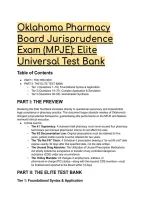
Oklahoma Pharmacy
Board Jurisprudence
Exam (MPJE): Elite
Universal Test Bank
Table of Contents
● PART I: THE PREVIEW
● PART II: THE ELITE TEST BANK
○ Tier 1 (Questions 1–18): Foundational Syntax & Application
○ Tier 2 (Questions 19–37): Complex Application & Simulation
○ Tier 3 (Questions 38–55): Grandmaster Synthesis
PART I: THE PREVIEW
Mastering this Elite Test Bank translates directly to operational supremacy and impenetrable
legal compliance in pharmacy practice. This document forges absolute mastery of Oklahoma's
stringent jurisprudential frameworks, guaranteeing elite performance on the MPJE and flawless
real-world clinical execution.
● Critical Axioms:
○ The 4:1 Supremacy: A licensed retail pharmacy must never exceed four pharmacy
technicians per licensed pharmacist; interns do not affect this ratio.
○ The 5/2 Documentation Law: Original prescriptions must be retained for five
years; patient profile records must be retained for two years.
○ The "Do Not Fill" Clock: A Schedule II prescription bearing a "do not fill until" date
expires exactly 30 days after that specified date, not the date written.
○ The Unused Drug Absolute: The Utilization of Unused Prescription Medications
Act strictly forbids the acceptance or transfer of any controlled dangerous
substance (CDS) under any circumstance.
○ The 10-Day Mandate: All changes in employment, address, or
pharmacist-in-charge (PIC) status—along with the required CDS inventory—must
be finalized and reported to the Board within 10 days.
PART II: THE ELITE TEST BANK
Tier 1: Foundational Syntax & Application
,Q1: A retail pharmacy schedules one pharmacist, four technicians, and two interns. Based on
the principles of Oklahoma Administrative Code (OAC) staffing frameworks, which conclusion
regarding the staffing ratio is the MOST ACCURATE? A) Non-compliant because interns count
toward the maximum 4:1 personnel ratio. B) Non-compliant as the maximum retail technician
ratio remains strictly 3:1. C) Compliant because interns do not affect the 4:1 technician ratio. D)
Compliant only if two of the technicians are certified compounding specialists.
● Answer: C (Compliant because interns do not affect the 4:1 technician ratio)
● Distractor Analysis:
○ A is incorrect: Oklahoma law explicitly states that interns do not affect or change the
ratio; they are considered separate educational entities.
○ B is incorrect: The retail ratio was officially raised to 4:1, rendering legacy 3:1
regulations obsolete.
○ D is incorrect: The 4:1 baseline ratio is inherently met without requiring specialized
compounding exemptions, which previously applied to older 2:1 ratios.
The Mentor's Analysis: Maximize operational throughput by understanding strict capacity laws.
When facing staffing limitations, the immediate priority is isolating licensed technicians from
interns in your headcount calculations. By utilizing the intern exclusion rule, you bypass the
common trap of artificially limiting floor staff and bottlenecking patient care. Professional
Intuition: Interns are an additive educational resource; they never subtract from your allowable
technician roster.
Q2: A newly permitted pharmacy technician is hired and must complete Phase II training. Based
on the principles of OAC Title 535 technician credentialing, what is the MAXIMUM allowable
timeframe for completion? A) 30 days after permit issuance B) 60 days after permit issuance C)
90 days after permit issuance D) 120 days after permit issuance
● Answer: C (90 days after permit issuance)
● Distractor Analysis:
○ A is incorrect: 30 days represents a common orientation window, not the statutory
Phase II completion deadline.
○ B is incorrect: 60 days has no basis in current OAC statutes for technician training
milestones.
○ D is incorrect: 120 days explicitly exceeds the strict statutory limit, which would
trigger automatic voiding of the technician's permit.
The Mentor's Analysis: Technician credentialing operates on a strict, unforgiving countdown.
When facing new personnel onboarding, the immediate priority is initiating and documenting
Phase II training immediately upon hire. By utilizing the 90-day completion window, you bypass
the common trap of accidental permit expiration and the subsequent liability of unauthorized
practice. Professional Intuition: Day 91 without Phase II completion transforms a legal
technician into an unpermitted liability.
Q3: An Oklahoma pharmacist is submitting documentation for annual license renewal. Based on
the principles of the Uniform Pharmacy Continuing Education framework, which requirement is
MANDATORY? A) 15 hours annually, with 3 hours guaranteed live. B) 20 hours annually, with 2
hours in pharmacy law. C) 15 hours annually, with no mandatory live hours. D) 30 hours
biennially, with 3 hours in medication errors.
● Answer: C (15 hours annually, with no mandatory live hours)
● Distractor Analysis:
○ A is incorrect: While 3 live hours are strongly encouraged by the Board for
networking and peer interaction, they are not statutorily mandatory for standard
renewal.
, ○ B is incorrect: This mirrors PTCB or out-of-state requirements, projecting external
mandates onto Oklahoma pharmacists.
○ D is incorrect: Oklahoma requires an annual renewal cycle of 15 hours, not a
biennial 30-hour block.
CE Requirement Category Oklahoma Pharmacist Mandate
Total Hours 15 hours annually
Live Hours 0 mandatory (3 recommended)
Topic-Specific 0 mandatory (unless specifically holding an
immunizer registry)
The Mentor's Analysis: License renewal relies on raw mathematical compliance rather than
subjective guidelines. When facing CE audits, the immediate priority is verifying the 15-hour
accredited baseline. By utilizing ACPE-accredited general programs, you bypass the common
trap of confusing encouraged guidelines (live hours) with rigid mandatory statutes. Professional
Intuition: Fifteen accredited hours keep the license alive; live hours simply build the network.
Q4: An immunizing pharmacist submits their annual continuing education portfolio. Based on
the principles of specialized registries under OAC 535, which specific topic is REQUIRED for
this registrant? A) 1 hour of immunization-related CE B) 2 hours of CPR certification training C)
3 hours of sterile compounding CE D) 1 hour of opioid abuse prevention
● Answer: A (1 hour of immunization-related CE)
● Distractor Analysis:
○ B is incorrect: CPR certification must be maintained as an active credential, but the
training itself does not count toward the specific pharmacy CE hour mandate.
○ C is incorrect: Sterile compounding CE is reserved for compounding specialists and
is not uniformly required for immunizers.
○ D is incorrect: Opioid CE is required in other jurisdictions or specific DEA contexts,
but is not the targeted mandate for immunizing pharmacists in Oklahoma.
The Mentor's Analysis: Specialty privileges demand hyper-specific educational maintenance.
When facing the retention of an immunization registry, the immediate priority is securing
topic-specific CE alongside general hours. By utilizing 1 hour of targeted vaccine CE, you
bypass the common trap of losing injection privileges despite achieving total hour compliance.
Professional Intuition: The privilege to pierce the skin requires one dedicated hour of annual
education.
Q5: A pharmacy is archiving historical prescription documentation. Based on the principles of
the Oklahoma Pharmacy Act record-keeping rules, what is the MINIMUM retention period for
original prescriptions? A) 2 years B) 3 years C) 5 years D) 7 years
● Answer: C (5 years)
● Distractor Analysis:
○ A is incorrect: Two years applies specifically to patient profile records, not the
original physical or electronic prescriptions.
○ B is incorrect: Three years is a common DEA inventory retention error projected
onto state prescription laws.
○ D is incorrect: Seven years applies to Medicaid/OHCA post-payment reviews, which
is a payer requirement, not the Board's baseline.
Record Type Minimum Retention Period
Original Prescriptions 5 Years
Patient Record Systems (Profiles) 2 Years
Medicaid Post-Payment Records 7 Years
Board Jurisprudence
Exam (MPJE): Elite
Universal Test Bank
Table of Contents
● PART I: THE PREVIEW
● PART II: THE ELITE TEST BANK
○ Tier 1 (Questions 1–18): Foundational Syntax & Application
○ Tier 2 (Questions 19–37): Complex Application & Simulation
○ Tier 3 (Questions 38–55): Grandmaster Synthesis
PART I: THE PREVIEW
Mastering this Elite Test Bank translates directly to operational supremacy and impenetrable
legal compliance in pharmacy practice. This document forges absolute mastery of Oklahoma's
stringent jurisprudential frameworks, guaranteeing elite performance on the MPJE and flawless
real-world clinical execution.
● Critical Axioms:
○ The 4:1 Supremacy: A licensed retail pharmacy must never exceed four pharmacy
technicians per licensed pharmacist; interns do not affect this ratio.
○ The 5/2 Documentation Law: Original prescriptions must be retained for five
years; patient profile records must be retained for two years.
○ The "Do Not Fill" Clock: A Schedule II prescription bearing a "do not fill until" date
expires exactly 30 days after that specified date, not the date written.
○ The Unused Drug Absolute: The Utilization of Unused Prescription Medications
Act strictly forbids the acceptance or transfer of any controlled dangerous
substance (CDS) under any circumstance.
○ The 10-Day Mandate: All changes in employment, address, or
pharmacist-in-charge (PIC) status—along with the required CDS inventory—must
be finalized and reported to the Board within 10 days.
PART II: THE ELITE TEST BANK
Tier 1: Foundational Syntax & Application
,Q1: A retail pharmacy schedules one pharmacist, four technicians, and two interns. Based on
the principles of Oklahoma Administrative Code (OAC) staffing frameworks, which conclusion
regarding the staffing ratio is the MOST ACCURATE? A) Non-compliant because interns count
toward the maximum 4:1 personnel ratio. B) Non-compliant as the maximum retail technician
ratio remains strictly 3:1. C) Compliant because interns do not affect the 4:1 technician ratio. D)
Compliant only if two of the technicians are certified compounding specialists.
● Answer: C (Compliant because interns do not affect the 4:1 technician ratio)
● Distractor Analysis:
○ A is incorrect: Oklahoma law explicitly states that interns do not affect or change the
ratio; they are considered separate educational entities.
○ B is incorrect: The retail ratio was officially raised to 4:1, rendering legacy 3:1
regulations obsolete.
○ D is incorrect: The 4:1 baseline ratio is inherently met without requiring specialized
compounding exemptions, which previously applied to older 2:1 ratios.
The Mentor's Analysis: Maximize operational throughput by understanding strict capacity laws.
When facing staffing limitations, the immediate priority is isolating licensed technicians from
interns in your headcount calculations. By utilizing the intern exclusion rule, you bypass the
common trap of artificially limiting floor staff and bottlenecking patient care. Professional
Intuition: Interns are an additive educational resource; they never subtract from your allowable
technician roster.
Q2: A newly permitted pharmacy technician is hired and must complete Phase II training. Based
on the principles of OAC Title 535 technician credentialing, what is the MAXIMUM allowable
timeframe for completion? A) 30 days after permit issuance B) 60 days after permit issuance C)
90 days after permit issuance D) 120 days after permit issuance
● Answer: C (90 days after permit issuance)
● Distractor Analysis:
○ A is incorrect: 30 days represents a common orientation window, not the statutory
Phase II completion deadline.
○ B is incorrect: 60 days has no basis in current OAC statutes for technician training
milestones.
○ D is incorrect: 120 days explicitly exceeds the strict statutory limit, which would
trigger automatic voiding of the technician's permit.
The Mentor's Analysis: Technician credentialing operates on a strict, unforgiving countdown.
When facing new personnel onboarding, the immediate priority is initiating and documenting
Phase II training immediately upon hire. By utilizing the 90-day completion window, you bypass
the common trap of accidental permit expiration and the subsequent liability of unauthorized
practice. Professional Intuition: Day 91 without Phase II completion transforms a legal
technician into an unpermitted liability.
Q3: An Oklahoma pharmacist is submitting documentation for annual license renewal. Based on
the principles of the Uniform Pharmacy Continuing Education framework, which requirement is
MANDATORY? A) 15 hours annually, with 3 hours guaranteed live. B) 20 hours annually, with 2
hours in pharmacy law. C) 15 hours annually, with no mandatory live hours. D) 30 hours
biennially, with 3 hours in medication errors.
● Answer: C (15 hours annually, with no mandatory live hours)
● Distractor Analysis:
○ A is incorrect: While 3 live hours are strongly encouraged by the Board for
networking and peer interaction, they are not statutorily mandatory for standard
renewal.
, ○ B is incorrect: This mirrors PTCB or out-of-state requirements, projecting external
mandates onto Oklahoma pharmacists.
○ D is incorrect: Oklahoma requires an annual renewal cycle of 15 hours, not a
biennial 30-hour block.
CE Requirement Category Oklahoma Pharmacist Mandate
Total Hours 15 hours annually
Live Hours 0 mandatory (3 recommended)
Topic-Specific 0 mandatory (unless specifically holding an
immunizer registry)
The Mentor's Analysis: License renewal relies on raw mathematical compliance rather than
subjective guidelines. When facing CE audits, the immediate priority is verifying the 15-hour
accredited baseline. By utilizing ACPE-accredited general programs, you bypass the common
trap of confusing encouraged guidelines (live hours) with rigid mandatory statutes. Professional
Intuition: Fifteen accredited hours keep the license alive; live hours simply build the network.
Q4: An immunizing pharmacist submits their annual continuing education portfolio. Based on
the principles of specialized registries under OAC 535, which specific topic is REQUIRED for
this registrant? A) 1 hour of immunization-related CE B) 2 hours of CPR certification training C)
3 hours of sterile compounding CE D) 1 hour of opioid abuse prevention
● Answer: A (1 hour of immunization-related CE)
● Distractor Analysis:
○ B is incorrect: CPR certification must be maintained as an active credential, but the
training itself does not count toward the specific pharmacy CE hour mandate.
○ C is incorrect: Sterile compounding CE is reserved for compounding specialists and
is not uniformly required for immunizers.
○ D is incorrect: Opioid CE is required in other jurisdictions or specific DEA contexts,
but is not the targeted mandate for immunizing pharmacists in Oklahoma.
The Mentor's Analysis: Specialty privileges demand hyper-specific educational maintenance.
When facing the retention of an immunization registry, the immediate priority is securing
topic-specific CE alongside general hours. By utilizing 1 hour of targeted vaccine CE, you
bypass the common trap of losing injection privileges despite achieving total hour compliance.
Professional Intuition: The privilege to pierce the skin requires one dedicated hour of annual
education.
Q5: A pharmacy is archiving historical prescription documentation. Based on the principles of
the Oklahoma Pharmacy Act record-keeping rules, what is the MINIMUM retention period for
original prescriptions? A) 2 years B) 3 years C) 5 years D) 7 years
● Answer: C (5 years)
● Distractor Analysis:
○ A is incorrect: Two years applies specifically to patient profile records, not the
original physical or electronic prescriptions.
○ B is incorrect: Three years is a common DEA inventory retention error projected
onto state prescription laws.
○ D is incorrect: Seven years applies to Medicaid/OHCA post-payment reviews, which
is a payer requirement, not the Board's baseline.
Record Type Minimum Retention Period
Original Prescriptions 5 Years
Patient Record Systems (Profiles) 2 Years
Medicaid Post-Payment Records 7 Years


