
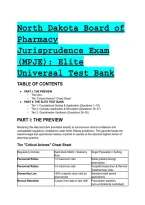
North Dakota Board of
Pharmacy
Jurisprudence Exam
(MPJE): Elite
Universal Test Bank
TABLE OF CONTENTS
● PART I: THE PREVIEW
○ The Intro
○ The "Critical Axioms" Cheat Sheet
● PART II: THE ELITE TEST BANK
○ Tier 1: Foundational Syntax & Application (Questions 1–18)
○ Tier 2: Complex Application & Simulation (Questions 19–37)
○ Tier 3: Grandmaster Synthesis (Questions 38–55)
PART I: THE PREVIEW
Mastering this elite test bank translates directly to autonomous clinical confidence and
unassailable regulatory compliance under North Dakota jurisdiction. This gauntlet forges the
baseline legal and operational mastery required to operate at the absolute highest levels of
pharmacy practice.
The "Critical Axioms" Cheat Sheet
Regulatory Domain Hard-Deck Metric / Statutory Target Population / Setting
Rule
Personnel Ratios 1:3 maximum ratio Retail (patient-facing)
pharmacies
Personnel Ratios 1:4 maximum ratio Hospital/closed-door & Remote
Telepharmacy sites
Ownership Law >50% majority stock held by Standard retail permit
pharmacists applications
Record Retention 5 years from date of last refill Prescription transfers
(non-controlled & controlled)
,Regulatory Domain Hard-Deck Metric / Statutory Target Population / Setting
Rule
Continuing Education 10 hours total (1 Law, 1 PatientRegistered Pharmacy
Safety) Technicians (due March 1)
CQI Reporting Within 30 days of discovery Dispensing errors sent to a
Patient Safety Organization
PDMP Triggers >90 MME; Opioid + Benzo; 3+ Mandatory query thresholds for
providers targeted intervention
● Prescription Validity: All paper prescriptions (non-controlled and Schedules III–V)
printed and handed to a patient must bear a manual (wet) signature. Stamps and
computer-generated signatures on hard copies are strictly invalid.
● Telepharmacy Operations: The central pharmacist must approve every prescription via
video/audio link, perform patient counseling via video, and conduct a physical on-site
inspection of the remote facility monthly.
● Emergency Dispensing: Pharmacists may independently dispense up to a 30-day
emergency supply of non-controlled maintenance medications if the prescriber is
unreachable.
PART II: THE ELITE TEST BANK
Tier 1: Foundational Syntax & Application
Q1: A retail community pharmacy in Fargo is operating during peak hours with one pharmacist
on duty. Based on the principles of North Dakota Administrative Code (NDAC) personnel ratios,
what is the MAXIMUM number of registered pharmacy technicians this pharmacist may legally
supervise? A) 4 B) 6 C) 3 D) Unlimited, provided the pharmacist utilizes professional judgment.
● Answer: C (3)
● Distractor Analysis:
○ A is incorrect: The 1:4 ratio applies exclusively to hospital or closed-door
pharmacies that do not deal directly with patients, as well as to remote
telepharmacy sites.
○ B is incorrect: While a 1:6 ratio has been debated by state task forces, it is not the
codified law in North Dakota.
○ D is incorrect: North Dakota mandates hard numerical caps on ratios; professional
judgment cannot override statutory limits.
The Mentor's Analysis: Personnel caps maintain acute supervisory control in patient-facing
environments to prevent dispensing errors. When facing retail workflow bottlenecks, the
immediate priority is adhering to the 1:3 ratio. By utilizing proper staff scheduling, you bypass
the common trap of regulatory non-compliance during peak hours. Professional Intuition: Retail
environments are restricted to a 1:3 ratio; hospital/closed-door environments operate at a
1:4 ratio.
Q2: A patient presents a computer-generated, printed hard-copy prescription for lisinopril (a
non-controlled medication). The prescription contains a printed electronic signature and was
handed directly to the patient by the prescriber. Based on the principles of NDAC 61-04-06,
what is the MANDATORY action? A) Dispense the medication, as e-signatures are valid for
non-controlled substances. B) Contact the prescriber or their designated nurse to obtain verbal
authorization prior to dispensing. C) Require the patient to return to the prescriber for an
, electronic transmission directly to the pharmacy. D) Dispense the medication, but write
"Signature Verified" on the back of the prescription.
● Answer: B (Contact the prescriber or their designated nurse to obtain verbal authorization
prior to dispensing.)
● Distractor Analysis:
○ A is incorrect: Hard copies handed to patients containing computer-generated or
rubber-stamped signatures are strictly illegal in North Dakota, even for
non-controlled substances.
○ C is incorrect: While electronic transmission is valid, the pharmacist is legally
permitted to convert the invalid hard copy into a valid verbal order by contacting the
prescriber.
○ D is incorrect: Documenting verification on an invalid prescription does not
retroactively make the physical signature valid.
The Mentor's Analysis: A prescription's physical integrity dictates its legal validity. When facing a
printed e-signature on a hard copy, the immediate priority is treating it as an unauthorized
document. By utilizing a verbal authorization call, you bypass the common trap of dispensing on
an illegal signature. Professional Intuition: If a patient physically hands you a prescription,
the prescriber's signature must be wet (manual), regardless of the drug's schedule.
Q3: An investment group of four individuals wishes to open a new retail pharmacy in Grand
Forks. Only one of the four investors is a licensed North Dakota pharmacist, but they hold 51%
of the corporate stock. Based on the principles of North Dakota Century Code (NDCC)
43-15-35, what is the MOST LIKELY outcome of their permit application? A) Denied, because
all investors must be licensed pharmacists. B) Denied, because the North Dakota Board of
Pharmacy prohibits corporate entities from owning pharmacies. C) Granted, because the
licensed pharmacist holds the majority (>50%) of the stock. D) Granted, but the non-pharmacist
investors cannot receive any dividends.
● Answer: C (Granted, because the licensed pharmacist holds the majority (>50%) of the
stock.)
● Distractor Analysis:
○ A is incorrect: The law requires the majority of stock to be held by pharmacists, not
100% of it.
○ B is incorrect: Corporations and LLCs can own pharmacies, provided the stock
ownership meets the pharmacist-majority requirement.
○ D is incorrect: Dividends are distributed based on standard corporate law; the ND
Board of Pharmacy does not restrict financial distributions, only the voting
control/ownership.
The Mentor's Analysis: Pharmacy ownership in North Dakota is uniquely restricted to preserve
professional autonomy over corporate interests. When facing ownership structuring, the
immediate priority is ensuring >50% of stock remains with licensed pharmacists. By utilizing the
majority rule, you bypass the common trap of illegal corporate structuring. Professional Intuition:
The >50% pharmacist ownership rule is the immovable anchor of North Dakota pharmacy
law.
Q4: A pharmacy technician receives their initial state registration on October 15. Based on the
principles of North Dakota Board of Pharmacy licensing requirements, when is the FIRST
deadline to renew this registration and pay the $35 fee? A) December 31 of the current year. B)
October 15 of the following year. C) March 1 of the following year. D) February 28 of the
following year.
● Answer: C (March 1 of the following year.)
Pharmacy
Jurisprudence Exam
(MPJE): Elite
Universal Test Bank
TABLE OF CONTENTS
● PART I: THE PREVIEW
○ The Intro
○ The "Critical Axioms" Cheat Sheet
● PART II: THE ELITE TEST BANK
○ Tier 1: Foundational Syntax & Application (Questions 1–18)
○ Tier 2: Complex Application & Simulation (Questions 19–37)
○ Tier 3: Grandmaster Synthesis (Questions 38–55)
PART I: THE PREVIEW
Mastering this elite test bank translates directly to autonomous clinical confidence and
unassailable regulatory compliance under North Dakota jurisdiction. This gauntlet forges the
baseline legal and operational mastery required to operate at the absolute highest levels of
pharmacy practice.
The "Critical Axioms" Cheat Sheet
Regulatory Domain Hard-Deck Metric / Statutory Target Population / Setting
Rule
Personnel Ratios 1:3 maximum ratio Retail (patient-facing)
pharmacies
Personnel Ratios 1:4 maximum ratio Hospital/closed-door & Remote
Telepharmacy sites
Ownership Law >50% majority stock held by Standard retail permit
pharmacists applications
Record Retention 5 years from date of last refill Prescription transfers
(non-controlled & controlled)
,Regulatory Domain Hard-Deck Metric / Statutory Target Population / Setting
Rule
Continuing Education 10 hours total (1 Law, 1 PatientRegistered Pharmacy
Safety) Technicians (due March 1)
CQI Reporting Within 30 days of discovery Dispensing errors sent to a
Patient Safety Organization
PDMP Triggers >90 MME; Opioid + Benzo; 3+ Mandatory query thresholds for
providers targeted intervention
● Prescription Validity: All paper prescriptions (non-controlled and Schedules III–V)
printed and handed to a patient must bear a manual (wet) signature. Stamps and
computer-generated signatures on hard copies are strictly invalid.
● Telepharmacy Operations: The central pharmacist must approve every prescription via
video/audio link, perform patient counseling via video, and conduct a physical on-site
inspection of the remote facility monthly.
● Emergency Dispensing: Pharmacists may independently dispense up to a 30-day
emergency supply of non-controlled maintenance medications if the prescriber is
unreachable.
PART II: THE ELITE TEST BANK
Tier 1: Foundational Syntax & Application
Q1: A retail community pharmacy in Fargo is operating during peak hours with one pharmacist
on duty. Based on the principles of North Dakota Administrative Code (NDAC) personnel ratios,
what is the MAXIMUM number of registered pharmacy technicians this pharmacist may legally
supervise? A) 4 B) 6 C) 3 D) Unlimited, provided the pharmacist utilizes professional judgment.
● Answer: C (3)
● Distractor Analysis:
○ A is incorrect: The 1:4 ratio applies exclusively to hospital or closed-door
pharmacies that do not deal directly with patients, as well as to remote
telepharmacy sites.
○ B is incorrect: While a 1:6 ratio has been debated by state task forces, it is not the
codified law in North Dakota.
○ D is incorrect: North Dakota mandates hard numerical caps on ratios; professional
judgment cannot override statutory limits.
The Mentor's Analysis: Personnel caps maintain acute supervisory control in patient-facing
environments to prevent dispensing errors. When facing retail workflow bottlenecks, the
immediate priority is adhering to the 1:3 ratio. By utilizing proper staff scheduling, you bypass
the common trap of regulatory non-compliance during peak hours. Professional Intuition: Retail
environments are restricted to a 1:3 ratio; hospital/closed-door environments operate at a
1:4 ratio.
Q2: A patient presents a computer-generated, printed hard-copy prescription for lisinopril (a
non-controlled medication). The prescription contains a printed electronic signature and was
handed directly to the patient by the prescriber. Based on the principles of NDAC 61-04-06,
what is the MANDATORY action? A) Dispense the medication, as e-signatures are valid for
non-controlled substances. B) Contact the prescriber or their designated nurse to obtain verbal
authorization prior to dispensing. C) Require the patient to return to the prescriber for an
, electronic transmission directly to the pharmacy. D) Dispense the medication, but write
"Signature Verified" on the back of the prescription.
● Answer: B (Contact the prescriber or their designated nurse to obtain verbal authorization
prior to dispensing.)
● Distractor Analysis:
○ A is incorrect: Hard copies handed to patients containing computer-generated or
rubber-stamped signatures are strictly illegal in North Dakota, even for
non-controlled substances.
○ C is incorrect: While electronic transmission is valid, the pharmacist is legally
permitted to convert the invalid hard copy into a valid verbal order by contacting the
prescriber.
○ D is incorrect: Documenting verification on an invalid prescription does not
retroactively make the physical signature valid.
The Mentor's Analysis: A prescription's physical integrity dictates its legal validity. When facing a
printed e-signature on a hard copy, the immediate priority is treating it as an unauthorized
document. By utilizing a verbal authorization call, you bypass the common trap of dispensing on
an illegal signature. Professional Intuition: If a patient physically hands you a prescription,
the prescriber's signature must be wet (manual), regardless of the drug's schedule.
Q3: An investment group of four individuals wishes to open a new retail pharmacy in Grand
Forks. Only one of the four investors is a licensed North Dakota pharmacist, but they hold 51%
of the corporate stock. Based on the principles of North Dakota Century Code (NDCC)
43-15-35, what is the MOST LIKELY outcome of their permit application? A) Denied, because
all investors must be licensed pharmacists. B) Denied, because the North Dakota Board of
Pharmacy prohibits corporate entities from owning pharmacies. C) Granted, because the
licensed pharmacist holds the majority (>50%) of the stock. D) Granted, but the non-pharmacist
investors cannot receive any dividends.
● Answer: C (Granted, because the licensed pharmacist holds the majority (>50%) of the
stock.)
● Distractor Analysis:
○ A is incorrect: The law requires the majority of stock to be held by pharmacists, not
100% of it.
○ B is incorrect: Corporations and LLCs can own pharmacies, provided the stock
ownership meets the pharmacist-majority requirement.
○ D is incorrect: Dividends are distributed based on standard corporate law; the ND
Board of Pharmacy does not restrict financial distributions, only the voting
control/ownership.
The Mentor's Analysis: Pharmacy ownership in North Dakota is uniquely restricted to preserve
professional autonomy over corporate interests. When facing ownership structuring, the
immediate priority is ensuring >50% of stock remains with licensed pharmacists. By utilizing the
majority rule, you bypass the common trap of illegal corporate structuring. Professional Intuition:
The >50% pharmacist ownership rule is the immovable anchor of North Dakota pharmacy
law.
Q4: A pharmacy technician receives their initial state registration on October 15. Based on the
principles of North Dakota Board of Pharmacy licensing requirements, when is the FIRST
deadline to renew this registration and pay the $35 fee? A) December 31 of the current year. B)
October 15 of the following year. C) March 1 of the following year. D) February 28 of the
following year.
● Answer: C (March 1 of the following year.)


