
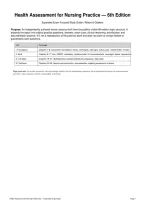
Health Assessment for Nursing Practice — 6th Edition
Expanded Exam-Focused Study Guide | Wilson & Giddens
Purpose: An independently authored review resource built from the publicly visible 6th-edition topic structure. It
expands the topics into original practice questions, answers, exam cues, clinical reasoning, prioritization, and
documentation practice. It is not a reproduction of the paid test bank and does not claim to contain leaked or
guaranteed exam questions.
Unit Coverage
I. Foundations Chapters 1–8: assessment foundations, history, techniques, vital signs, culture, pain, mental health, nutrition
II. Adult Chapters 9–17: skin, HEENT, respiratory, cardiovascular, GI, musculoskeletal, neurologic, breast, reproductive
III. Life Span Chapters 18–21: developmental, pediatric/adolescent, pregnancy, older adult
IV. Synthesis Chapters 22–24: head-to-toe examination, documentation, adapting assessment to illness
High-yield rule: For priority questions, think physiologic stability first; for examination questions, think systematic technique; for documentation
questions, think objective, specific, measurable, and timely.
Health Assessment for Nursing Practice 6e — Expanded Study Guide Page 1
, Introduction to Health Assessment
1. What is a comprehensive assessment?
Answer: A detailed baseline history and physical examination, commonly performed when establishing care or on admission.
Exam cue: Link the finding to assessment type, technique, urgency, and the patient's context.
2. What is a focused assessment?
Answer: An assessment directed at a specific complaint, symptom, or body system.
Exam cue: Link the finding to assessment type, technique, urgency, and the patient's context.
3. What is a screening assessment?
Answer: Assessment intended to detect disease or risk in people who may not have recognized symptoms.
Exam cue: Link the finding to assessment type, technique, urgency, and the patient's context.
4. What is a shift assessment?
Answer: A reassessment during ongoing care to identify changes from baseline.
Exam cue: Link the finding to assessment type, technique, urgency, and the patient's context.
5. What is an episodic or follow-up assessment?
Answer: Assessment used to evaluate a known problem, treatment, or recovery over time.
Exam cue: Link the finding to assessment type, technique, urgency, and the patient's context.
6. What is subjective data?
Answer: Information reported by the patient or another source, such as symptoms or concerns.
Exam cue: Link the finding to assessment type, technique, urgency, and the patient's context.
7. What is objective data?
Answer: Observable or measurable information obtained through examination, measurement, or testing.
Exam cue: Link the finding to assessment type, technique, urgency, and the patient's context.
8. Why prioritize a focused assessment in an unstable patient?
Answer: Immediate threats to physiologic function must be identified before less urgent data are collected.
Exam cue: Link the finding to assessment type, technique, urgency, and the patient's context.
9. Why establish a baseline?
Answer: A baseline allows meaningful changes to be recognized during subsequent assessments.
Exam cue: Link the finding to assessment type, technique, urgency, and the patient's context.
10. What is clinical judgment in assessment?
Answer: Interpreting findings, recognizing patterns, setting priorities, and deciding what action is needed.
Exam cue: Link the finding to assessment type, technique, urgency, and the patient's context.
11. What is the role of assessment in the nursing process?
Answer: Assessment supplies the data used to identify problems, plan care, implement interventions, and evaluate outcomes.
Exam cue: Link the finding to assessment type, technique, urgency, and the patient's context.
12. What is a red-flag finding?
Answer: A finding that suggests possible deterioration or serious disease and requires timely evaluation or escalation.
Exam cue: Link the finding to assessment type, technique, urgency, and the patient's context.
Interviewing Patients to Obtain a Health History
13. What is the chief concern?
Answer: The patient's main reason for seeking care, ideally documented using the patient's own words when appropriate.
Exam cue: Link the finding to assessment type, technique, urgency, and the patient's context.
Health Assessment for Nursing Practice 6e — Expanded Study Guide Page 2
, 14. What is the history of present illness?
Answer: A structured account of the current problem, including onset, location, quality, timing, associated symptoms, and relevant
context.
Exam cue: Link the finding to assessment type, technique, urgency, and the patient's context.
15. What does OLDCARTS help assess?
Answer: Onset, location, duration, characteristics, aggravating/alleviating factors, related symptoms, and temporal pattern.
Exam cue: Link the finding to assessment type, technique, urgency, and the patient's context.
16. Why begin with open-ended questions?
Answer: They let patients tell their story and reduce premature narrowing of the problem.
Exam cue: Link the finding to assessment type, technique, urgency, and the patient's context.
17. When are closed questions useful?
Answer: For clarifying or confirming specific details after the patient's narrative has been established.
Exam cue: Link the finding to assessment type, technique, urgency, and the patient's context.
18. What is therapeutic silence?
Answer: A deliberate pause that allows the patient time to think, continue speaking, or express emotion.
Exam cue: Link the finding to assessment type, technique, urgency, and the patient's context.
19. Why avoid leading questions?
Answer: They can bias responses and reduce the accuracy of the history.
Exam cue: Link the finding to assessment type, technique, urgency, and the patient's context.
20. What belongs in medication history?
Answer: Prescription drugs, over-the-counter products, supplements, herbal products, allergies, and relevant adherence information.
Exam cue: Link the finding to assessment type, technique, urgency, and the patient's context.
21. Why assess social history?
Answer: Living situation, occupation, substance use, relationships, resources, and exposures can alter health risks and care plans.
Exam cue: Link the finding to assessment type, technique, urgency, and the patient's context.
22. What is health literacy?
Answer: The ability to access, understand, and use health information and services appropriately.
Exam cue: Link the finding to assessment type, technique, urgency, and the patient's context.
23. Why use teach-back?
Answer: It checks whether the patient understood instructions rather than merely whether information was delivered.
Exam cue: Link the finding to assessment type, technique, urgency, and the patient's context.
24. What is the review of systems?
Answer: A systematic inquiry about symptoms across body systems that supplements the health history.
Exam cue: Link the finding to assessment type, technique, urgency, and the patient's context.
Techniques and Equipment for Physical Assessment
25. What are the four basic examination techniques?
Answer: Inspection, palpation, percussion, and auscultation.
Exam cue: Link the finding to assessment type, technique, urgency, and the patient's context.
26. What is inspection?
Answer: Systematic visual observation of the patient and body region.
Exam cue: Link the finding to assessment type, technique, urgency, and the patient's context.
Health Assessment for Nursing Practice 6e — Expanded Study Guide Page 3
Expanded Exam-Focused Study Guide | Wilson & Giddens
Purpose: An independently authored review resource built from the publicly visible 6th-edition topic structure. It
expands the topics into original practice questions, answers, exam cues, clinical reasoning, prioritization, and
documentation practice. It is not a reproduction of the paid test bank and does not claim to contain leaked or
guaranteed exam questions.
Unit Coverage
I. Foundations Chapters 1–8: assessment foundations, history, techniques, vital signs, culture, pain, mental health, nutrition
II. Adult Chapters 9–17: skin, HEENT, respiratory, cardiovascular, GI, musculoskeletal, neurologic, breast, reproductive
III. Life Span Chapters 18–21: developmental, pediatric/adolescent, pregnancy, older adult
IV. Synthesis Chapters 22–24: head-to-toe examination, documentation, adapting assessment to illness
High-yield rule: For priority questions, think physiologic stability first; for examination questions, think systematic technique; for documentation
questions, think objective, specific, measurable, and timely.
Health Assessment for Nursing Practice 6e — Expanded Study Guide Page 1
, Introduction to Health Assessment
1. What is a comprehensive assessment?
Answer: A detailed baseline history and physical examination, commonly performed when establishing care or on admission.
Exam cue: Link the finding to assessment type, technique, urgency, and the patient's context.
2. What is a focused assessment?
Answer: An assessment directed at a specific complaint, symptom, or body system.
Exam cue: Link the finding to assessment type, technique, urgency, and the patient's context.
3. What is a screening assessment?
Answer: Assessment intended to detect disease or risk in people who may not have recognized symptoms.
Exam cue: Link the finding to assessment type, technique, urgency, and the patient's context.
4. What is a shift assessment?
Answer: A reassessment during ongoing care to identify changes from baseline.
Exam cue: Link the finding to assessment type, technique, urgency, and the patient's context.
5. What is an episodic or follow-up assessment?
Answer: Assessment used to evaluate a known problem, treatment, or recovery over time.
Exam cue: Link the finding to assessment type, technique, urgency, and the patient's context.
6. What is subjective data?
Answer: Information reported by the patient or another source, such as symptoms or concerns.
Exam cue: Link the finding to assessment type, technique, urgency, and the patient's context.
7. What is objective data?
Answer: Observable or measurable information obtained through examination, measurement, or testing.
Exam cue: Link the finding to assessment type, technique, urgency, and the patient's context.
8. Why prioritize a focused assessment in an unstable patient?
Answer: Immediate threats to physiologic function must be identified before less urgent data are collected.
Exam cue: Link the finding to assessment type, technique, urgency, and the patient's context.
9. Why establish a baseline?
Answer: A baseline allows meaningful changes to be recognized during subsequent assessments.
Exam cue: Link the finding to assessment type, technique, urgency, and the patient's context.
10. What is clinical judgment in assessment?
Answer: Interpreting findings, recognizing patterns, setting priorities, and deciding what action is needed.
Exam cue: Link the finding to assessment type, technique, urgency, and the patient's context.
11. What is the role of assessment in the nursing process?
Answer: Assessment supplies the data used to identify problems, plan care, implement interventions, and evaluate outcomes.
Exam cue: Link the finding to assessment type, technique, urgency, and the patient's context.
12. What is a red-flag finding?
Answer: A finding that suggests possible deterioration or serious disease and requires timely evaluation or escalation.
Exam cue: Link the finding to assessment type, technique, urgency, and the patient's context.
Interviewing Patients to Obtain a Health History
13. What is the chief concern?
Answer: The patient's main reason for seeking care, ideally documented using the patient's own words when appropriate.
Exam cue: Link the finding to assessment type, technique, urgency, and the patient's context.
Health Assessment for Nursing Practice 6e — Expanded Study Guide Page 2
, 14. What is the history of present illness?
Answer: A structured account of the current problem, including onset, location, quality, timing, associated symptoms, and relevant
context.
Exam cue: Link the finding to assessment type, technique, urgency, and the patient's context.
15. What does OLDCARTS help assess?
Answer: Onset, location, duration, characteristics, aggravating/alleviating factors, related symptoms, and temporal pattern.
Exam cue: Link the finding to assessment type, technique, urgency, and the patient's context.
16. Why begin with open-ended questions?
Answer: They let patients tell their story and reduce premature narrowing of the problem.
Exam cue: Link the finding to assessment type, technique, urgency, and the patient's context.
17. When are closed questions useful?
Answer: For clarifying or confirming specific details after the patient's narrative has been established.
Exam cue: Link the finding to assessment type, technique, urgency, and the patient's context.
18. What is therapeutic silence?
Answer: A deliberate pause that allows the patient time to think, continue speaking, or express emotion.
Exam cue: Link the finding to assessment type, technique, urgency, and the patient's context.
19. Why avoid leading questions?
Answer: They can bias responses and reduce the accuracy of the history.
Exam cue: Link the finding to assessment type, technique, urgency, and the patient's context.
20. What belongs in medication history?
Answer: Prescription drugs, over-the-counter products, supplements, herbal products, allergies, and relevant adherence information.
Exam cue: Link the finding to assessment type, technique, urgency, and the patient's context.
21. Why assess social history?
Answer: Living situation, occupation, substance use, relationships, resources, and exposures can alter health risks and care plans.
Exam cue: Link the finding to assessment type, technique, urgency, and the patient's context.
22. What is health literacy?
Answer: The ability to access, understand, and use health information and services appropriately.
Exam cue: Link the finding to assessment type, technique, urgency, and the patient's context.
23. Why use teach-back?
Answer: It checks whether the patient understood instructions rather than merely whether information was delivered.
Exam cue: Link the finding to assessment type, technique, urgency, and the patient's context.
24. What is the review of systems?
Answer: A systematic inquiry about symptoms across body systems that supplements the health history.
Exam cue: Link the finding to assessment type, technique, urgency, and the patient's context.
Techniques and Equipment for Physical Assessment
25. What are the four basic examination techniques?
Answer: Inspection, palpation, percussion, and auscultation.
Exam cue: Link the finding to assessment type, technique, urgency, and the patient's context.
26. What is inspection?
Answer: Systematic visual observation of the patient and body region.
Exam cue: Link the finding to assessment type, technique, urgency, and the patient's context.
Health Assessment for Nursing Practice 6e — Expanded Study Guide Page 3


