
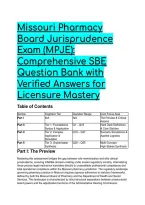
Missouri Pharmacy
Board Jurisprudence
Exam (MPJE):
Comprehensive SBE
Question Bank with
Verified Answers for
Licensure Mastery
Table of Contents
Section Cognitive Tier Question Range Core Focus Area
Part I N/A N/A The Preview & Critical
Axioms
Part II Tier 1: Foundational Q1 – Q18 Hard Deck Definitions
Syntax & Application & Core Statutes
Part II Tier 2: Complex Q19 – Q37 Scenario Simulations &
Application & Applied Logistics
Simulation
Part II Tier 3: Grandmaster Q38 – Q55 Multi-Concept
Synthesis High-Stakes Synthesis
Part I: The Preview
Mastering this assessment bridges the gap between rote memorization and elite clinical
jurisprudence, ensuring infallible decision-making under severe regulatory scrutiny. Internalizing
these precise legal mechanics translates directly to unassailable professional competence and
total operational compliance within the Missouri pharmacy jurisdiction. The regulatory landscape
governing pharmacy practice in Missouri requires rigorous adherence to statutory frameworks
defined by both the Missouri Board of Pharmacy and the Department of Health and Senior
Services. This landscape is characterized by strict structural separations between prosecutorial
board powers and the adjudicative functions of the Administrative Hearing Commission,
,ensuring due process while demanding absolute operational fidelity from licensees.
Recent legislative updates reflect a dynamic shift toward expanded scopes of practice—such as
authorizing pharmacists to immunize patients as young as seven years old and permitting
Advanced Practice Registered Nurses (APRNs) to prescribe controlled substances under
heavily scrutinized quantitative limits. Simultaneously, logistical mechanisms like continuous
temperature monitoring, electronic verification systems (EVS), and common commercial carrier
(CCC) delivery protocols have been codified to protect cold-chain integrity and patient
transparency in a rapidly digitizing healthcare economy. The synthesis of these operational,
clinical, and disciplinary statutes forms the foundation of Missouri pharmacy jurisprudence.
The "Critical Axioms" Cheat Sheet
Regulatory Domain Core Principle & Statutory Limit
Prescriptive Authority APRNs and PAs are strictly limited to a
maximum 120-hour supply of Schedule II
hydrocodone or Schedule III narcotics, with
zero refills permitted. Hospice patients are
exempt from this strict limit for APRNs.
Record Retention General prescription records, bulk
compounding logs, and controlled substance
transaction records must be maintained for
exactly two (2) years. Dispensing data for
controlled substances must be transmitted to
the Missouri PDMP within 24 hours.
Licensure Chronology Pharmacist licenses renew biennially on
October 31 of even-numbered years, requiring
30 CE hours. Pharmacy technician registrations
renew annually on May 31.
Clinical Endorsements Medication Therapy Services (MTS) protocols
remain valid for a maximum of eight (8) years
and require 6 hours of targeted CE biennially.
Blood-clotting factor dispensing requires 4
hours of targeted CE.
Disciplinary Action The Administrative Hearing Commission (AHC)
must formally establish cause before the
Missouri Board of Pharmacy can execute
disciplinary actions such as revocation,
probation, or suspension.
Part II: The Elite Test Bank
Q1: A Missouri APRN transmits an electronic prescription for a 30-day supply of a Schedule II
hydrocodone/acetaminophen product with one authorized refill. Based on the principles of
Missouri Controlled Substance Prescriptive Authority, which action is the MOST
APPROPRIATE? A) Dispense the 30-day supply as written but manually void the authorized
refill. B) Dispense a 120-hour supply, voiding the remainder of the quantity and the refill. C)
Process the prescription completely, provided the APRN's collaborative practice agreement is
actively on file. D) Reject the prescription entirely because APRNs possess zero Schedule II
,prescribing authority.
● Answer: B (Dispense a 120-hour supply, voiding the remainder of the quantity and the
refill)
● Distractor Analysis:
○ A is incorrect: A common novice misconception assumes standard 30-day supply
limits apply; however, Missouri strictly limits APRN Schedule II prescribing to a
120-hour supply.
○ C is incorrect: Contextually inappropriate because a collaborative practice
agreement cannot legally supersede statutory maximum quantity limits for mid-level
practitioners.
○ D is incorrect: A legacy error assuming blanket prohibition; APRNs holding a
certificate of controlled substance prescriptive authority may prescribe hydrocodone
products.
The Mentor's Analysis: Statutory limitations rigidly restrict mid-level practitioners. When facing
APRN Schedule II prescriptions, the immediate priority is enforcing the 120-hour maximum
threshold. By utilizing strict statutory quantity capping, you bypass the common trap of honoring
unauthorized extended therapies. Professional Intuition: APRN Schedule II prescribing in
Missouri is strictly confined to hydrocodone and hospice care, capped precisely at a
120-hour supply.
Q2: A licensed Missouri pharmacist intends to renew their active license on October 15 of an
even-numbered year. The pharmacist holds a certificate of medication therapeutic plan
authority. Based on the principles of Missouri Continuing Education Requirements, which
conclusion is FIRST regarding their required hours? A) The pharmacist must submit 15 total CE
hours, including 6 hours dedicated to medication therapy management. B) The pharmacist must
submit 30 total CE hours, all of which must be obtained via live, in-person instruction. C) The
pharmacist must submit 30 total CE hours, including 6 hours dedicated to medication therapy
management. D) The pharmacist is entirely exempt from CE requirements if they have
maintained continuous practice for 10 years.
● Answer: C (The pharmacist must submit 30 total CE hours, including 6 hours dedicated to
medication therapy management)
● Distractor Analysis:
○ A is incorrect: Represents an outdated calculation error; Missouri mandates 30
hours biennially, not 15 hours.
○ B is incorrect: Contextually inappropriate because Missouri law does not mandate
any live or in-person CE hours for license renewal.
○ D is incorrect: A common novice misconception; exemptions are only granted for
pharmacists licensed for less than one year before the renewal deadline, regardless
of total career length.
The Mentor's Analysis: Endorsements dictate specialized continuing education thresholds.
When facing biennial renewals, the immediate priority is validating total hours and
endorsement-specific requirements. By utilizing targeted CE tracking, you bypass the common
trap of general-hour over-accumulation at the expense of specialized requirements.
Professional Intuition: Pharmacists holding an MTS certificate must allocate exactly 6 of
their 30 biennial CE hours to medication therapy management.
Q3: An independent pharmacy undergoes a routine board inspection. The pharmacist-in-charge
(PIC) provides prescription records from the past 18 months but states older records were
destroyed to maximize server space. Based on the principles of Missouri Pharmacy Record
Retention, which conclusion is MOST ACCURATE regarding this action? A) The action is
, compliant because Missouri requires prescription records to be maintained for exactly 12
months. B) The action is compliant provided the records were backed up to a secure,
out-of-state cloud server. C) The action is non-compliant because prescription records must be
maintained for a minimum of two (2) years. D) The action is non-compliant because all
pharmacy records must be retained indefinitely under federal law.
● Answer: C (The action is non-compliant because prescription records must be maintained
for a minimum of two (2) years)
● Distractor Analysis:
○ A is incorrect: A common novice mistake underestimating the retention window;
state law explicitly mandates a two-year retention.
○ B is incorrect: Contextually inappropriate because destroying original records
before the statutory deadline is a violation, regardless of cloud backups, unless
specific electronic record-keeping waivers are met and the two-year timeline is
honored.
○ D is incorrect: A legacy error assuming permanent retention; the statutory
requirement for dispensing records is two years, not indefinitely.
The Mentor's Analysis: Record retention is the bedrock of regulatory audits. When facing record
disposal schedules, the immediate priority is securing all documentation for the rolling 24-month
window. By utilizing the 2-year retention baseline, you bypass the common trap of premature
record destruction. Professional Intuition: Prescription hard copies, compounding logs, and
controlled substance transaction records carry an absolute minimum 2-year retention
mandate in Missouri.
Q4: A pharmacy technician prepares to assist in dispensing medications at a Missouri
community pharmacy. The technician's state registration expired on June 5 of the current year.
Based on the principles of Missouri Pharmacy Technician Registration, which action is
REQUIRED? A) The technician may continue working under a 30-day grace period while
completing their renewal application. B) The technician must immediately cease working until
the registration is officially renewed by the board. C) The technician may continue working
provided the PIC signs an emergency authorization waiver. D) The technician must submit 10
hours of continuing education to qualify for late registration renewal.
● Answer: B (The technician must immediately cease working until the registration is
officially renewed by the board)
● Distractor Analysis:
○ A is incorrect: A common novice misconception regarding grace periods; an expired
registration immediately voids the legal authority to assist in pharmacy practice.
○ C is incorrect: Contextually inappropriate because PICs do not possess statutory
authority to override state registration expirations.
○ D is incorrect: A legacy error assuming CE requirements; Missouri does not require
continuing education hours for state pharmacy technician registration renewal.
The Mentor's Analysis: Registration deadlines are absolute statutory hardlines. When facing an
expired technician registration, the immediate priority is the cessation of all pharmacy duties. By
utilizing immediate operational suspension, you bypass the common trap of unlicensed practice
violations. Professional Intuition: Pharmacy technician registrations expire annually on May
31; working on June 1 without an active renewal constitutes unlicensed practice.
Q5: A pharmacy is establishing a new continuous temperature monitoring system for its
medication storage refrigerators. Based on the principles of Missouri Pharmacy Standards of
Operation (20 CSR 2220-2.010), which action is the PIVOT WORD for compliance? A)
Temperatures must be reviewed and recorded at least once each day the pharmacy is in
Board Jurisprudence
Exam (MPJE):
Comprehensive SBE
Question Bank with
Verified Answers for
Licensure Mastery
Table of Contents
Section Cognitive Tier Question Range Core Focus Area
Part I N/A N/A The Preview & Critical
Axioms
Part II Tier 1: Foundational Q1 – Q18 Hard Deck Definitions
Syntax & Application & Core Statutes
Part II Tier 2: Complex Q19 – Q37 Scenario Simulations &
Application & Applied Logistics
Simulation
Part II Tier 3: Grandmaster Q38 – Q55 Multi-Concept
Synthesis High-Stakes Synthesis
Part I: The Preview
Mastering this assessment bridges the gap between rote memorization and elite clinical
jurisprudence, ensuring infallible decision-making under severe regulatory scrutiny. Internalizing
these precise legal mechanics translates directly to unassailable professional competence and
total operational compliance within the Missouri pharmacy jurisdiction. The regulatory landscape
governing pharmacy practice in Missouri requires rigorous adherence to statutory frameworks
defined by both the Missouri Board of Pharmacy and the Department of Health and Senior
Services. This landscape is characterized by strict structural separations between prosecutorial
board powers and the adjudicative functions of the Administrative Hearing Commission,
,ensuring due process while demanding absolute operational fidelity from licensees.
Recent legislative updates reflect a dynamic shift toward expanded scopes of practice—such as
authorizing pharmacists to immunize patients as young as seven years old and permitting
Advanced Practice Registered Nurses (APRNs) to prescribe controlled substances under
heavily scrutinized quantitative limits. Simultaneously, logistical mechanisms like continuous
temperature monitoring, electronic verification systems (EVS), and common commercial carrier
(CCC) delivery protocols have been codified to protect cold-chain integrity and patient
transparency in a rapidly digitizing healthcare economy. The synthesis of these operational,
clinical, and disciplinary statutes forms the foundation of Missouri pharmacy jurisprudence.
The "Critical Axioms" Cheat Sheet
Regulatory Domain Core Principle & Statutory Limit
Prescriptive Authority APRNs and PAs are strictly limited to a
maximum 120-hour supply of Schedule II
hydrocodone or Schedule III narcotics, with
zero refills permitted. Hospice patients are
exempt from this strict limit for APRNs.
Record Retention General prescription records, bulk
compounding logs, and controlled substance
transaction records must be maintained for
exactly two (2) years. Dispensing data for
controlled substances must be transmitted to
the Missouri PDMP within 24 hours.
Licensure Chronology Pharmacist licenses renew biennially on
October 31 of even-numbered years, requiring
30 CE hours. Pharmacy technician registrations
renew annually on May 31.
Clinical Endorsements Medication Therapy Services (MTS) protocols
remain valid for a maximum of eight (8) years
and require 6 hours of targeted CE biennially.
Blood-clotting factor dispensing requires 4
hours of targeted CE.
Disciplinary Action The Administrative Hearing Commission (AHC)
must formally establish cause before the
Missouri Board of Pharmacy can execute
disciplinary actions such as revocation,
probation, or suspension.
Part II: The Elite Test Bank
Q1: A Missouri APRN transmits an electronic prescription for a 30-day supply of a Schedule II
hydrocodone/acetaminophen product with one authorized refill. Based on the principles of
Missouri Controlled Substance Prescriptive Authority, which action is the MOST
APPROPRIATE? A) Dispense the 30-day supply as written but manually void the authorized
refill. B) Dispense a 120-hour supply, voiding the remainder of the quantity and the refill. C)
Process the prescription completely, provided the APRN's collaborative practice agreement is
actively on file. D) Reject the prescription entirely because APRNs possess zero Schedule II
,prescribing authority.
● Answer: B (Dispense a 120-hour supply, voiding the remainder of the quantity and the
refill)
● Distractor Analysis:
○ A is incorrect: A common novice misconception assumes standard 30-day supply
limits apply; however, Missouri strictly limits APRN Schedule II prescribing to a
120-hour supply.
○ C is incorrect: Contextually inappropriate because a collaborative practice
agreement cannot legally supersede statutory maximum quantity limits for mid-level
practitioners.
○ D is incorrect: A legacy error assuming blanket prohibition; APRNs holding a
certificate of controlled substance prescriptive authority may prescribe hydrocodone
products.
The Mentor's Analysis: Statutory limitations rigidly restrict mid-level practitioners. When facing
APRN Schedule II prescriptions, the immediate priority is enforcing the 120-hour maximum
threshold. By utilizing strict statutory quantity capping, you bypass the common trap of honoring
unauthorized extended therapies. Professional Intuition: APRN Schedule II prescribing in
Missouri is strictly confined to hydrocodone and hospice care, capped precisely at a
120-hour supply.
Q2: A licensed Missouri pharmacist intends to renew their active license on October 15 of an
even-numbered year. The pharmacist holds a certificate of medication therapeutic plan
authority. Based on the principles of Missouri Continuing Education Requirements, which
conclusion is FIRST regarding their required hours? A) The pharmacist must submit 15 total CE
hours, including 6 hours dedicated to medication therapy management. B) The pharmacist must
submit 30 total CE hours, all of which must be obtained via live, in-person instruction. C) The
pharmacist must submit 30 total CE hours, including 6 hours dedicated to medication therapy
management. D) The pharmacist is entirely exempt from CE requirements if they have
maintained continuous practice for 10 years.
● Answer: C (The pharmacist must submit 30 total CE hours, including 6 hours dedicated to
medication therapy management)
● Distractor Analysis:
○ A is incorrect: Represents an outdated calculation error; Missouri mandates 30
hours biennially, not 15 hours.
○ B is incorrect: Contextually inappropriate because Missouri law does not mandate
any live or in-person CE hours for license renewal.
○ D is incorrect: A common novice misconception; exemptions are only granted for
pharmacists licensed for less than one year before the renewal deadline, regardless
of total career length.
The Mentor's Analysis: Endorsements dictate specialized continuing education thresholds.
When facing biennial renewals, the immediate priority is validating total hours and
endorsement-specific requirements. By utilizing targeted CE tracking, you bypass the common
trap of general-hour over-accumulation at the expense of specialized requirements.
Professional Intuition: Pharmacists holding an MTS certificate must allocate exactly 6 of
their 30 biennial CE hours to medication therapy management.
Q3: An independent pharmacy undergoes a routine board inspection. The pharmacist-in-charge
(PIC) provides prescription records from the past 18 months but states older records were
destroyed to maximize server space. Based on the principles of Missouri Pharmacy Record
Retention, which conclusion is MOST ACCURATE regarding this action? A) The action is
, compliant because Missouri requires prescription records to be maintained for exactly 12
months. B) The action is compliant provided the records were backed up to a secure,
out-of-state cloud server. C) The action is non-compliant because prescription records must be
maintained for a minimum of two (2) years. D) The action is non-compliant because all
pharmacy records must be retained indefinitely under federal law.
● Answer: C (The action is non-compliant because prescription records must be maintained
for a minimum of two (2) years)
● Distractor Analysis:
○ A is incorrect: A common novice mistake underestimating the retention window;
state law explicitly mandates a two-year retention.
○ B is incorrect: Contextually inappropriate because destroying original records
before the statutory deadline is a violation, regardless of cloud backups, unless
specific electronic record-keeping waivers are met and the two-year timeline is
honored.
○ D is incorrect: A legacy error assuming permanent retention; the statutory
requirement for dispensing records is two years, not indefinitely.
The Mentor's Analysis: Record retention is the bedrock of regulatory audits. When facing record
disposal schedules, the immediate priority is securing all documentation for the rolling 24-month
window. By utilizing the 2-year retention baseline, you bypass the common trap of premature
record destruction. Professional Intuition: Prescription hard copies, compounding logs, and
controlled substance transaction records carry an absolute minimum 2-year retention
mandate in Missouri.
Q4: A pharmacy technician prepares to assist in dispensing medications at a Missouri
community pharmacy. The technician's state registration expired on June 5 of the current year.
Based on the principles of Missouri Pharmacy Technician Registration, which action is
REQUIRED? A) The technician may continue working under a 30-day grace period while
completing their renewal application. B) The technician must immediately cease working until
the registration is officially renewed by the board. C) The technician may continue working
provided the PIC signs an emergency authorization waiver. D) The technician must submit 10
hours of continuing education to qualify for late registration renewal.
● Answer: B (The technician must immediately cease working until the registration is
officially renewed by the board)
● Distractor Analysis:
○ A is incorrect: A common novice misconception regarding grace periods; an expired
registration immediately voids the legal authority to assist in pharmacy practice.
○ C is incorrect: Contextually inappropriate because PICs do not possess statutory
authority to override state registration expirations.
○ D is incorrect: A legacy error assuming CE requirements; Missouri does not require
continuing education hours for state pharmacy technician registration renewal.
The Mentor's Analysis: Registration deadlines are absolute statutory hardlines. When facing an
expired technician registration, the immediate priority is the cessation of all pharmacy duties. By
utilizing immediate operational suspension, you bypass the common trap of unlicensed practice
violations. Professional Intuition: Pharmacy technician registrations expire annually on May
31; working on June 1 without an active renewal constitutes unlicensed practice.
Q5: A pharmacy is establishing a new continuous temperature monitoring system for its
medication storage refrigerators. Based on the principles of Missouri Pharmacy Standards of
Operation (20 CSR 2220-2.010), which action is the PIVOT WORD for compliance? A)
Temperatures must be reviewed and recorded at least once each day the pharmacy is in


