
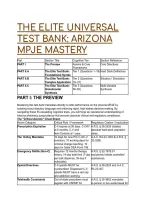
THE ELITE UNIVERSAL
TEST BANK: ARIZONA
MPJE MASTERY
Part Section Title Cognitive Tier Section Reference
PART I The Preview Axioms & Core Core Directives
Frameworks
PART II.A The Elite Test Bank: Tier 1 (Questions 1–18) Hard Deck Definitions
Foundational Syntax
PART II.B The Elite Test Bank: Tier 2 (Questions Situation / Simulation
Complex Application 19–37)
PART II.C The Elite Test Bank: Tier 3 (Questions Multi-Variable
Grandmaster 38–55) Synthesis
Synthesis
PART I: THE PREVIEW
Mastering this test bank translates directly to elite performance on the Arizona MPJE by
isolating exact statutory language and enforcing rapid, high-stakes decision-making. By
navigating these 55 escalating cognitive traps, you will forge an operational understanding of
Arizona pharmacy jurisprudence that ensures absolute clinical and regulatory compliance.
The "Critical Axioms" Cheat Sheet:
Axiom Category Critical Rule / Framework Regulatory Citation / Implication
Prescription Expiration C-II expires at 90 days. C-III/IV A.R.S. § 36-2525 dictates
at 6 months. C-V and absolute hard-deck expiration
Non-Controls at 1 year. dates.
The 10-Day Mandates 10 days for new PIC C-II/C-V A.A.C. R4-23-1003 & A.R.S. §
inventory. 10 working days for 32-3208.
criminal charge reporting. 10
days for State DEA Form 106.
Emergency Refills (Non-C) Requires 12 months therapy A.R.S. § 32-1979.01
history. 14-day total limit (7-day exclusively forbids controlled
per bulk dispense, 30-day if substances.
indivisible).
Opioid Directives C-II opioids MUST be A.R.S. § 36-2525 and A.A.C.
e-prescribed. Dispensed C-II R4-23-407.
opioids MUST have a red cap
and addiction warning.
Telehealth Constraints Out-of-state prescribers must A.R.S. § 36-3602 mandates
register with CSPMP for in-person or live audio/visual for
,Axiom Category Critical Rule / Framework Regulatory Citation / Implication
controls. No audio-only C-II.
telehealth for C-II.
PART II.A: THE ELITE TEST BANK - FOUNDATIONAL
SYNTAX & APPLICATION (TIER 1)
Q1: A newly appointed Pharmacist-in-Charge (PIC) at a community pharmacy in Phoenix
assumes their role on Monday morning. Based on the principles of Arizona Administrative Code
(A.A.C. R4-23-1003), which action is REQUIRED regarding controlled substance inventory?
A) The PIC must conduct a full inventory of all C-II through C-V substances within 30 days of
assuming responsibility.
B) The outgoing PIC must complete the inventory prior to the new PIC assuming the role.
C) The new PIC must complete an inventory of all controlled substances within 10 days of
assuming responsibility.
D) The PIC must notify the Board immediately and conduct the inventory by May 1st of the
calendar year.
● Answer: C (The new PIC must complete an inventory of all controlled substances within
10 days of assuming responsibility)
● Distractor Analysis:
○ A is incorrect: 30 days is a common novice misconception derived from general
operational grace periods; the statutory requirement is strictly 10 days.
○ B is incorrect: While good practice for the outgoing PIC to document status, the
legal burden falls explicitly on the new PIC to perform the inventory.
○ D is incorrect: May 1st is the standard annual inventory date for manufacturers and
wholesalers, not the trigger for a PIC change.
The Mentor's Analysis: Accountability shifts the exact moment the PIC title is assumed. When
facing a PIC transition, the immediate priority is establishing a verified baseline of all controlled
substances. By utilizing the 10-day rule, you bypass the common trap of waiting for standard
annual inventory dates. Professional Intuition: Always initiate a complete C-II through C-V
inventory within 10 days of a PIC change to establish an unassailable chain of custody.
Q2: A patient presents a written prescription for oxycodone 10mg (a Schedule II opioid) issued
95 days ago by an Arizona medical practitioner. The pharmacy's electronic prescribing system is
currently operational. Based on the principles of A.R.S. § 36-2525, which conclusion is the
MOST APPROPRIATE?
A) The prescription can be dispensed because C-II prescriptions are valid for 6 months from the
date of issuance.
B) The prescription cannot be dispensed because it was not electronically prescribed and the
system is operational.
C) The prescription cannot be dispensed because it is older than 90 days.
D) The prescription can be dispensed if the pharmacist verifies the prescriber's DEA registration
and manually signs the back.
● Answer: C (The prescription cannot be dispensed because it is older than 90 days)
● Distractor Analysis:
○ A is incorrect: Schedule III and IV prescriptions are valid for 6 months; Schedule II
prescriptions expire strictly at 90 days.
○ B is incorrect: While C-II opioids must generally be e-prescribed, the immediate,
, unequivocal invalidator here is the 90-day expiration, which supersedes
transmission method analysis.
○ D is incorrect: No verification can legally revive a Schedule II prescription that has
passed its 90-day expiration date.
The Mentor's Analysis: Expiration dates serve as absolute legal hard decks. When facing an
aged Schedule II prescription, the immediate priority is verifying the 90-day window. By utilizing
the 90-day expiration rule, you bypass the common trap of analyzing transmission methods on
an already void document. Professional Intuition: A Schedule II prescription is legally dead
on day 91; evaluate dates before analyzing formatting.
Q3: A pharmacist licensed in Arizona is preparing to renew their license. They maintain a
certification to administer immunizations and actively dispense self-administered hormonal
contraceptives via standing order. Based on the principles of A.A.C. R4-23-204, which
Continuing Education (CE) distribution is MANDATORY for their biennial renewal?
A) 30 total hours, including 3 hours on opioids, 2 hours on immunizations, and 3 hours on
hormonal contraceptives.
B) 30 total hours, including 2 hours on pharmacy law, 2 hours on immunizations, and 2 hours on
hormonal contraceptives.
C) 20 total hours, including 3 hours on opioids and 2 hours on immunizations.
D) 30 total hours, including 5 hours on opioids and 5 hours of live CE.
● Answer: A (30 total hours, including 3 hours on opioids, 2 hours on immunizations, and 3
hours on hormonal contraceptives)
● Distractor Analysis:
○ B is incorrect: Arizona does not explicitly mandate 2 hours of pharmacy law for
general pharmacists, unlike other jurisdictions; it mandates 3 hours for
opioids/substance use.
○ C is incorrect: 20 total hours is the biennial requirement for pharmacy technicians,
not pharmacists.
○ D is incorrect: Live CE is not strictly mandated by the Arizona Board of Pharmacy
for general renewal.
The Mentor's Analysis: Privileges dictate continuing education burdens. When facing license
renewal with expanded practice authorities, the immediate priority is mapping CE hours to
specific clinical privileges. By utilizing the 3-2-3 privilege mapping
(Opioids-Immunizations-Contraceptives), you bypass the common trap of fulfilling general hours
while neglecting specific statutory mandates. Professional Intuition: 30 hours total: 3 for
opioids, plus targeted hours matching your specific clinical certifications (2 for shots, 3
for birth control).
Q4: An Arizona pharmacist is arrested over the weekend and charged with a misdemeanor
Extreme DUI. Based on the principles of A.R.S. § 32-3208 regarding mandatory reporting for
health professionals, which action is REQUIRED?
A) The pharmacist must report the charge to the Board within 30 days of conviction.
B) The pharmacist must report the charge to the Board in writing within 10 working days after
the charge is filed.
C) The pharmacist does not need to report a misdemeanor, only felony convictions.
D) The pharmacist must surrender their license immediately until the court case is resolved.
● Answer: B (The pharmacist must report the charge to the Board in writing within 10
working days after the charge is filed)
● Distractor Analysis:
○ A is incorrect: Reporting is triggered by the charge, not the conviction, and the
, timeline is strictly 10 working days, not 30.
○ C is incorrect: Misdemeanors involving conduct that may affect patient safety
(explicitly including DUI) are mandatory reportable offenses.
○ D is incorrect: Preemptive surrender is an unmandated overreaction not required by
the mere filing of a charge.
The Mentor's Analysis: Regulatory transparency is non-negotiable for health professionals.
When facing criminal charges involving patient safety risks (like substance abuse), the
immediate priority is statutory notification. By utilizing the 10-working-day reporting rule, you
bypass the common trap of waiting for a legal conviction before notifying the Board.
Professional Intuition: The clock starts at the charge, not the conviction; 10 working days
is the absolute limit for disclosure.
Q5: A pharmacy discovers a significant loss of Schedule II controlled substances following a
weekend break-in. Based on the principles of federal and Arizona state reporting requirements,
which reporting timeline is ACCURATE?
A) Submit DEA Form 106 to the DEA within 45 days and provide a copy to the Arizona Board
within 10 days of discovery.
B) Submit DEA Form 106 to the DEA within 15 days and notify the Arizona Board within 30
days.
C) Notify the DEA in writing within 1 business day and submit DEA Form 106 to both the DEA
and the Board within 45 days.
D) Submit DEA Form 106 to the Arizona Board within 1 business day.
● Answer: A (Submit DEA Form 106 to the DEA within 45 days and provide a copy to the
Arizona Board within 10 days of discovery)
● Distractor Analysis:
○ B is incorrect: The 15-day DEA rule was proposed but ultimately finalized as 45
days. The state rule is 10 days, not 30.
○ C is incorrect: While the DEA requires a 45-day Form 106 submission, Arizona
state law (A.A.C. R4-23-1003) specifically requires the loss to be reported on Form
106 within 10 days of discovery.
○ D is incorrect: 1 business day is the DEA requirement for initial written notice, not
the submission of the formalized DEA 106 form.
The Mentor's Analysis: Dual-jurisdiction compliance requires adhering to the most stringent
timeline. When facing a significant loss, the immediate priority is triaging federal vs. state
deadlines. By utilizing Arizona's 10-day Form 106 rule, you bypass the common trap of relying
solely on the federal 45-day allowance, which would result in a state-level violation. Professional
Intuition: Federal law allows 45 days for Form 106; Arizona law demands it in 10. Always
comply with the stricter state clock.
Q6: A patient requests an emergency refill for their non-controlled blood pressure medication on
a Sunday when their prescriber is unavailable. The patient has been on a consistent dose for 14
months. The medication is dispensed in standard amber vials. Based on the principles of A.R.S.
§ 32-1979.01, what is the MAXIMUM supply the pharmacist may legally dispense?
A) A 30-day supply.
B) A 14-day supply.
C) A 7-day supply.
D) A 3-day supply.
● Answer: C (A 7-day supply)
● Distractor Analysis:
○ A is incorrect: A 30-day supply is only permitted for medications prepackaged in a
TEST BANK: ARIZONA
MPJE MASTERY
Part Section Title Cognitive Tier Section Reference
PART I The Preview Axioms & Core Core Directives
Frameworks
PART II.A The Elite Test Bank: Tier 1 (Questions 1–18) Hard Deck Definitions
Foundational Syntax
PART II.B The Elite Test Bank: Tier 2 (Questions Situation / Simulation
Complex Application 19–37)
PART II.C The Elite Test Bank: Tier 3 (Questions Multi-Variable
Grandmaster 38–55) Synthesis
Synthesis
PART I: THE PREVIEW
Mastering this test bank translates directly to elite performance on the Arizona MPJE by
isolating exact statutory language and enforcing rapid, high-stakes decision-making. By
navigating these 55 escalating cognitive traps, you will forge an operational understanding of
Arizona pharmacy jurisprudence that ensures absolute clinical and regulatory compliance.
The "Critical Axioms" Cheat Sheet:
Axiom Category Critical Rule / Framework Regulatory Citation / Implication
Prescription Expiration C-II expires at 90 days. C-III/IV A.R.S. § 36-2525 dictates
at 6 months. C-V and absolute hard-deck expiration
Non-Controls at 1 year. dates.
The 10-Day Mandates 10 days for new PIC C-II/C-V A.A.C. R4-23-1003 & A.R.S. §
inventory. 10 working days for 32-3208.
criminal charge reporting. 10
days for State DEA Form 106.
Emergency Refills (Non-C) Requires 12 months therapy A.R.S. § 32-1979.01
history. 14-day total limit (7-day exclusively forbids controlled
per bulk dispense, 30-day if substances.
indivisible).
Opioid Directives C-II opioids MUST be A.R.S. § 36-2525 and A.A.C.
e-prescribed. Dispensed C-II R4-23-407.
opioids MUST have a red cap
and addiction warning.
Telehealth Constraints Out-of-state prescribers must A.R.S. § 36-3602 mandates
register with CSPMP for in-person or live audio/visual for
,Axiom Category Critical Rule / Framework Regulatory Citation / Implication
controls. No audio-only C-II.
telehealth for C-II.
PART II.A: THE ELITE TEST BANK - FOUNDATIONAL
SYNTAX & APPLICATION (TIER 1)
Q1: A newly appointed Pharmacist-in-Charge (PIC) at a community pharmacy in Phoenix
assumes their role on Monday morning. Based on the principles of Arizona Administrative Code
(A.A.C. R4-23-1003), which action is REQUIRED regarding controlled substance inventory?
A) The PIC must conduct a full inventory of all C-II through C-V substances within 30 days of
assuming responsibility.
B) The outgoing PIC must complete the inventory prior to the new PIC assuming the role.
C) The new PIC must complete an inventory of all controlled substances within 10 days of
assuming responsibility.
D) The PIC must notify the Board immediately and conduct the inventory by May 1st of the
calendar year.
● Answer: C (The new PIC must complete an inventory of all controlled substances within
10 days of assuming responsibility)
● Distractor Analysis:
○ A is incorrect: 30 days is a common novice misconception derived from general
operational grace periods; the statutory requirement is strictly 10 days.
○ B is incorrect: While good practice for the outgoing PIC to document status, the
legal burden falls explicitly on the new PIC to perform the inventory.
○ D is incorrect: May 1st is the standard annual inventory date for manufacturers and
wholesalers, not the trigger for a PIC change.
The Mentor's Analysis: Accountability shifts the exact moment the PIC title is assumed. When
facing a PIC transition, the immediate priority is establishing a verified baseline of all controlled
substances. By utilizing the 10-day rule, you bypass the common trap of waiting for standard
annual inventory dates. Professional Intuition: Always initiate a complete C-II through C-V
inventory within 10 days of a PIC change to establish an unassailable chain of custody.
Q2: A patient presents a written prescription for oxycodone 10mg (a Schedule II opioid) issued
95 days ago by an Arizona medical practitioner. The pharmacy's electronic prescribing system is
currently operational. Based on the principles of A.R.S. § 36-2525, which conclusion is the
MOST APPROPRIATE?
A) The prescription can be dispensed because C-II prescriptions are valid for 6 months from the
date of issuance.
B) The prescription cannot be dispensed because it was not electronically prescribed and the
system is operational.
C) The prescription cannot be dispensed because it is older than 90 days.
D) The prescription can be dispensed if the pharmacist verifies the prescriber's DEA registration
and manually signs the back.
● Answer: C (The prescription cannot be dispensed because it is older than 90 days)
● Distractor Analysis:
○ A is incorrect: Schedule III and IV prescriptions are valid for 6 months; Schedule II
prescriptions expire strictly at 90 days.
○ B is incorrect: While C-II opioids must generally be e-prescribed, the immediate,
, unequivocal invalidator here is the 90-day expiration, which supersedes
transmission method analysis.
○ D is incorrect: No verification can legally revive a Schedule II prescription that has
passed its 90-day expiration date.
The Mentor's Analysis: Expiration dates serve as absolute legal hard decks. When facing an
aged Schedule II prescription, the immediate priority is verifying the 90-day window. By utilizing
the 90-day expiration rule, you bypass the common trap of analyzing transmission methods on
an already void document. Professional Intuition: A Schedule II prescription is legally dead
on day 91; evaluate dates before analyzing formatting.
Q3: A pharmacist licensed in Arizona is preparing to renew their license. They maintain a
certification to administer immunizations and actively dispense self-administered hormonal
contraceptives via standing order. Based on the principles of A.A.C. R4-23-204, which
Continuing Education (CE) distribution is MANDATORY for their biennial renewal?
A) 30 total hours, including 3 hours on opioids, 2 hours on immunizations, and 3 hours on
hormonal contraceptives.
B) 30 total hours, including 2 hours on pharmacy law, 2 hours on immunizations, and 2 hours on
hormonal contraceptives.
C) 20 total hours, including 3 hours on opioids and 2 hours on immunizations.
D) 30 total hours, including 5 hours on opioids and 5 hours of live CE.
● Answer: A (30 total hours, including 3 hours on opioids, 2 hours on immunizations, and 3
hours on hormonal contraceptives)
● Distractor Analysis:
○ B is incorrect: Arizona does not explicitly mandate 2 hours of pharmacy law for
general pharmacists, unlike other jurisdictions; it mandates 3 hours for
opioids/substance use.
○ C is incorrect: 20 total hours is the biennial requirement for pharmacy technicians,
not pharmacists.
○ D is incorrect: Live CE is not strictly mandated by the Arizona Board of Pharmacy
for general renewal.
The Mentor's Analysis: Privileges dictate continuing education burdens. When facing license
renewal with expanded practice authorities, the immediate priority is mapping CE hours to
specific clinical privileges. By utilizing the 3-2-3 privilege mapping
(Opioids-Immunizations-Contraceptives), you bypass the common trap of fulfilling general hours
while neglecting specific statutory mandates. Professional Intuition: 30 hours total: 3 for
opioids, plus targeted hours matching your specific clinical certifications (2 for shots, 3
for birth control).
Q4: An Arizona pharmacist is arrested over the weekend and charged with a misdemeanor
Extreme DUI. Based on the principles of A.R.S. § 32-3208 regarding mandatory reporting for
health professionals, which action is REQUIRED?
A) The pharmacist must report the charge to the Board within 30 days of conviction.
B) The pharmacist must report the charge to the Board in writing within 10 working days after
the charge is filed.
C) The pharmacist does not need to report a misdemeanor, only felony convictions.
D) The pharmacist must surrender their license immediately until the court case is resolved.
● Answer: B (The pharmacist must report the charge to the Board in writing within 10
working days after the charge is filed)
● Distractor Analysis:
○ A is incorrect: Reporting is triggered by the charge, not the conviction, and the
, timeline is strictly 10 working days, not 30.
○ C is incorrect: Misdemeanors involving conduct that may affect patient safety
(explicitly including DUI) are mandatory reportable offenses.
○ D is incorrect: Preemptive surrender is an unmandated overreaction not required by
the mere filing of a charge.
The Mentor's Analysis: Regulatory transparency is non-negotiable for health professionals.
When facing criminal charges involving patient safety risks (like substance abuse), the
immediate priority is statutory notification. By utilizing the 10-working-day reporting rule, you
bypass the common trap of waiting for a legal conviction before notifying the Board.
Professional Intuition: The clock starts at the charge, not the conviction; 10 working days
is the absolute limit for disclosure.
Q5: A pharmacy discovers a significant loss of Schedule II controlled substances following a
weekend break-in. Based on the principles of federal and Arizona state reporting requirements,
which reporting timeline is ACCURATE?
A) Submit DEA Form 106 to the DEA within 45 days and provide a copy to the Arizona Board
within 10 days of discovery.
B) Submit DEA Form 106 to the DEA within 15 days and notify the Arizona Board within 30
days.
C) Notify the DEA in writing within 1 business day and submit DEA Form 106 to both the DEA
and the Board within 45 days.
D) Submit DEA Form 106 to the Arizona Board within 1 business day.
● Answer: A (Submit DEA Form 106 to the DEA within 45 days and provide a copy to the
Arizona Board within 10 days of discovery)
● Distractor Analysis:
○ B is incorrect: The 15-day DEA rule was proposed but ultimately finalized as 45
days. The state rule is 10 days, not 30.
○ C is incorrect: While the DEA requires a 45-day Form 106 submission, Arizona
state law (A.A.C. R4-23-1003) specifically requires the loss to be reported on Form
106 within 10 days of discovery.
○ D is incorrect: 1 business day is the DEA requirement for initial written notice, not
the submission of the formalized DEA 106 form.
The Mentor's Analysis: Dual-jurisdiction compliance requires adhering to the most stringent
timeline. When facing a significant loss, the immediate priority is triaging federal vs. state
deadlines. By utilizing Arizona's 10-day Form 106 rule, you bypass the common trap of relying
solely on the federal 45-day allowance, which would result in a state-level violation. Professional
Intuition: Federal law allows 45 days for Form 106; Arizona law demands it in 10. Always
comply with the stricter state clock.
Q6: A patient requests an emergency refill for their non-controlled blood pressure medication on
a Sunday when their prescriber is unavailable. The patient has been on a consistent dose for 14
months. The medication is dispensed in standard amber vials. Based on the principles of A.R.S.
§ 32-1979.01, what is the MAXIMUM supply the pharmacist may legally dispense?
A) A 30-day supply.
B) A 14-day supply.
C) A 7-day supply.
D) A 3-day supply.
● Answer: C (A 7-day supply)
● Distractor Analysis:
○ A is incorrect: A 30-day supply is only permitted for medications prepackaged in a


