
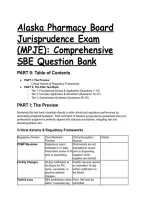
Alaska Pharmacy Board
Jurisprudence Exam
(MPJE): Comprehensive
SBE Question Bank
PART 0: Table of Contents
● PART I: The Preview
○ Critical Axioms & Regulatory Frameworks
● PART II: The Elite Test Bank
○ Tier 1: Foundational Syntax & Application (Questions 1–18)
○ Tier 2: Complex Application & Simulation (Questions 19–37)
○ Tier 3: Grandmaster Synthesis (Questions 38–55)
PART I: The Preview
Mastering this test bank translates directly to elite clinical and regulatory performance by
eliminating analytical hesitation. Total command of Alaska’s jurisprudence guarantees that your
professional judgment is perfectly aligned with statutory boundaries, mitigating risk and
elevating patient care.
Critical Axioms & Regulatory Frameworks
Regulatory Domain Core Standard / Critical Exception / Citation
Timeline Nuance
PDMP Mandates Dispensers report Pharmacists are not
Schedule II–IV daily; mandated to review
Prescribers review II–III prior to dispensing;
prior to prescribing. inpatient <24hr
supplies are exempt.
Facility Changes 30-day notification to Facility closures require
the Board for PIC, an expedited 10-day
name, ownership, or written notification to
physical address the Board.
changes.
Theft & Loss DEA preliminary notice Form 106 must be
within 1 business day; submitted
,Regulatory Domain Core Standard / Critical Exception / Citation
Timeline Nuance
DEA Form 106 within electronically; a copy
45 days. must be sent to the
Alaska Board.
Record Retention Prescription orders, Wholesale records
wholesale records, and must be retrievable
consultant evaluations within 2 working days
retained for 2 years. during an audit.
Technician Scope Baseline technicians National Certification
require 10 CE hours unlocks non-controlled
biennially for renewal. transfer and
tech-check-tech
privileges.
PART II: The Elite Test Bank
Tier 1: Foundational Syntax & Application
Q1: Under Alaska law, what is the MAXIMUM allowable timeframe for a dispenser to report the
dispensation of a federally scheduled III controlled substance to the Prescription Drug
Monitoring Program (PDMP)? Based on the principles of state diversion control, which reporting
schedule is MANDATORY? A) Within 72 hours of dispensation B) By the end of the next
calendar week C) Daily, with weekend and state holiday exemptions reported on the following
business day D) Within 15 days of the end of the month
● Answer: C (Daily, with weekend and state holiday exemptions reported on the following
business day)
● Distractor Analysis:
○ A is incorrect: Outdated federal or alternative state legacy frameworks cite 72
hours, but Alaska requires daily reporting.
○ B is incorrect: Weekly reporting is a legacy standard that has been superseded by
real-time tracking mandates.
○ D is incorrect: This confuses the PDMP timeline with older chemical or theft
reporting timelines.
The Mentor's Analysis: Real-time data provides the cornerstone of diversion prevention. Alaska
enforces strict daily reporting for Schedule II–IV substances to maintain an actionable database.
By isolating weekends and holidays, the statute acknowledges operational reality without
sacrificing surveillance integrity . Professional Intuition: Dispensers report daily; prescribers
review prior to prescribing.
Q2: Which of the following professionals is statutorily required to review a patient’s PDMP
history prior to issuing a 30-day supply of an outpatient Schedule II pain medication? Based on
the principles of the Alaska Prescription Drug Monitoring Program, who bears the EXCLUSIVE
legal mandate? A) The dispensing pharmacist only B) The prescribing practitioner only C) Both
the prescribing practitioner and the dispensing pharmacist D) The consultant pharmacist
reviewing the patient profile
● Answer: B (The prescribing practitioner only)
● Distractor Analysis:
○ A is incorrect: Pharmacists are explicitly not required to review the PDMP history in
, Alaska, though they may choose to do so.
○ C is incorrect: This plausible distractor reflects clinical best practice but overstates
the statutory mandate for pharmacists.
○ D is incorrect: Consultant pharmacists evaluate drug handling and policies; they are
not mandated to perform pre-dispensing PDMP reviews.
The Mentor's Analysis: Statutory obligations and clinical best practices occasionally diverge.
While reviewing the PDMP remains excellent clinical practice for a dispensing pharmacist,
Alaska law places the legal mandate for review strictly on the prescriber before the prescription
is issued. Professional Intuition: Never confuse clinical recommendations with statutory
mandates.
Q3: An applicant for renewal of a pharmacist license in Alaska must certify the completion of
how many contact hours of continuing education (CE) during the concluding license period?
Based on the principles of license maintenance, what is the MINIMUM requirement? A) 15
hours B) 20 hours C) 30 hours D) 45 hours
● Answer: C (30 hours)
● Distractor Analysis:
○ A is incorrect: 15 hours is the requirement for advanced pharmacology for APRNs
or the annualized amount for a first-time pharmacist renewal.
○ B is incorrect: 20 hours represents a common metric in other jurisdictions, but
remains insufficient for Alaska.
○ D is incorrect: 45 hours acts as an outdated or specialized requirement occasionally
seen in non-pharmacist disciplines.
The Mentor's Analysis: Maintaining licensure requires absolute compliance with administrative
thresholds. The baseline metric for pharmacists in Alaska is firmly established at 30 hours per
biennial period to ensure ongoing professional competency. Professional Intuition: Pharmacists
require 30 hours every two years; technicians require 10 hours.
Q4: If a pharmacist in Alaska is authorized to independently administer vaccines, what specific
Continuing Education (CE) requirement MUST be met within their total required CE hours?
Based on the principles of expanded practice, which nested requirement is MANDATORY? A) 3
hours of medication error prevention B) 2 hours of pain management and opioid addiction C) 1
hour specific to immunizations or vaccines approved by ACPE D) 5 hours of live webinar clinical
updates
● Answer: C (1 hour specific to immunizations or vaccines approved by ACPE)
● Distractor Analysis:
○ A is incorrect: Medication error CE exists as a requirement in other states but is not
specified under Alaska's general pharmacist renewal.
○ B is incorrect: 2 hours of opioid/pain management functions as a requirement for
APRNs with DEA registrations, not pharmacists.
○ D is incorrect: Alaska allows all CE to be completed via home study; live hours are
not statutorily mandated for pharmacists.
The Mentor's Analysis: Expanded scopes of practice demand targeted maintenance of
competency. Administering vaccines triggers a micro-requirement of one ACPE-approved hour,
which nests seamlessly within the total 30-hour requirement. Professional Intuition: Specialized
clinical privileges carry specialized, nested CE obligations.
Q5: A pharmacy technician applying for license renewal in Alaska must complete a minimum of
how many CE contact hours during the concluding licensing period? Based on the principles of
personnel registration, what is the MINIMUM threshold? A) 5 hours B) 10 hours C) 15 hours D)
30 hours
Jurisprudence Exam
(MPJE): Comprehensive
SBE Question Bank
PART 0: Table of Contents
● PART I: The Preview
○ Critical Axioms & Regulatory Frameworks
● PART II: The Elite Test Bank
○ Tier 1: Foundational Syntax & Application (Questions 1–18)
○ Tier 2: Complex Application & Simulation (Questions 19–37)
○ Tier 3: Grandmaster Synthesis (Questions 38–55)
PART I: The Preview
Mastering this test bank translates directly to elite clinical and regulatory performance by
eliminating analytical hesitation. Total command of Alaska’s jurisprudence guarantees that your
professional judgment is perfectly aligned with statutory boundaries, mitigating risk and
elevating patient care.
Critical Axioms & Regulatory Frameworks
Regulatory Domain Core Standard / Critical Exception / Citation
Timeline Nuance
PDMP Mandates Dispensers report Pharmacists are not
Schedule II–IV daily; mandated to review
Prescribers review II–III prior to dispensing;
prior to prescribing. inpatient <24hr
supplies are exempt.
Facility Changes 30-day notification to Facility closures require
the Board for PIC, an expedited 10-day
name, ownership, or written notification to
physical address the Board.
changes.
Theft & Loss DEA preliminary notice Form 106 must be
within 1 business day; submitted
,Regulatory Domain Core Standard / Critical Exception / Citation
Timeline Nuance
DEA Form 106 within electronically; a copy
45 days. must be sent to the
Alaska Board.
Record Retention Prescription orders, Wholesale records
wholesale records, and must be retrievable
consultant evaluations within 2 working days
retained for 2 years. during an audit.
Technician Scope Baseline technicians National Certification
require 10 CE hours unlocks non-controlled
biennially for renewal. transfer and
tech-check-tech
privileges.
PART II: The Elite Test Bank
Tier 1: Foundational Syntax & Application
Q1: Under Alaska law, what is the MAXIMUM allowable timeframe for a dispenser to report the
dispensation of a federally scheduled III controlled substance to the Prescription Drug
Monitoring Program (PDMP)? Based on the principles of state diversion control, which reporting
schedule is MANDATORY? A) Within 72 hours of dispensation B) By the end of the next
calendar week C) Daily, with weekend and state holiday exemptions reported on the following
business day D) Within 15 days of the end of the month
● Answer: C (Daily, with weekend and state holiday exemptions reported on the following
business day)
● Distractor Analysis:
○ A is incorrect: Outdated federal or alternative state legacy frameworks cite 72
hours, but Alaska requires daily reporting.
○ B is incorrect: Weekly reporting is a legacy standard that has been superseded by
real-time tracking mandates.
○ D is incorrect: This confuses the PDMP timeline with older chemical or theft
reporting timelines.
The Mentor's Analysis: Real-time data provides the cornerstone of diversion prevention. Alaska
enforces strict daily reporting for Schedule II–IV substances to maintain an actionable database.
By isolating weekends and holidays, the statute acknowledges operational reality without
sacrificing surveillance integrity . Professional Intuition: Dispensers report daily; prescribers
review prior to prescribing.
Q2: Which of the following professionals is statutorily required to review a patient’s PDMP
history prior to issuing a 30-day supply of an outpatient Schedule II pain medication? Based on
the principles of the Alaska Prescription Drug Monitoring Program, who bears the EXCLUSIVE
legal mandate? A) The dispensing pharmacist only B) The prescribing practitioner only C) Both
the prescribing practitioner and the dispensing pharmacist D) The consultant pharmacist
reviewing the patient profile
● Answer: B (The prescribing practitioner only)
● Distractor Analysis:
○ A is incorrect: Pharmacists are explicitly not required to review the PDMP history in
, Alaska, though they may choose to do so.
○ C is incorrect: This plausible distractor reflects clinical best practice but overstates
the statutory mandate for pharmacists.
○ D is incorrect: Consultant pharmacists evaluate drug handling and policies; they are
not mandated to perform pre-dispensing PDMP reviews.
The Mentor's Analysis: Statutory obligations and clinical best practices occasionally diverge.
While reviewing the PDMP remains excellent clinical practice for a dispensing pharmacist,
Alaska law places the legal mandate for review strictly on the prescriber before the prescription
is issued. Professional Intuition: Never confuse clinical recommendations with statutory
mandates.
Q3: An applicant for renewal of a pharmacist license in Alaska must certify the completion of
how many contact hours of continuing education (CE) during the concluding license period?
Based on the principles of license maintenance, what is the MINIMUM requirement? A) 15
hours B) 20 hours C) 30 hours D) 45 hours
● Answer: C (30 hours)
● Distractor Analysis:
○ A is incorrect: 15 hours is the requirement for advanced pharmacology for APRNs
or the annualized amount for a first-time pharmacist renewal.
○ B is incorrect: 20 hours represents a common metric in other jurisdictions, but
remains insufficient for Alaska.
○ D is incorrect: 45 hours acts as an outdated or specialized requirement occasionally
seen in non-pharmacist disciplines.
The Mentor's Analysis: Maintaining licensure requires absolute compliance with administrative
thresholds. The baseline metric for pharmacists in Alaska is firmly established at 30 hours per
biennial period to ensure ongoing professional competency. Professional Intuition: Pharmacists
require 30 hours every two years; technicians require 10 hours.
Q4: If a pharmacist in Alaska is authorized to independently administer vaccines, what specific
Continuing Education (CE) requirement MUST be met within their total required CE hours?
Based on the principles of expanded practice, which nested requirement is MANDATORY? A) 3
hours of medication error prevention B) 2 hours of pain management and opioid addiction C) 1
hour specific to immunizations or vaccines approved by ACPE D) 5 hours of live webinar clinical
updates
● Answer: C (1 hour specific to immunizations or vaccines approved by ACPE)
● Distractor Analysis:
○ A is incorrect: Medication error CE exists as a requirement in other states but is not
specified under Alaska's general pharmacist renewal.
○ B is incorrect: 2 hours of opioid/pain management functions as a requirement for
APRNs with DEA registrations, not pharmacists.
○ D is incorrect: Alaska allows all CE to be completed via home study; live hours are
not statutorily mandated for pharmacists.
The Mentor's Analysis: Expanded scopes of practice demand targeted maintenance of
competency. Administering vaccines triggers a micro-requirement of one ACPE-approved hour,
which nests seamlessly within the total 30-hour requirement. Professional Intuition: Specialized
clinical privileges carry specialized, nested CE obligations.
Q5: A pharmacy technician applying for license renewal in Alaska must complete a minimum of
how many CE contact hours during the concluding licensing period? Based on the principles of
personnel registration, what is the MINIMUM threshold? A) 5 hours B) 10 hours C) 15 hours D)
30 hours


