
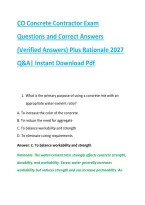
CO Concrete Contractor Exam
Questions and Correct Answers
(Verified Answers) Plus Rationale 2027
Q&A| Instant Download Pdf
1. What is the primary purpose of using a concrete mix with an
appropriate water-cement ratio?
A. To increase the color of the concrete
B. To reduce the need for aggregate
C. To balance workability and strength
D. To eliminate curing requirements
Answer: C. To balance workability and strength
Rationale: The water-cement ratio strongly affects concrete strength,
durability, and workability. Excess water generally increases
workability but reduces strength and can increase permeability. An
,appropriate ratio provides sufficient workability while maintaining
the desired performance.
2. Which material primarily acts as the binding agent in conventional
Portland cement concrete?
A. Coarse aggregate
B. Portland cement
C. Fine aggregate
D. Water
Answer: B. Portland cement
Rationale: Portland cement reacts chemically with water through
hydration and forms cementitious compounds that bind the aggregate
together. Sand and gravel provide most of the concrete's volume but
do not serve as the primary binder.
3. What is the main purpose of coarse aggregate in concrete?
A. To provide bulk and structural stability
B. To accelerate cement hydration
C. To replace all cement
D. To prevent hydration
Answer: A. To provide bulk and structural stability
,Rationale: Coarse aggregate, such as crushed stone or gravel, makes
up a substantial portion of concrete volume. Properly graded
aggregate reduces cement paste demand, helps control shrinkage,
and contributes to strength and stability.
4. What is the standard field test commonly used to measure the
consistency or workability of fresh concrete?
A. Compression test
B. Slump test
C. Tensile test
D. Absorption test
Answer: B. Slump test
Rationale: The slump test provides a practical measurement of the
consistency of fresh concrete. A higher slump generally indicates a
more fluid mixture, although slump does not directly measure
compressive strength.
5. If excessive water is added to a concrete mixture at the jobsite,
what is the most likely effect?
A. Increased compressive strength
B. Reduced permeability
, C. Reduced strength and increased shrinkage
D. Elimination of bleeding
Answer: C. Reduced strength and increased shrinkage
Rationale: Adding water beyond the designed mix increases the
water-cement ratio. This can reduce compressive strength, increase
permeability, increase bleeding, and contribute to drying shrinkage
and cracking.
6. What process causes Portland cement to harden after water is
added?
A. Evaporation
B. Hydration
C. Oxidation
D. Carbonation only
Answer: B. Hydration
Rationale: Hydration is the chemical reaction between cement
compounds and water. It produces cementitious hydration products
that develop the strength and hardened structure of concrete.
7. What is the primary purpose of curing concrete?
A. To remove all moisture immediately
B. To maintain conditions favorable for cement hydration
Questions and Correct Answers
(Verified Answers) Plus Rationale 2027
Q&A| Instant Download Pdf
1. What is the primary purpose of using a concrete mix with an
appropriate water-cement ratio?
A. To increase the color of the concrete
B. To reduce the need for aggregate
C. To balance workability and strength
D. To eliminate curing requirements
Answer: C. To balance workability and strength
Rationale: The water-cement ratio strongly affects concrete strength,
durability, and workability. Excess water generally increases
workability but reduces strength and can increase permeability. An
,appropriate ratio provides sufficient workability while maintaining
the desired performance.
2. Which material primarily acts as the binding agent in conventional
Portland cement concrete?
A. Coarse aggregate
B. Portland cement
C. Fine aggregate
D. Water
Answer: B. Portland cement
Rationale: Portland cement reacts chemically with water through
hydration and forms cementitious compounds that bind the aggregate
together. Sand and gravel provide most of the concrete's volume but
do not serve as the primary binder.
3. What is the main purpose of coarse aggregate in concrete?
A. To provide bulk and structural stability
B. To accelerate cement hydration
C. To replace all cement
D. To prevent hydration
Answer: A. To provide bulk and structural stability
,Rationale: Coarse aggregate, such as crushed stone or gravel, makes
up a substantial portion of concrete volume. Properly graded
aggregate reduces cement paste demand, helps control shrinkage,
and contributes to strength and stability.
4. What is the standard field test commonly used to measure the
consistency or workability of fresh concrete?
A. Compression test
B. Slump test
C. Tensile test
D. Absorption test
Answer: B. Slump test
Rationale: The slump test provides a practical measurement of the
consistency of fresh concrete. A higher slump generally indicates a
more fluid mixture, although slump does not directly measure
compressive strength.
5. If excessive water is added to a concrete mixture at the jobsite,
what is the most likely effect?
A. Increased compressive strength
B. Reduced permeability
, C. Reduced strength and increased shrinkage
D. Elimination of bleeding
Answer: C. Reduced strength and increased shrinkage
Rationale: Adding water beyond the designed mix increases the
water-cement ratio. This can reduce compressive strength, increase
permeability, increase bleeding, and contribute to drying shrinkage
and cracking.
6. What process causes Portland cement to harden after water is
added?
A. Evaporation
B. Hydration
C. Oxidation
D. Carbonation only
Answer: B. Hydration
Rationale: Hydration is the chemical reaction between cement
compounds and water. It produces cementitious hydration products
that develop the strength and hardened structure of concrete.
7. What is the primary purpose of curing concrete?
A. To remove all moisture immediately
B. To maintain conditions favorable for cement hydration


