
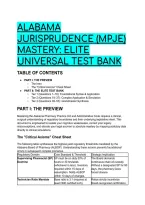
ALABAMA
JURISPRUDENCE (MPJE)
MASTERY: ELITE
UNIVERSAL TEST BANK
TABLE OF CONTENTS
● PART I: THE PREVIEW
○ The Intro
○ The "Critical Axioms" Cheat Sheet
● PART II: THE ELITE TEST BANK
○ Tier 1 (Questions 1–18): Foundational Syntax & Application
○ Tier 2 (Questions 19–37): Complex Application & Simulation
○ Tier 3 (Questions 38–55): Grandmaster Synthesis
PART I: THE PREVIEW
Mastering the Alabama Pharmacy Practice Act and Administrative Code requires a clinical,
surgical understanding of regulatory boundaries and their underlying legislative intent. This
document is engineered to isolate your cognitive weaknesses, correct your legacy
misconceptions, and elevate your legal acumen to absolute mastery by mapping statutory data
directly to clinical simulations.
The "Critical Axioms" Cheat Sheet
The following table synthesizes the highest-yield regulatory thresholds mandated by the
Alabama Board of Pharmacy (ALBOP). Understanding these axioms prevents foundational
errors in subsequent complex scenarios.
Regulatory Domain Core Standard & Threshold Strategic Implication
Supervising Pharmacist (SP) SP must be on duty 50% of The Board demands
Doctrine hours or 30 hrs/week continuous chain-of-custody.
(whichever is less). Inventory Without a designated SP for 90
required within 15 days of days, the pharmacy faces
assumption. Notify ALBOP forced closure.
within 10 days of changes.
Technician Ratio Mandate Base ratio is 3:1 (requires at Ratios strictly incentivize
least ONE certified tech). Board-recognized certification,
,Regulatory Domain Core Standard & Threshold Strategic Implication
Maximum ratio is 4:1 (requires mitigating dispensing errors
at least TWO certified techs). through forced credentialing.
Gabapentin Scheduling Strictly classified as a Schedule Prescriptions expire at 6
V controlled substance in months/5 refills and require
Alabama effective Nov. 2019. PDMP reporting, bypassing the
federal non-controlled status.
Emergency Refill Parameters One-time, 72-hour supply for Prevents acute harm (e.g.,
non-controlled maintenance rebound hypertension) without
drugs. Prescriber must be usurping physician diagnostic
notified within 24 hours. authority.
Dual Inventory Protocol State inventory mandated Ensures high-frequency
annually on January 15th, in reconciliation of highly diverted
addition to federal DEA biennial substances, creating a tighter
requirement. audit trail.
PART II: THE ELITE TEST BANK
Tier 1: Foundational Syntax & Application
Q1: A newly permitted retail pharmacy in Alabama is finalizing its staffing model. The pharmacy
manager plans to schedule one pharmacist on duty at all times. To maximize efficiency, what is
the MAXIMUM allowable number of pharmacy technicians that can be scheduled concurrently
under this single pharmacist's supervision? A) Three technicians, provided none of them are
certified B) Three technicians, provided at least two of them are certified C) Four technicians,
provided at least two of them are certified D) Four technicians, provided at least one of them is
certified
● Answer: C (Four technicians, provided at least two of them are certified)
● Distractor Analysis:
○ A is incorrect: A 3:1 ratio without any certified technicians is a statutory violation; at
least one must be certified to reach a 3:1 tier.
○ B is incorrect: While legally permissible to have three technicians with two certified,
this does not represent the mathematical maximum allowable under ALBOP
regulations.
○ D is incorrect: A 4:1 ratio is strictly prohibited if only one technician is certified;
exactly two must hold certification to unlock this tier.
The Mentor's Analysis: Alabama law explicitly tiers its technician ratios to mandate baseline
professional credentialing. The absolute hard deck is 4:1 (with two certified) or 3:1 (with one
certified). By linking staffing volume to certification, the Board forces corporate entities to invest
in technician education, thereby reducing systemic dispensing errors. Professional Intuition: To
maximize staffing at 4:1, half of the baseline technicians (two) must hold active
Board-recognized certification.
Double-space
Q2: A licensed pharmacist has just accepted a position as the Supervising Pharmacist (SP) at a
high-volume community pharmacy. Based on the rules of the Alabama Board of Pharmacy
(ALBOP), what is the FIRST mandatory regulatory action this pharmacist must complete
regarding the pharmacy's physical inventory? A) Conduct a full inventory of all legend drugs
within 30 days B) Conduct an inventory of all controlled substances within 15 days C) Conduct a
, biennial DEA inventory of Schedule II substances within 10 days D) Conduct a full inventory of
all Schedule III-V substances within 72 hours
● Answer: B (Conduct an inventory of all controlled substances within 15 days)
● Distractor Analysis:
○ A is incorrect: The Board does not mandate a complete legend drug inventory upon
the assumption of the SP role, as the primary diversion risk lies with scheduled
drugs.
○ C is incorrect: The biennial DEA inventory is a distinct federal requirement; the
state-specific trigger for a newly minted SP dictates a complete controlled
substance inventory within 15 days, not 10.
○ D is incorrect: The 72-hour window is a distinct metric applied to emergency refills
and digital computer printout verifications, entirely unrelated to physical SP
inventory demands.
The Mentor's Analysis: The Alabama Board holds the Supervising Pharmacist strictly
accountable for the facility's legal compliance and controlled substance integrity. Establishing a
baseline prevents the incoming SP from absorbing the criminal or administrative liability of
missing stock resulting from their predecessor's negligence. Professional Intuition: A new SP
means a new legal baseline; count the controlled substances within 15 days of taking the
throne.
Double-space
Q3: A patient presents a valid prescription for Neurontin (gabapentin) 300 mg. The prescription
was written 8 months ago and has "PRN" refills indicated. Based on Alabama controlled
substance scheduling, what is the MOST APPROPRIATE action for the pharmacist? A) Fill the
prescription as requested, as gabapentin is a non-controlled legend drug. B) Refuse to fill the
prescription, as it has expired under Schedule V regulations. C) Fill the prescription, but limit the
quantity to a 30-day supply per Alabama law. D) Refuse to fill the prescription, as PRN refills are
invalid for Schedule IV medications.
● Answer: B (Refuse to fill the prescription, as it has expired under Schedule V regulations)
● Distractor Analysis:
○ A is incorrect: Alabama surgically reclassified gabapentin as a Schedule V
controlled substance in November 2019; it is no longer governed as a standard
non-controlled legend drug.
○ C is incorrect: The prescription is entirely void. Under the Controlled Substances
Act, Schedule V prescriptions definitively expire 6 months from the date of issue.
○ D is incorrect: Gabapentin is explicitly classified as Schedule V in Alabama, not
Schedule IV.
The Mentor's Analysis: While the DEA does not federally schedule gabapentin, Alabama
jurisprudence dictates that state law supersedes federal law when the state imposes a stricter
classification. Treating gabapentin as a Schedule V substance instantly imposes the
6-month/5-refill expiration boundary. Professional Intuition: Treat gabapentin with the exact
same regulatory respect as codeine cough syrups—it is a Schedule V controlled
substance in Alabama.
Double-space
Q4: A pharmacy operates a computerized system for recordkeeping of original prescription
orders and refill histories. Due to a software limitation, the pharmacy chooses to print a daily
hard-copy of the controlled substance refill data. Which action is REQUIRED by the dispensing
pharmacists regarding this daily printout? A) The printout must be verified, dated, and signed by
all dispensing pharmacists within 72 hours of dispensing. B) The printout must be sent to the
JURISPRUDENCE (MPJE)
MASTERY: ELITE
UNIVERSAL TEST BANK
TABLE OF CONTENTS
● PART I: THE PREVIEW
○ The Intro
○ The "Critical Axioms" Cheat Sheet
● PART II: THE ELITE TEST BANK
○ Tier 1 (Questions 1–18): Foundational Syntax & Application
○ Tier 2 (Questions 19–37): Complex Application & Simulation
○ Tier 3 (Questions 38–55): Grandmaster Synthesis
PART I: THE PREVIEW
Mastering the Alabama Pharmacy Practice Act and Administrative Code requires a clinical,
surgical understanding of regulatory boundaries and their underlying legislative intent. This
document is engineered to isolate your cognitive weaknesses, correct your legacy
misconceptions, and elevate your legal acumen to absolute mastery by mapping statutory data
directly to clinical simulations.
The "Critical Axioms" Cheat Sheet
The following table synthesizes the highest-yield regulatory thresholds mandated by the
Alabama Board of Pharmacy (ALBOP). Understanding these axioms prevents foundational
errors in subsequent complex scenarios.
Regulatory Domain Core Standard & Threshold Strategic Implication
Supervising Pharmacist (SP) SP must be on duty 50% of The Board demands
Doctrine hours or 30 hrs/week continuous chain-of-custody.
(whichever is less). Inventory Without a designated SP for 90
required within 15 days of days, the pharmacy faces
assumption. Notify ALBOP forced closure.
within 10 days of changes.
Technician Ratio Mandate Base ratio is 3:1 (requires at Ratios strictly incentivize
least ONE certified tech). Board-recognized certification,
,Regulatory Domain Core Standard & Threshold Strategic Implication
Maximum ratio is 4:1 (requires mitigating dispensing errors
at least TWO certified techs). through forced credentialing.
Gabapentin Scheduling Strictly classified as a Schedule Prescriptions expire at 6
V controlled substance in months/5 refills and require
Alabama effective Nov. 2019. PDMP reporting, bypassing the
federal non-controlled status.
Emergency Refill Parameters One-time, 72-hour supply for Prevents acute harm (e.g.,
non-controlled maintenance rebound hypertension) without
drugs. Prescriber must be usurping physician diagnostic
notified within 24 hours. authority.
Dual Inventory Protocol State inventory mandated Ensures high-frequency
annually on January 15th, in reconciliation of highly diverted
addition to federal DEA biennial substances, creating a tighter
requirement. audit trail.
PART II: THE ELITE TEST BANK
Tier 1: Foundational Syntax & Application
Q1: A newly permitted retail pharmacy in Alabama is finalizing its staffing model. The pharmacy
manager plans to schedule one pharmacist on duty at all times. To maximize efficiency, what is
the MAXIMUM allowable number of pharmacy technicians that can be scheduled concurrently
under this single pharmacist's supervision? A) Three technicians, provided none of them are
certified B) Three technicians, provided at least two of them are certified C) Four technicians,
provided at least two of them are certified D) Four technicians, provided at least one of them is
certified
● Answer: C (Four technicians, provided at least two of them are certified)
● Distractor Analysis:
○ A is incorrect: A 3:1 ratio without any certified technicians is a statutory violation; at
least one must be certified to reach a 3:1 tier.
○ B is incorrect: While legally permissible to have three technicians with two certified,
this does not represent the mathematical maximum allowable under ALBOP
regulations.
○ D is incorrect: A 4:1 ratio is strictly prohibited if only one technician is certified;
exactly two must hold certification to unlock this tier.
The Mentor's Analysis: Alabama law explicitly tiers its technician ratios to mandate baseline
professional credentialing. The absolute hard deck is 4:1 (with two certified) or 3:1 (with one
certified). By linking staffing volume to certification, the Board forces corporate entities to invest
in technician education, thereby reducing systemic dispensing errors. Professional Intuition: To
maximize staffing at 4:1, half of the baseline technicians (two) must hold active
Board-recognized certification.
Double-space
Q2: A licensed pharmacist has just accepted a position as the Supervising Pharmacist (SP) at a
high-volume community pharmacy. Based on the rules of the Alabama Board of Pharmacy
(ALBOP), what is the FIRST mandatory regulatory action this pharmacist must complete
regarding the pharmacy's physical inventory? A) Conduct a full inventory of all legend drugs
within 30 days B) Conduct an inventory of all controlled substances within 15 days C) Conduct a
, biennial DEA inventory of Schedule II substances within 10 days D) Conduct a full inventory of
all Schedule III-V substances within 72 hours
● Answer: B (Conduct an inventory of all controlled substances within 15 days)
● Distractor Analysis:
○ A is incorrect: The Board does not mandate a complete legend drug inventory upon
the assumption of the SP role, as the primary diversion risk lies with scheduled
drugs.
○ C is incorrect: The biennial DEA inventory is a distinct federal requirement; the
state-specific trigger for a newly minted SP dictates a complete controlled
substance inventory within 15 days, not 10.
○ D is incorrect: The 72-hour window is a distinct metric applied to emergency refills
and digital computer printout verifications, entirely unrelated to physical SP
inventory demands.
The Mentor's Analysis: The Alabama Board holds the Supervising Pharmacist strictly
accountable for the facility's legal compliance and controlled substance integrity. Establishing a
baseline prevents the incoming SP from absorbing the criminal or administrative liability of
missing stock resulting from their predecessor's negligence. Professional Intuition: A new SP
means a new legal baseline; count the controlled substances within 15 days of taking the
throne.
Double-space
Q3: A patient presents a valid prescription for Neurontin (gabapentin) 300 mg. The prescription
was written 8 months ago and has "PRN" refills indicated. Based on Alabama controlled
substance scheduling, what is the MOST APPROPRIATE action for the pharmacist? A) Fill the
prescription as requested, as gabapentin is a non-controlled legend drug. B) Refuse to fill the
prescription, as it has expired under Schedule V regulations. C) Fill the prescription, but limit the
quantity to a 30-day supply per Alabama law. D) Refuse to fill the prescription, as PRN refills are
invalid for Schedule IV medications.
● Answer: B (Refuse to fill the prescription, as it has expired under Schedule V regulations)
● Distractor Analysis:
○ A is incorrect: Alabama surgically reclassified gabapentin as a Schedule V
controlled substance in November 2019; it is no longer governed as a standard
non-controlled legend drug.
○ C is incorrect: The prescription is entirely void. Under the Controlled Substances
Act, Schedule V prescriptions definitively expire 6 months from the date of issue.
○ D is incorrect: Gabapentin is explicitly classified as Schedule V in Alabama, not
Schedule IV.
The Mentor's Analysis: While the DEA does not federally schedule gabapentin, Alabama
jurisprudence dictates that state law supersedes federal law when the state imposes a stricter
classification. Treating gabapentin as a Schedule V substance instantly imposes the
6-month/5-refill expiration boundary. Professional Intuition: Treat gabapentin with the exact
same regulatory respect as codeine cough syrups—it is a Schedule V controlled
substance in Alabama.
Double-space
Q4: A pharmacy operates a computerized system for recordkeeping of original prescription
orders and refill histories. Due to a software limitation, the pharmacy chooses to print a daily
hard-copy of the controlled substance refill data. Which action is REQUIRED by the dispensing
pharmacists regarding this daily printout? A) The printout must be verified, dated, and signed by
all dispensing pharmacists within 72 hours of dispensing. B) The printout must be sent to the


