
ATI RN Pharmacology for Nursing Edition 9.0 | Test Bank 2026 400 Questions with Detailed Rationales
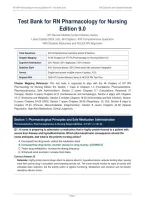
Test Bank for RN Pharmacology for Nursing
Edition 9.0
ATI Review Module Content Mastery Series
Latest Update 2026 | ALL 48 Chapters | 400 Comprehensive Questions
With Detailed Rationales and NCLEX-RN Alignment
Total Questions 400 Comprehensive Questions across 9 Sections
Chapter Mapping All 48 Chapters of ATI RN Pharmacology for Nursing Edition 9.0
Cognitive Distribution 30% Recall | 50% Application | 20% Analysis
Question Style 80% Scenario-based | 20% Direct recall with calculation integration
Format Single-best-answer multiple choice (4 options, A-D)
Aligned With 2026 ATI Content Mastery Series & NCLEX-RN Test Plan
Chapter Mapping Reference: This test bank is organized to align with the 48 chapters of ATI RN
Pharmacology for Nursing Edition 9.0. Section 1 maps to Chapters 1-4 (Foundations, Pharmacokinetics,
Pharmacodynamics, Safe Administration). Section 2 covers Chapters 5-7 (Calculations, Parenteral, IV
Therapy). Section 3 spans Chapters 8-12 (Cardiovascular and Hematologic). Section 4 aligns with Chapters
13-17 (Endocrine and Metabolic). Section 5 includes Chapters 18-23 (Antimicrobial and Anti-Infective). Section
6 covers Chapters 24-29 (CNS). Section 7 spans Chapters 30-36 (Respiratory, GI, GU). Section 8 maps to
Chapters 37-43 (Immune, Musculoskeletal, Integumentary). Section 9 covers Chapters 44-48 (Special
Populations, High-Alert Medications, Clinical Judgment).
Section 1: Pharmacological Principles and Safe Medication Administration
Pharmacokinetics, Pharmacodynamics, & Nursing Responsibilities | ATI Ch 1-4 | Q1-35
Q1: A nurse is preparing to administer a medication that is highly protein-bound to a patient with
severe liver disease and hypoalbuminemia. Which pharmacokinetic consequence should the
nurse anticipate, and what is the priority nursing action?
A. Decreased free drug levels; reduce the medication dose.
B. Increased free drug levels; monitor closely for drug toxicity. [CORRECT]
C. Faster drug metabolism; increase the dosing frequency.
D. Enhanced renal excretion; increase fluid intake.
Correct Answer: B
Rationale: Highly protein-bound drugs attach to plasma albumin; hypoalbuminemia reduces binding sites, leaving
more free (active) drug in circulation and increasing toxicity risk. The nurse should monitor for signs of toxicity and
anticipate dose reduction, but the priority action is vigilant monitoring. Metabolism and excretion are not directly
altered by albumin levels.
Page 1
,ATI RN Pharmacology for Nursing Edition 9.0 | Test Bank 2026 400 Questions with Detailed Rationales
Q2: A patient with chronic kidney disease has a creatinine clearance of 20 mL/min. Which phase of
pharmacokinetics is most affected, and what adjustment is typically required for renally excreted
medications?
A. Absorption; administer with food to slow uptake.
B. Distribution; increase loading doses.
C. Metabolism; switch to IV route.
D. Excretion; reduce dose or extend dosing intervals. [CORRECT]
Correct Answer: D
Rationale: Renal impairment directly affects the excretion phase, prolonging drug half-life and increasing
accumulation and toxicity risk. Standard nursing practice is dose reduction or extended dosing intervals, guided by
creatinine clearance. Absorption, distribution, and metabolism are not primarily affected by reduced renal
clearance.
Q3: A nurse is teaching a patient about a medication with a half-life of 12 hours. The patient asks
how long it will take for the medication to reach steady state. Which response by the nurse is
correct?
A. 12 hours (one half-life).
B. 24 hours (two half-lives).
C. 48 hours (four half-lives). [CORRECT]
D. 72 hours (six half-lives).
Correct Answer: C
Rationale: Steady state is reached after approximately 4-5 half-lives. With a 12-hour half-life: 12 × 4 = 48 hours.
Steady state occurs when the amount of drug administered equals the amount eliminated per unit time.
Understanding half-life guides dosing intervals and timing of therapeutic drug monitoring.
Q4: A medication is a substrate of the cytochrome P450 3A4 (CYP3A4) enzyme system. The patient
is concurrently started on clarithromycin, a strong CYP3A4 inhibitor. Which effect should the
nurse anticipate?
A. Decreased substrate levels; therapeutic failure likely.
B. Increased substrate levels; increased risk of toxicity. [CORRECT]
C. No change; CYP3A4 is not clinically relevant.
D. Faster metabolism; dose increase required.
Correct Answer: B
Rationale: CYP3A4 inhibitors (like clarithromycin, ketoconazole, grapefruit juice) reduce enzyme activity,
decreasing substrate metabolism and increasing plasma levels and toxicity risk. The nurse should monitor for
adverse effects and anticipate dose adjustment or alternative therapy. Therapeutic failure would result from CYP
inducers, not inhibitors.
Page 2
,ATI RN Pharmacology for Nursing Edition 9.0 | Test Bank 2026 400 Questions with Detailed Rationales
Q5: A nurse is caring for a patient receiving a medication with a narrow therapeutic index. Which
laboratory and clinical monitoring is most important for safe therapy?
A. Monthly serum albumin and CBC.
B. Therapeutic drug levels and signs of toxicity. [CORRECT]
C. Annual liver function tests.
D. Daily weights only.
Correct Answer: B
Rationale: A narrow therapeutic index (e.g., digoxin, lithium, warfarin, aminoglycosides) means the toxic and
therapeutic doses are close; both serum drug levels and clinical toxicity signs must be monitored regularly. The
other tests are not specific to narrow-index drugs and would not detect impending toxicity.
Q6: A nurse is preparing to administer medications and applies the 'Right Patient' principle. Which
method best verifies patient identity according to The Joint Commission National Patient Safety
Goals?
A. Verify the patient's room number and bed assignment.
B. Ask the patient to state their full name and date of birth, comparing to the MAR. [CORRECT]
C. Confirm identity with the nursing assistant.
D. Check the patient's armband color.
Correct Answer: B
Rationale: The Joint Commission requires at least two patient identifiers—typically full name and date of
birth—verified against the MAR (or wristband). Room numbers are not acceptable identifiers because they
change. The nurse must personally verify identity, not delegate to unlicensed personnel.
Q7: A prescriber orders a medication that is not listed in the patient's MAR. The pharmacy has not
yet verified the order. Which action demonstrates safe nursing practice?
A. Administer the medication to avoid delay in therapy.
B. Withhold the medication and clarify the order with the prescriber and pharmacy. [CORRECT]
C. Administer half the dose and document the rationale.
D. Ask the patient if they have taken the medication before.
Correct Answer: B
Rationale: Safe medication administration requires a verified, current order before administering any medication.
Withholding the dose and clarifying with both prescriber and pharmacy prevents errors. Administering without
pharmacy verification, giving partial doses, or relying on patient history are unsafe practices.
Q8: A nurse is calculating a pediatric dose using the formula: (Child's weight in kg × dose per kg ×
frequency) ÷ concentration. Which principle must the nurse apply to verify the 'Right Dose'?
A. Round down all pediatric doses to the nearest whole number.
B. Verify the calculation with another licensed nurse, especially for high-alert medications.
[CORRECT]
C. Use the adult dose as a maximum reference.
D. Calculate using pounds instead of kilograms.
Correct Answer: B
Rationale: Pediatric calculations carry high error risk; the nurse must use kilograms (not pounds), verify with a
second licensed nurse (especially for high-alert drugs like insulin, heparin, opioids), and apply rounding rules
carefully. Using adult doses or pounds is dangerous; rounding rules depend on the medication.
Page 3
, ATI RN Pharmacology for Nursing Edition 9.0 | Test Bank 2026 400 Questions with Detailed Rationales
Q9: A patient is prescribed nitroglycerin 0.4 mg sublingual PRN for angina. The nurse notes the
patient has an order for nitroglycerin ointment 1 inch topically every 6 hours as well. Which action
reflects the 'Right Route' principle?
A. Apply the ointment under the patient's tongue for faster relief.
B. Administer each medication by its specified route; sublingual tablets under the tongue, ointment
topically. [CORRECT]
C. Crush the sublingual tablet and apply it topically.
D. Choose one route based on patient preference.
Correct Answer: B
Rationale: Each medication is formulated for a specific route; sublingual nitroglycerin bypasses first-pass
metabolism for rapid onset (1-3 min) during acute angina, while topical ointment provides sustained prophylactic
effect. Altering routes can cause unpredictable absorption, overdose, or therapeutic failure.
Q10: A medication is scheduled for 0800. According to most facility policies, what is the
acceptable window for administering a non-time-critical scheduled medication to fulfill the 'Right
Time' principle?
A. Exactly at 0800; no exceptions.
B. Within 30 minutes before or after the scheduled time (0730-0830). [CORRECT]
C. Anytime during the shift.
D. Within 2 hours of the scheduled time.
Correct Answer: B
Rationale: ISMP and most facility policies allow non-time-critical scheduled medications within 30 minutes before
or after the scheduled time (0730-0830 for 0800). Time-critical medications (e.g., insulin, antibiotics,
anticoagulants) have stricter windows. Exact timing is impractical; 'anytime during shift' is unsafe.
Q11: After administering a PRN analgesic, the nurse is called to assist another patient. Which
action best demonstrates the 'Right Documentation' principle?
A. Document at end of shift to save time.
B. Document immediately after administration, including the patient's response and pain
reassessment. [CORRECT]
C. Have the LPN document on behalf of the RN.
D. Document only if the patient reports pain relief.
Correct Answer: B
Rationale: Right Documentation requires immediate, accurate, and complete recording: drug, dose, route, time,
site (for injections), and patient response (including pain reassessment for PRN analgesics within 30-60 minutes).
Delayed or delegated documentation violates safe practice; documenting only positive outcomes is incomplete and
unsafe.
Page 4
Test Bank for RN Pharmacology for Nursing
Edition 9.0
ATI Review Module Content Mastery Series
Latest Update 2026 | ALL 48 Chapters | 400 Comprehensive Questions
With Detailed Rationales and NCLEX-RN Alignment
Total Questions 400 Comprehensive Questions across 9 Sections
Chapter Mapping All 48 Chapters of ATI RN Pharmacology for Nursing Edition 9.0
Cognitive Distribution 30% Recall | 50% Application | 20% Analysis
Question Style 80% Scenario-based | 20% Direct recall with calculation integration
Format Single-best-answer multiple choice (4 options, A-D)
Aligned With 2026 ATI Content Mastery Series & NCLEX-RN Test Plan
Chapter Mapping Reference: This test bank is organized to align with the 48 chapters of ATI RN
Pharmacology for Nursing Edition 9.0. Section 1 maps to Chapters 1-4 (Foundations, Pharmacokinetics,
Pharmacodynamics, Safe Administration). Section 2 covers Chapters 5-7 (Calculations, Parenteral, IV
Therapy). Section 3 spans Chapters 8-12 (Cardiovascular and Hematologic). Section 4 aligns with Chapters
13-17 (Endocrine and Metabolic). Section 5 includes Chapters 18-23 (Antimicrobial and Anti-Infective). Section
6 covers Chapters 24-29 (CNS). Section 7 spans Chapters 30-36 (Respiratory, GI, GU). Section 8 maps to
Chapters 37-43 (Immune, Musculoskeletal, Integumentary). Section 9 covers Chapters 44-48 (Special
Populations, High-Alert Medications, Clinical Judgment).
Section 1: Pharmacological Principles and Safe Medication Administration
Pharmacokinetics, Pharmacodynamics, & Nursing Responsibilities | ATI Ch 1-4 | Q1-35
Q1: A nurse is preparing to administer a medication that is highly protein-bound to a patient with
severe liver disease and hypoalbuminemia. Which pharmacokinetic consequence should the
nurse anticipate, and what is the priority nursing action?
A. Decreased free drug levels; reduce the medication dose.
B. Increased free drug levels; monitor closely for drug toxicity. [CORRECT]
C. Faster drug metabolism; increase the dosing frequency.
D. Enhanced renal excretion; increase fluid intake.
Correct Answer: B
Rationale: Highly protein-bound drugs attach to plasma albumin; hypoalbuminemia reduces binding sites, leaving
more free (active) drug in circulation and increasing toxicity risk. The nurse should monitor for signs of toxicity and
anticipate dose reduction, but the priority action is vigilant monitoring. Metabolism and excretion are not directly
altered by albumin levels.
Page 1
,ATI RN Pharmacology for Nursing Edition 9.0 | Test Bank 2026 400 Questions with Detailed Rationales
Q2: A patient with chronic kidney disease has a creatinine clearance of 20 mL/min. Which phase of
pharmacokinetics is most affected, and what adjustment is typically required for renally excreted
medications?
A. Absorption; administer with food to slow uptake.
B. Distribution; increase loading doses.
C. Metabolism; switch to IV route.
D. Excretion; reduce dose or extend dosing intervals. [CORRECT]
Correct Answer: D
Rationale: Renal impairment directly affects the excretion phase, prolonging drug half-life and increasing
accumulation and toxicity risk. Standard nursing practice is dose reduction or extended dosing intervals, guided by
creatinine clearance. Absorption, distribution, and metabolism are not primarily affected by reduced renal
clearance.
Q3: A nurse is teaching a patient about a medication with a half-life of 12 hours. The patient asks
how long it will take for the medication to reach steady state. Which response by the nurse is
correct?
A. 12 hours (one half-life).
B. 24 hours (two half-lives).
C. 48 hours (four half-lives). [CORRECT]
D. 72 hours (six half-lives).
Correct Answer: C
Rationale: Steady state is reached after approximately 4-5 half-lives. With a 12-hour half-life: 12 × 4 = 48 hours.
Steady state occurs when the amount of drug administered equals the amount eliminated per unit time.
Understanding half-life guides dosing intervals and timing of therapeutic drug monitoring.
Q4: A medication is a substrate of the cytochrome P450 3A4 (CYP3A4) enzyme system. The patient
is concurrently started on clarithromycin, a strong CYP3A4 inhibitor. Which effect should the
nurse anticipate?
A. Decreased substrate levels; therapeutic failure likely.
B. Increased substrate levels; increased risk of toxicity. [CORRECT]
C. No change; CYP3A4 is not clinically relevant.
D. Faster metabolism; dose increase required.
Correct Answer: B
Rationale: CYP3A4 inhibitors (like clarithromycin, ketoconazole, grapefruit juice) reduce enzyme activity,
decreasing substrate metabolism and increasing plasma levels and toxicity risk. The nurse should monitor for
adverse effects and anticipate dose adjustment or alternative therapy. Therapeutic failure would result from CYP
inducers, not inhibitors.
Page 2
,ATI RN Pharmacology for Nursing Edition 9.0 | Test Bank 2026 400 Questions with Detailed Rationales
Q5: A nurse is caring for a patient receiving a medication with a narrow therapeutic index. Which
laboratory and clinical monitoring is most important for safe therapy?
A. Monthly serum albumin and CBC.
B. Therapeutic drug levels and signs of toxicity. [CORRECT]
C. Annual liver function tests.
D. Daily weights only.
Correct Answer: B
Rationale: A narrow therapeutic index (e.g., digoxin, lithium, warfarin, aminoglycosides) means the toxic and
therapeutic doses are close; both serum drug levels and clinical toxicity signs must be monitored regularly. The
other tests are not specific to narrow-index drugs and would not detect impending toxicity.
Q6: A nurse is preparing to administer medications and applies the 'Right Patient' principle. Which
method best verifies patient identity according to The Joint Commission National Patient Safety
Goals?
A. Verify the patient's room number and bed assignment.
B. Ask the patient to state their full name and date of birth, comparing to the MAR. [CORRECT]
C. Confirm identity with the nursing assistant.
D. Check the patient's armband color.
Correct Answer: B
Rationale: The Joint Commission requires at least two patient identifiers—typically full name and date of
birth—verified against the MAR (or wristband). Room numbers are not acceptable identifiers because they
change. The nurse must personally verify identity, not delegate to unlicensed personnel.
Q7: A prescriber orders a medication that is not listed in the patient's MAR. The pharmacy has not
yet verified the order. Which action demonstrates safe nursing practice?
A. Administer the medication to avoid delay in therapy.
B. Withhold the medication and clarify the order with the prescriber and pharmacy. [CORRECT]
C. Administer half the dose and document the rationale.
D. Ask the patient if they have taken the medication before.
Correct Answer: B
Rationale: Safe medication administration requires a verified, current order before administering any medication.
Withholding the dose and clarifying with both prescriber and pharmacy prevents errors. Administering without
pharmacy verification, giving partial doses, or relying on patient history are unsafe practices.
Q8: A nurse is calculating a pediatric dose using the formula: (Child's weight in kg × dose per kg ×
frequency) ÷ concentration. Which principle must the nurse apply to verify the 'Right Dose'?
A. Round down all pediatric doses to the nearest whole number.
B. Verify the calculation with another licensed nurse, especially for high-alert medications.
[CORRECT]
C. Use the adult dose as a maximum reference.
D. Calculate using pounds instead of kilograms.
Correct Answer: B
Rationale: Pediatric calculations carry high error risk; the nurse must use kilograms (not pounds), verify with a
second licensed nurse (especially for high-alert drugs like insulin, heparin, opioids), and apply rounding rules
carefully. Using adult doses or pounds is dangerous; rounding rules depend on the medication.
Page 3
, ATI RN Pharmacology for Nursing Edition 9.0 | Test Bank 2026 400 Questions with Detailed Rationales
Q9: A patient is prescribed nitroglycerin 0.4 mg sublingual PRN for angina. The nurse notes the
patient has an order for nitroglycerin ointment 1 inch topically every 6 hours as well. Which action
reflects the 'Right Route' principle?
A. Apply the ointment under the patient's tongue for faster relief.
B. Administer each medication by its specified route; sublingual tablets under the tongue, ointment
topically. [CORRECT]
C. Crush the sublingual tablet and apply it topically.
D. Choose one route based on patient preference.
Correct Answer: B
Rationale: Each medication is formulated for a specific route; sublingual nitroglycerin bypasses first-pass
metabolism for rapid onset (1-3 min) during acute angina, while topical ointment provides sustained prophylactic
effect. Altering routes can cause unpredictable absorption, overdose, or therapeutic failure.
Q10: A medication is scheduled for 0800. According to most facility policies, what is the
acceptable window for administering a non-time-critical scheduled medication to fulfill the 'Right
Time' principle?
A. Exactly at 0800; no exceptions.
B. Within 30 minutes before or after the scheduled time (0730-0830). [CORRECT]
C. Anytime during the shift.
D. Within 2 hours of the scheduled time.
Correct Answer: B
Rationale: ISMP and most facility policies allow non-time-critical scheduled medications within 30 minutes before
or after the scheduled time (0730-0830 for 0800). Time-critical medications (e.g., insulin, antibiotics,
anticoagulants) have stricter windows. Exact timing is impractical; 'anytime during shift' is unsafe.
Q11: After administering a PRN analgesic, the nurse is called to assist another patient. Which
action best demonstrates the 'Right Documentation' principle?
A. Document at end of shift to save time.
B. Document immediately after administration, including the patient's response and pain
reassessment. [CORRECT]
C. Have the LPN document on behalf of the RN.
D. Document only if the patient reports pain relief.
Correct Answer: B
Rationale: Right Documentation requires immediate, accurate, and complete recording: drug, dose, route, time,
site (for injections), and patient response (including pain reassessment for PRN analgesics within 30-60 minutes).
Delayed or delegated documentation violates safe practice; documenting only positive outcomes is incomplete and
unsafe.
Page 4


