
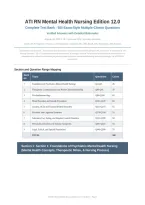
ATI RN Mental Health Nursing Edition 12.0
Complete Test Bank - 500 Exam-Style Multiple-Choice Questions
Verified Answers with Detailed Rationales
Aligned with DSM-5-TR Criteria and 2026 Curriculum Standards
Covers All 26 Chapters | 9 Sections | 500 Questions | Cognitive Mix: 30% Recall, 50% Application, 20% Analysis
Independent Study Resource - This test bank is an independent study resource and is NOT affiliated with, endorsed by, or sponsored by ATI
Nursing Education. ATI is a registered trademark of Assessment Technologies Institute. All questions and rationales in this test bank were
independently developed for educational purposes to support psychiatric-mental health nursing students preparing for the NCLEX-RN
examination.
Section and Question Range Mapping
Secti
Topic Questions Count
on
1 Foundations of Psychiatric-Mental Health Nursing Q1-Q45 45
2 Therapeutic Communication and Nurse-Client Relationship Q46-Q95 50
3 Psychopharmacology Q96-Q160 65
4 Mood Disorders and Suicide Prevention Q161-Q220 60
5 Anxiety, OCD, and Trauma-Related Disorders Q221-Q275 55
6 Psychotic and Cognitive Disorders Q276-Q330 55
7 Substance Use, Eating, and Impulse Control Disorders Q331-Q390 60
8 Personality Disorders and Somatic Symptoms Q391-Q445 55
9 Legal, Ethical, and Special Populations Q446-Q500 55
TOTAL 500
Section 1: Section 1: Foundations of Psychiatric-Mental Health Nursing
(Mental Health Concepts, Therapeutic Milieu, & Nursing Process)
ATI RN Mental Health Nursing Edition 12.0 Test Bank | Page 1
,ATI RN MENTAL HEALTH NURSING EDITION 12.0 - 500 QUESTION TEST BANK
Q1: A nurse is caring for a client diagnosed with schizophrenia who states, 'I am working with the recovery
model.' The client asks what this means. Which response by the nurse best reflects the recovery model
philosophy?
A. You will be cured of schizophrenia with the right medication regimen.
B. You can live a meaningful life despite your diagnosis by focusing on your strengths, hope, and personal
empowerment. [CORRECT]
C. Your symptoms will go into remission if you avoid stress.
D. You need to accept that you will require lifelong institutional care.
Correct Answer: B
Rationale: The recovery model in mental health nursing emphasizes that recovery is possible even with a serious mental
illness, focusing on the client's strengths, hope, empowerment, and living a meaningful life rather than symptom elimination
alone. This model is client-centered and promotes self-determination, contrasting with the traditional medical model focused
on cure (A) or institutionalization (D). While stress reduction helps (C), it is not the central principle of the recovery model.
Q2: A psychiatric-mental health nurse is planning care for a client using the Recovery Model. Which of the
following principles should the nurse prioritize when developing the plan of care?
A. Implementing decisions made by the interdisciplinary team without client input.
B. Encouraging client self-direction and active participation in all aspects of care. [CORRECT]
C. Focusing exclusively on symptom management through pharmacological interventions.
D. Limiting client choices to prevent relapse.
Correct Answer: B
Rationale: The Recovery Model prioritizes client self-direction, empowerment, and active participation in care decisions,
supporting the client as the driver of their own recovery. Options A and D violate client autonomy, a core recovery principle.
While symptom management matters (C), the recovery model goes beyond pharmacologic intervention to encompass holistic
wellness, hope, and meaningful life engagement. NCLEX tip: Look for the option that maximizes client autonomy and dignity.
Q3: A nurse working on an inpatient psychiatric unit is establishing a therapeutic milieu. Which intervention
best reflects the principles of a therapeutic milieu?
A. Keeping the unit as quiet as possible with minimal client interaction to reduce stimulation.
B. Creating a structured, safe environment that promotes social interaction, client responsibility, and
therapeutic community. [CORRECT]
C. Allowing clients to determine all unit rules and schedules to maximize autonomy.
D. Focusing solely on medication administration as the primary treatment.
Correct Answer: B
Rationale: A therapeutic milieu is a structured, safe, and supportive environment designed to promote therapeutic community,
social interaction, and client responsibility for self-care and unit functioning. It involves all aspects of the environment
(physical, social, interpersonal). Option A isolates clients; option C lacks the structure needed for safety and growth; option D
ignores the holistic nature of milieu therapy. The milieu is itself a therapeutic tool.
ATI RN Mental Health Nursing Edition 12.0 Test Bank | Page 2
,ATI RN MENTAL HEALTH NURSING EDITION 12.0 - 500 QUESTION TEST BANK
Q4: A nurse is assessing a client's mental status. The client states, 'The moon is controlling my thoughts
through invisible rays.' How should the nurse document this finding in the mental status examination?
A. Hallucination.
B. Delusion of influence (ideas of reference). [CORRECT]
C. Illusion.
D. Loose association.
Correct Answer: B
Rationale: A delusion is a fixed, false belief not grounded in reality. The client's belief that the moon is controlling their
thoughts is a delusion of influence (also called ideas of reference or somatic passivity), reflecting a belief that external forces
control one's thoughts or actions. A hallucination (A) is a sensory perception without external stimulus. An illusion (C) is a
misperception of an actual external stimulus. Loose association (D) is disorganized thinking. NCLEX tip: Distinguish delusion
(false belief) from hallucination (false perception).
Q5: A client on an inpatient psychiatric unit becomes increasingly agitated and verbally aggressive toward
staff. Which nursing intervention reflects the least restrictive means of managing the client's behavior?
A. Administering a PRN intramuscular sedative immediately.
B. Verbal de-escalation, offering choices, and using a quiet room for the client to calm down. [CORRECT]
C. Placing the client in physical restraints for safety.
D. Initiating seclusion with the door locked.
Correct Answer: B
Rationale: The principle of least restrictive intervention requires nurses to use the least intrusive method that ensures safety.
Verbal de-escalation, offering choices, and providing a quiet environment are non-restrictive approaches that respect client
autonomy while managing safety. PRN medication (A) may be necessary if verbal de-escalation fails, but it is more restrictive
than verbal techniques. Physical restraints (C) and locked seclusion (D) are the most restrictive interventions and are reserved
for situations where the client poses an imminent danger that cannot be managed by less restrictive means.
Q6: A psychiatric-mental health nurse is using the nursing process to plan care for a newly admitted client
with major depressive disorder. Which action represents the assessment phase of the nursing process?
A. Developing a care plan with the goal 'Client will report no suicidal ideation within 72 hours.'
B. Collecting data through mental status examination, client interview, and review of records. [CORRECT]
C. Administering prescribed sertraline 50 mg daily.
D. Evaluating whether the client's depression score on the PHQ-9 has decreased.
Correct Answer: B
Rationale: The assessment phase of the nursing process involves the systematic collection of subjective and objective data
through interview, observation, mental status examination, and review of records. Option A is the planning phase (writing
goals). Option C is the implementation phase (executing interventions). Option D is the evaluation phase (measuring goal
attainment). NCLEX tip: Assessment always involves data collection, not intervention or evaluation.
ATI RN Mental Health Nursing Edition 12.0 Test Bank | Page 3
, ATI RN MENTAL HEALTH NURSING EDITION 12.0 - 500 QUESTION TEST BANK
Q7: A nurse is assessing a client's mental status and asks the client to interpret the proverb 'People in glass
houses shouldn't throw stones.' The client responds, 'Glass breaks if you throw stones at it.' This response
most likely indicates which of the following?
A. Concrete thinking, often seen in schizophrenia or cognitive impairment. [CORRECT]
B. Abstract thinking, indicating intact cognition.
C. Loose associations, indicating thought disorder.
D. Perseveration, indicating frontal lobe damage.
Correct Answer: A
Rationale: Proverb interpretation assesses abstract thinking, the ability to grasp metaphorical meaning. The client's literal
interpretation ('Glass breaks') is concrete thinking, a deficit in abstract reasoning often seen in schizophrenia, cognitive
disorders, or lower intellectual functioning. Abstract thinking would be demonstrated by interpreting the meaning ('Don't
criticize others when you have faults yourself'). Loose associations (C) involve disconnected thoughts. Perseveration (D) is
persistent repetition of words or ideas. NCLEX tip: Concrete thinking = literal interpretation.
Q8: A client newly diagnosed with bipolar I disorder asks the nurse about the difference between mental
health and mental illness. Which response by the nurse best reflects the current understanding?
A. Mental health is the absence of mental illness.
B. Mental health is a state of well-being in which an individual can cope with stressors, work productively, and
contribute to community, regardless of diagnosis. [CORRECT]
C. Mental illness is solely determined by genetic factors.
D. Mental health is achieved only when all psychiatric symptoms are eliminated.
Correct Answer: B
Rationale: Mental health, per WHO and contemporary psychiatric nursing, is defined as a state of well-being in which an
individual realizes their potential, copes with normal life stressors, works productively, and contributes to their community.
Mental illness and mental health are not mutually exclusive - a person can have a mental illness diagnosis and still experience
mental health (recovery model). Options A and D are incorrect because they equate mental health with absence of symptoms.
Option C is incorrect because mental illness results from biopsychosocial factors, not genetics alone.
Q9: A nurse is caring for a client from a cultural background different from the nurse's. Which intervention
best demonstrates culturally competent care?
A. Treating all clients the same regardless of cultural background.
B. Asking the client about their cultural beliefs, values, and practices and incorporating them into care.
[CORRECT]
C. Assigning a staff member from the same culture to care for the client.
D. Educating the client about Western medical practices only.
Correct Answer: B
Rationale: Culturally competent care involves asking clients about their cultural beliefs, values, and practices and integrating
them into care, respecting individual differences. Treating all clients the same (A) ignores cultural variation and individual
needs. Assigning same-culture staff (C) is not always feasible or desired by the client and assumes culture is the only factor.
Option D ignores the client's cultural perspective. NCLEX tip: Cultural competence requires individualized assessment, not
assumptions based on stereotypes.
ATI RN Mental Health Nursing Edition 12.0 Test Bank | Page 4
Complete Test Bank - 500 Exam-Style Multiple-Choice Questions
Verified Answers with Detailed Rationales
Aligned with DSM-5-TR Criteria and 2026 Curriculum Standards
Covers All 26 Chapters | 9 Sections | 500 Questions | Cognitive Mix: 30% Recall, 50% Application, 20% Analysis
Independent Study Resource - This test bank is an independent study resource and is NOT affiliated with, endorsed by, or sponsored by ATI
Nursing Education. ATI is a registered trademark of Assessment Technologies Institute. All questions and rationales in this test bank were
independently developed for educational purposes to support psychiatric-mental health nursing students preparing for the NCLEX-RN
examination.
Section and Question Range Mapping
Secti
Topic Questions Count
on
1 Foundations of Psychiatric-Mental Health Nursing Q1-Q45 45
2 Therapeutic Communication and Nurse-Client Relationship Q46-Q95 50
3 Psychopharmacology Q96-Q160 65
4 Mood Disorders and Suicide Prevention Q161-Q220 60
5 Anxiety, OCD, and Trauma-Related Disorders Q221-Q275 55
6 Psychotic and Cognitive Disorders Q276-Q330 55
7 Substance Use, Eating, and Impulse Control Disorders Q331-Q390 60
8 Personality Disorders and Somatic Symptoms Q391-Q445 55
9 Legal, Ethical, and Special Populations Q446-Q500 55
TOTAL 500
Section 1: Section 1: Foundations of Psychiatric-Mental Health Nursing
(Mental Health Concepts, Therapeutic Milieu, & Nursing Process)
ATI RN Mental Health Nursing Edition 12.0 Test Bank | Page 1
,ATI RN MENTAL HEALTH NURSING EDITION 12.0 - 500 QUESTION TEST BANK
Q1: A nurse is caring for a client diagnosed with schizophrenia who states, 'I am working with the recovery
model.' The client asks what this means. Which response by the nurse best reflects the recovery model
philosophy?
A. You will be cured of schizophrenia with the right medication regimen.
B. You can live a meaningful life despite your diagnosis by focusing on your strengths, hope, and personal
empowerment. [CORRECT]
C. Your symptoms will go into remission if you avoid stress.
D. You need to accept that you will require lifelong institutional care.
Correct Answer: B
Rationale: The recovery model in mental health nursing emphasizes that recovery is possible even with a serious mental
illness, focusing on the client's strengths, hope, empowerment, and living a meaningful life rather than symptom elimination
alone. This model is client-centered and promotes self-determination, contrasting with the traditional medical model focused
on cure (A) or institutionalization (D). While stress reduction helps (C), it is not the central principle of the recovery model.
Q2: A psychiatric-mental health nurse is planning care for a client using the Recovery Model. Which of the
following principles should the nurse prioritize when developing the plan of care?
A. Implementing decisions made by the interdisciplinary team without client input.
B. Encouraging client self-direction and active participation in all aspects of care. [CORRECT]
C. Focusing exclusively on symptom management through pharmacological interventions.
D. Limiting client choices to prevent relapse.
Correct Answer: B
Rationale: The Recovery Model prioritizes client self-direction, empowerment, and active participation in care decisions,
supporting the client as the driver of their own recovery. Options A and D violate client autonomy, a core recovery principle.
While symptom management matters (C), the recovery model goes beyond pharmacologic intervention to encompass holistic
wellness, hope, and meaningful life engagement. NCLEX tip: Look for the option that maximizes client autonomy and dignity.
Q3: A nurse working on an inpatient psychiatric unit is establishing a therapeutic milieu. Which intervention
best reflects the principles of a therapeutic milieu?
A. Keeping the unit as quiet as possible with minimal client interaction to reduce stimulation.
B. Creating a structured, safe environment that promotes social interaction, client responsibility, and
therapeutic community. [CORRECT]
C. Allowing clients to determine all unit rules and schedules to maximize autonomy.
D. Focusing solely on medication administration as the primary treatment.
Correct Answer: B
Rationale: A therapeutic milieu is a structured, safe, and supportive environment designed to promote therapeutic community,
social interaction, and client responsibility for self-care and unit functioning. It involves all aspects of the environment
(physical, social, interpersonal). Option A isolates clients; option C lacks the structure needed for safety and growth; option D
ignores the holistic nature of milieu therapy. The milieu is itself a therapeutic tool.
ATI RN Mental Health Nursing Edition 12.0 Test Bank | Page 2
,ATI RN MENTAL HEALTH NURSING EDITION 12.0 - 500 QUESTION TEST BANK
Q4: A nurse is assessing a client's mental status. The client states, 'The moon is controlling my thoughts
through invisible rays.' How should the nurse document this finding in the mental status examination?
A. Hallucination.
B. Delusion of influence (ideas of reference). [CORRECT]
C. Illusion.
D. Loose association.
Correct Answer: B
Rationale: A delusion is a fixed, false belief not grounded in reality. The client's belief that the moon is controlling their
thoughts is a delusion of influence (also called ideas of reference or somatic passivity), reflecting a belief that external forces
control one's thoughts or actions. A hallucination (A) is a sensory perception without external stimulus. An illusion (C) is a
misperception of an actual external stimulus. Loose association (D) is disorganized thinking. NCLEX tip: Distinguish delusion
(false belief) from hallucination (false perception).
Q5: A client on an inpatient psychiatric unit becomes increasingly agitated and verbally aggressive toward
staff. Which nursing intervention reflects the least restrictive means of managing the client's behavior?
A. Administering a PRN intramuscular sedative immediately.
B. Verbal de-escalation, offering choices, and using a quiet room for the client to calm down. [CORRECT]
C. Placing the client in physical restraints for safety.
D. Initiating seclusion with the door locked.
Correct Answer: B
Rationale: The principle of least restrictive intervention requires nurses to use the least intrusive method that ensures safety.
Verbal de-escalation, offering choices, and providing a quiet environment are non-restrictive approaches that respect client
autonomy while managing safety. PRN medication (A) may be necessary if verbal de-escalation fails, but it is more restrictive
than verbal techniques. Physical restraints (C) and locked seclusion (D) are the most restrictive interventions and are reserved
for situations where the client poses an imminent danger that cannot be managed by less restrictive means.
Q6: A psychiatric-mental health nurse is using the nursing process to plan care for a newly admitted client
with major depressive disorder. Which action represents the assessment phase of the nursing process?
A. Developing a care plan with the goal 'Client will report no suicidal ideation within 72 hours.'
B. Collecting data through mental status examination, client interview, and review of records. [CORRECT]
C. Administering prescribed sertraline 50 mg daily.
D. Evaluating whether the client's depression score on the PHQ-9 has decreased.
Correct Answer: B
Rationale: The assessment phase of the nursing process involves the systematic collection of subjective and objective data
through interview, observation, mental status examination, and review of records. Option A is the planning phase (writing
goals). Option C is the implementation phase (executing interventions). Option D is the evaluation phase (measuring goal
attainment). NCLEX tip: Assessment always involves data collection, not intervention or evaluation.
ATI RN Mental Health Nursing Edition 12.0 Test Bank | Page 3
, ATI RN MENTAL HEALTH NURSING EDITION 12.0 - 500 QUESTION TEST BANK
Q7: A nurse is assessing a client's mental status and asks the client to interpret the proverb 'People in glass
houses shouldn't throw stones.' The client responds, 'Glass breaks if you throw stones at it.' This response
most likely indicates which of the following?
A. Concrete thinking, often seen in schizophrenia or cognitive impairment. [CORRECT]
B. Abstract thinking, indicating intact cognition.
C. Loose associations, indicating thought disorder.
D. Perseveration, indicating frontal lobe damage.
Correct Answer: A
Rationale: Proverb interpretation assesses abstract thinking, the ability to grasp metaphorical meaning. The client's literal
interpretation ('Glass breaks') is concrete thinking, a deficit in abstract reasoning often seen in schizophrenia, cognitive
disorders, or lower intellectual functioning. Abstract thinking would be demonstrated by interpreting the meaning ('Don't
criticize others when you have faults yourself'). Loose associations (C) involve disconnected thoughts. Perseveration (D) is
persistent repetition of words or ideas. NCLEX tip: Concrete thinking = literal interpretation.
Q8: A client newly diagnosed with bipolar I disorder asks the nurse about the difference between mental
health and mental illness. Which response by the nurse best reflects the current understanding?
A. Mental health is the absence of mental illness.
B. Mental health is a state of well-being in which an individual can cope with stressors, work productively, and
contribute to community, regardless of diagnosis. [CORRECT]
C. Mental illness is solely determined by genetic factors.
D. Mental health is achieved only when all psychiatric symptoms are eliminated.
Correct Answer: B
Rationale: Mental health, per WHO and contemporary psychiatric nursing, is defined as a state of well-being in which an
individual realizes their potential, copes with normal life stressors, works productively, and contributes to their community.
Mental illness and mental health are not mutually exclusive - a person can have a mental illness diagnosis and still experience
mental health (recovery model). Options A and D are incorrect because they equate mental health with absence of symptoms.
Option C is incorrect because mental illness results from biopsychosocial factors, not genetics alone.
Q9: A nurse is caring for a client from a cultural background different from the nurse's. Which intervention
best demonstrates culturally competent care?
A. Treating all clients the same regardless of cultural background.
B. Asking the client about their cultural beliefs, values, and practices and incorporating them into care.
[CORRECT]
C. Assigning a staff member from the same culture to care for the client.
D. Educating the client about Western medical practices only.
Correct Answer: B
Rationale: Culturally competent care involves asking clients about their cultural beliefs, values, and practices and integrating
them into care, respecting individual differences. Treating all clients the same (A) ignores cultural variation and individual
needs. Assigning same-culture staff (C) is not always feasible or desired by the client and assumes culture is the only factor.
Option D ignores the client's cultural perspective. NCLEX tip: Cultural competence requires individualized assessment, not
assumptions based on stereotypes.
ATI RN Mental Health Nursing Edition 12.0 Test Bank | Page 4


