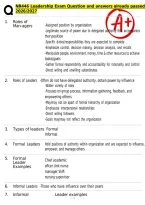
NR446 Leadership Exam Question and answers already passed
2026/2027
1. Roles of
Man-agers -Assigned position by organization
-Legitimate source of power due to delegated authority that accompanies
their position
-Specific duties/responsibilities they are expected to complete
-Emphasize control, decision making, decision analysis, and results
-Manipulate people, environment, money, time & other resources to achieve
tasks/goals
-Gather formal responsibility and accountability for rationality and control
-Direct willing and unwilling subordinates
2. Roles of Leaders -Often do not have delegated authority, obtain power by influence
-Wilder variety of roles
-Focuses on group process, information gathering, feedback, and
empowering others
-May/may not be apart of formal hierarchy of organization
-Emphasize interpersonal relationships
-Direct willing followers
-Goals may/may not reflect the organization
3. Types of leaders Formal
Informal
4. Formal Leaders Hold positions of authority within organization and are expected to influence,
empower, and manage others
5. Formal Chief academic
Leader
Examples oflcer Unit nurse
manager Shift
nursing supervisor
6. Informal Leaders -Those who have influence over their peers
7. Informal Leader examples
,Statt nurse ottering advice
, NR446 Leadership Exam
8. Critical Thinking -used for decision making and problem solving
-Way a person takes control of thinking using an intellectual process
9. Problem Solving Systematic process used to complete a full analysis of all known data
-Goal: Discover the root cause of an issue and ends when a decision is
made on how to proceed.
Critical thinking supports problem solving.
10. Decision Making Final step
-Critical thinking is used in decision-making to determine root cause of an
issue
11. Structured 1) Defines objectives clearly
Decision-Making 2) Gather data carefully
Process
3) Use an evidence-based approach
4) Generate many alternatives
5) Choose and act decisively
12. What
separates
critical The analyzing of cues and evaluating outcomes
thinking from
problem
solving?
13. Clinical Judge-
ment Nurse
-Cognitive processes applied to managing a nursing unit
14. Critical Thinking Leader
-Cognitive processes applied to managing a nursing unit
15. Cognitive 1) Recognize cues
Processes 2) Analyze cues
3) Prioritize hypothesis
4) Generate solutions
2026/2027
1. Roles of
Man-agers -Assigned position by organization
-Legitimate source of power due to delegated authority that accompanies
their position
-Specific duties/responsibilities they are expected to complete
-Emphasize control, decision making, decision analysis, and results
-Manipulate people, environment, money, time & other resources to achieve
tasks/goals
-Gather formal responsibility and accountability for rationality and control
-Direct willing and unwilling subordinates
2. Roles of Leaders -Often do not have delegated authority, obtain power by influence
-Wilder variety of roles
-Focuses on group process, information gathering, feedback, and
empowering others
-May/may not be apart of formal hierarchy of organization
-Emphasize interpersonal relationships
-Direct willing followers
-Goals may/may not reflect the organization
3. Types of leaders Formal
Informal
4. Formal Leaders Hold positions of authority within organization and are expected to influence,
empower, and manage others
5. Formal Chief academic
Leader
Examples oflcer Unit nurse
manager Shift
nursing supervisor
6. Informal Leaders -Those who have influence over their peers
7. Informal Leader examples
,Statt nurse ottering advice
, NR446 Leadership Exam
8. Critical Thinking -used for decision making and problem solving
-Way a person takes control of thinking using an intellectual process
9. Problem Solving Systematic process used to complete a full analysis of all known data
-Goal: Discover the root cause of an issue and ends when a decision is
made on how to proceed.
Critical thinking supports problem solving.
10. Decision Making Final step
-Critical thinking is used in decision-making to determine root cause of an
issue
11. Structured 1) Defines objectives clearly
Decision-Making 2) Gather data carefully
Process
3) Use an evidence-based approach
4) Generate many alternatives
5) Choose and act decisively
12. What
separates
critical The analyzing of cues and evaluating outcomes
thinking from
problem
solving?
13. Clinical Judge-
ment Nurse
-Cognitive processes applied to managing a nursing unit
14. Critical Thinking Leader
-Cognitive processes applied to managing a nursing unit
15. Cognitive 1) Recognize cues
Processes 2) Analyze cues
3) Prioritize hypothesis
4) Generate solutions