
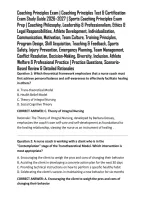
Coaching Principles Exam | Coaching Principles Test & Certification
Exam Study Guide 2026–2027 | Sports Coaching Principles Exam
Prep | Coaching Philosophy, Leadership & Professionalism, Ethics &
Legal Responsibilities, Athlete Development, Individualization,
Communication, Motivation, Team Culture, Training Principles,
Program Design, Skill Acquisition, Teaching & Feedback, Sports
Safety, Injury Prevention, Emergency Planning, Team Management,
Conflict Resolution, Decision-Making, Diversity, Inclusion, Athlete
Welfare & Professional Practice | Practice Questions, Scenario-
Based Review & Detailed Rationales
Question 1: Which theoretical framework emphasizes that a nurse coach must
first achieve personal balance and self-awareness to effectively facilitate healing
in others?
A. Trans-theoretical Model
B. Health Belief Model
C. Theory of Integral Nursing
D. Social Cognitive Theory
CORRECT ANSWER: C. Theory of Integral Nursing
Rationale: The Theory of Integral Nursing, developed by Barbara Dossey,
emphasizes the coach's own self-care and self-development as foundational to
the healing relationship, viewing the nurse as an instrument of healing .
Question 2: A nurse coach is working with a client who is in the
"Contemplation" stage of the Transtheoretical Model. Which intervention is
most appropriate?
A. Encouraging the client to weigh the pros and cons of changing their behavior
B. Assisting the client in developing a concrete action plan for the next 30 days
C. Providing technical instructions on how to perform a specific healthy habit
D. Celebrating the client's success in maintaining a new behavior for six months
CORRECT ANSWER: A. Encouraging the client to weigh the pros and cons of
changing their behavior
,Rationale: In the Contemplation stage, the individual is aware of the problem and
considering change but is ambivalent. Weighing pros and cons (decisional
balance) helps move them toward Preparation .
Question 3: During a coaching session, the nurse coach notices the client's
shoulders are hunched and their voice is trembling. Which core coaching skill is
the nurse utilizing?
A. Powerful Questioning
B. Direct Communication
C. Active Listening
D. Establishing Trust
CORRECT ANSWER: C. Active Listening
Rationale: Active listening involves attending to both verbal and non-verbal cues,
such as body language and tone of voice, to understand the client's full
experience .
Question 4: Which ethical principle is primarily upheld when a nurse coach
ensures the client is the primary driver of their own health goals and action
plans?
A. Beneficence
B. Autonomy
C. Non-maleficence
D. Justice
CORRECT ANSWER: B. Autonomy
Rationale: Autonomy respects the client's right to self-determination and
acknowledges that the client is the expert on their own life and the primary
decision-maker in the coaching relationship .
Question 5: The Nurse Coach Code of Ethics differentiates coaching from
therapy primarily by:
,A. Focusing on future goals versus past trauma
B. Diagnosing mental health disorders
C. Prescribing medication
D. Emphasizing crisis intervention
CORRECT ANSWER: A. Focusing on future goals versus past trauma
Rationale: Coaching centers on strengths and goal attainment, while therapy
often explores past patterns and pathology .
Question 6: A nurse coach who integrates SMART goal theory ensures goals are:
A. Simple, Measurable, Attainable, Rewarding, Timely
B. Specific, Measurable, Achievable, Relevant, Timebound
C. Strategic, Manageable, Attainable, Resourced, Timely
D. Standardized, Measurable, Actionable, Realistic, Tested
CORRECT ANSWER: B. Specific, Measurable, Achievable, Relevant, Timebound
Rationale: SMART is a widely used framework for clear, trackable goal setting in
coaching practice .
Question 7: Applying Florence Nightingale's environmental theory to coaching
highlights:
A. Medication management
B. Rest, nutrition, and social factors as change levers
C. Strict diet protocols
D. Advanced clinical diagnostics
CORRECT ANSWER: B. Rest, nutrition, and social factors as change levers
Rationale: Environment—as defined by Nightingale—influences health; coaches
address holistic factors such as rest and social support .
Question 8: When a conflict of interest arises (e.g., dual relationship), the coach
should first:
, A. Ignore it if minor
B. Disclose to the client and seek consultation
C. Bill for extra services
D. Terminate coaching immediately
CORRECT ANSWER: B. Disclose to the client and seek consultation
Rationale: Ethical practice requires transparency and consultation before deciding
on boundary adjustments .
Question 9: Which theory underpins using "decisional balance" to explore pros
and cons of change?
A. Social Cognitive Theory
B. Transtheoretical Model
C. Self-Determination Theory
D. Health Belief Model
CORRECT ANSWER: B. Transtheoretical Model
Rationale: Decisional balance is a core process in the Transtheoretical Model's
contemplation stage .
Question 10: The four D's of Appreciative Inquiry are:
A. Discover, Dream, Design, Destiny
B. Diagnose, Develop, Deliver, Determine
C. Define, Design, Develop, Deliver
D. Discover, Develop, Deploy, Determine
CORRECT ANSWER: A. Discover, Dream, Design, Destiny
Rationale: Appreciative Inquiry uses a structured 4-D cycle: Discovery, Dream,
Design, and Destiny to facilitate transformation .
Question 11: Which nurse coaching core value calls for coaches to remain fully
present, centered, and grounded?


