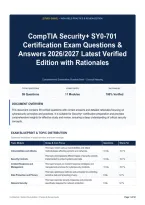
[STUDY GUIDE] • HIGH-YIELD PRACTICE & REVIEW EDITION
CompTIA Security+ SY0-701
Certification Exam Questions &
Answers 2026/2027 Latest Verified
Edition with Rationales
Comprehensive Examination Question Bank • Concept Mapping
TOTAL QUESTIONS EXAM TOPICS RATIONALES
99 Questions 11 Modules 100% Verified
DOCUMENT OVERVIEW
This document contains 99 verified questions with correct answers and detailed rationales focusing on
cybersecurity principles and practices. It is suitable for Security+ certification preparation and provides
comprehensive insights for effective study and review, ensuring a deep understanding of critical security
concepts.
EXAM BLUEPRINT & TOPIC DISTRIBUTION
Systematic breakdown of subject domains and exam coverage.
Topic Module Scope & Core Focus Questions Share (%)
This topic covers various vulnerabilities and attack
Vulnerabilities and Attacks methodologies affecting systems and networks. 10 Qs 10.1%
This topic encompasses different types of security controls
Security Controls implemented to protect systems and data. 10 Qs 10.1%
Incident Response and This topic focuses on incident response strategies and
Management management practices for cybersecurity incidents. 10 Qs 10.1%
This topic addresses methods and principles for protecting
Data Protection and Privacy sensitive data and ensuring privacy. 9 Qs 9.1%
This topic explores security measures and protocols
Network Security specifically designed for network protection. 9 Qs 9.1%
Confidential • Student Study Edition • Practice & Review Guide Page 1 of 52
,STUDENT STUDY & MASTERY EDITION PRACTICE & REVIEW GUIDE
This topic discusses legal and compliance considerations
Compliance and Legal Issues relevant to cybersecurity practices. 9 Qs 9.1%
This topic examines security aspects related to cloud
Cloud Security computing and services. 9 Qs 9.1%
Authentication and Access This topic focuses on authentication methods and access
Control control measures to secure systems. 9 Qs 9.1%
Threats and Vulnerability This topic involves identifying and managing threats and
Management vulnerabilities within an organization. 8 Qs 8.1%
This topic addresses security practices and considerations for
Application Security application development and deployment. 8 Qs 8.1%
Security Awareness and This topic emphasizes the importance of security awareness
Training programs and employee training. 8 Qs 8.1%
Total Exam Coverage 11 Integrated Topic Modules 99 Qs 100.0%
Confidential • Student Study Edition • Practice & Review Guide Page 2 of 52
,STUDENT STUDY & MASTERY EDITION PRACTICE & REVIEW GUIDE
TOPIC 1: VULNERABILITIES AND ATTACKS
10 Questions • 10.1% of Exam • This topic covers various vulnerabilities and attack methodologies affecting systems and networks.
QUESTION 1
Which of the following vulnerabilities is exploited when an attacker overwrites a
register with amalicious address?
A. VM escape
B. SQL injection
C. Buffer overflow
D. Race condition
Answer: C. Buffer overflow.
Rationale: Overwriting a register with a malicious address exploits a buffer overflow, a vulnerability where program
execution is diverted by writing data beyond the allocated buffer's boundaries. This principle of exceeding allocated memory
space is central to buffer overflow attacks.
QUESTION 2
Which of the following is a primary security concern for a company setting up a
BYODprogram?
A. End of life
B. Buffer overflow
C. VM escape
D. Jailbreaking
Answer: D. Jailbreaking.
Rationale: Jailbreaking circumvents the built-in security controls of a mobile device, allowing unauthorized access and
modification of the operating system, which is a primary concern when personal devices are used for corporate data. This
bypass of security measures poses a significant risk to data integrity and confidentiality within a BYOD program.
Confidential • Student Study Edition • Practice & Review Guide Page 3 of 52
, STUDENT STUDY & MASTERY EDITION PRACTICE & REVIEW GUIDE
QUESTION 3
Which of the following describes the process of concealing code or text inside a
graphicalimage?
A. Symmetric encryption
B. Hashing
C. Data masking
D. Steganography
Answer: D. Steganography.
Rationale: Steganography is the practice of hiding secret data within an ordinary, non-secret file or message, such as an
image, to avoid
detection. This differs from encryption, which scrambles data, and hashing, which creates a fixed-size digest for integrity
checks.
QUESTION 4
An organization's internet-facing website was compromised when an attacker exploited
a buffer overflow. Which of the following should the organization deploy to best protect
against similar attacks in the future?
A. NGFW
B. WAF
C. TLS
D. SD-WAN
Answer: B. WAF.
Rationale: A Web Application Firewall (WAF) inspects and filters HTTP traffic to and from a web application, specifically
designed to detect and block common web attacks like buffer overflows. This directly addresses the vulnerability exploited in
the compromise by providing application-layer security.
Confidential • Student Study Edition • Practice & Review Guide Page 4 of 52